
The Best Amazon Accounting Software Depends on Your Stage

BeanHawk is the best Amazon accounting software for sellers who need automated settlement posting and reimbursement recovery working together instead of as two separate headaches. It monitors your FBA ledger and inbound shipments continuously, catches what Amazon owes you for lost or damaged inventory, and posts clean, reconciled entries straight into QuickBooks or Xero. That combination matters because most tools handle one job or the other, not both.
If BeanHawk-style automation isn’t the fit yet, three other paths exist. You can pair a core accounting platform with a separate Amazon connector, hire an outsourced bookkeeper who manually reconciles settlements, or run a free or low-cost tool while your order volume is still small enough to track by hand. Each works, at a cost, in time, accuracy, or cash.
Here’s the immediate move based on where you are:
- Side hustle, with relatively low annual sales: stick with a free or entry-level platform and do monthly reconciliation yourself. Automation isn’t worth the cost yet.
- Growing seller in modest revenue range: get a connector working with QuickBooks Online or Xero now, before missed reimbursements start compounding.
- Scaling brand beyond modest revenue: move to automated settlement posting and reimbursement monitoring, because manual reconciliation at this volume eats hours you don’t have and misses money you’re owed.
The rest of this guide walks through why those recommendations hold up, what to ask any vendor before you commit, and how the mechanics of Amazon settlements actually flow into your books.
Key Takeaways
The best Amazon accounting software matches your revenue stage, pairs settlement automation with accrual-based COGS tracking, and closes the reimbursement gap that generic tools ignore.
| Point | Details |
|---|---|
| Match software to stage | Free tools work under $50,000 in sales; automated posting earns its cost past $250,000. |
| Connectors do the real work | A connector’s settlement mapping, not the core platform, usually determines reconciliation quality. |
| Track both accounting bases | Run accrual for margin accuracy and cash for liquidity decisions, especially during any transition. |
| Verify reimbursement detection | Confirm any vendor actively flags lost or damaged inventory inside Amazon’s claim windows. |
| BeanHawk covers the full loop | It combines continuous ledger monitoring, reimbursement recovery, and automated QuickBooks/Xero posting without taking a cut. |
Table of Contents
- What Are the Best Amazon Accounting Software Paths for Sellers?
- How Do You Choose Amazon Seller Accounting Software?
- Which Amazon Accounting Software Fits Your Revenue Stage?
- How Should Amazon Settlement Reconciliation Actually Work?
- How Do You Handle Inventory Accounting and COGS?
- What Does BeanHawk Bring to Amazon Seller Accounting?
- Why the Accounting Platform Debate Misses the Point
- Get Automated Settlement Posting and Reimbursement Recovery With BeanHawk
- Sources
- FAQ
What Are the Best Amazon Accounting Software Paths for Sellers?
Four solution types cover almost every Amazon seller, and picking the wrong one for your stage is the single most common reason sellers end up redoing their books.
Automated reimbursement and settlement automation is the newest and most complete category. Software in this bucket continuously watches your inbound shipments and FBA ledger events, flags discrepancies between what Amazon shipped, received, and reimbursed, and posts the resulting journal entries directly to your accounting platform. This is the category BeanHawk operates in, and it exists because reimbursement claim windows are time-sensitive and easy to miss without ongoing monitoring.
Connector plus core accounting platform is the more traditional setup: QuickBooks Online or Xero handles your general ledger, and a separate connector tool translates Amazon’s settlement reports into journal entries neither platform can parse on its own. This remains the most common configuration among midmarket sellers, largely because the connector choice, not the accounting platform choice, is what determines reconciliation quality.
Outsourced bookkeeping means paying a person or firm to reconcile your books manually, usually monthly. It fits sellers who want a human relationship and don’t mind a slower turnaround, but it scales poorly. A bookkeeper working from spreadsheets and Amazon’s settlement CSVs can only review so many SKUs and adjustments before hours (and your bill) balloon.
Budget or free-tier accounting software works fine when your Amazon business is still small and simple. The tradeoff is you’re doing all the settlement mapping and reimbursement checking by hand, which is fine at low volume and painful past it.
- If your books are simple and volume is low, start with free-tier software and revisit in six months.
- If you’re pairing a connector with QuickBooks or Xero, budget time to verify SKU-level mapping accuracy before trusting the output.
- If you’re outsourcing, confirm your bookkeeper actually understands FBA settlement structure, not just general ledger work.
- If reimbursements or settlement volume have started slipping through the cracks, automation earns its cost fast.
Pro Tip: Before switching solution types, pull your last three months of Amazon settlement reports and count how many line items don’t map cleanly to a category you already track. That number tells you more about which path you need than your revenue does.
How Do You Choose Amazon Seller Accounting Software?
Five criteria separate software that actually works for Amazon sellers from software that just claims to.
Reconciliation accuracy comes first. The tool needs to match your bank deposits to Amazon settlements down to the fee, refund, and reimbursement level, not just post a lump-sum “Amazon deposit” entry. A lump-sum entry hides exactly the discrepancies you need to catch.

SKU-level mapping matters just as much. If your accounting software can’t tie revenue and fees back to individual SKUs, you can’t calculate real product margins. This becomes non-negotiable once you’re running more than a handful of ASINs.
Reimbursement detection is where most general accounting tools fall flat. Amazon’s own Seller Central documentation lays out how settlements, disbursements, and reimbursement policies work, but it doesn’t flag when Amazon underpays you. Software that actively checks inbound shipment data against what actually landed in inventory closes that gap.
Reporting and tax readiness rounds out the technical side. Your books need to produce statements a CPA can use at tax time without weeks of cleanup, following the recordkeeping standards the IRS outlines for business expenses.
Clear pricing sounds obvious, but Amazon-focused tools have a track record of add-on fees, per-transaction charges, or commission-based reimbursement recovery that eats into what you actually collect.
Before signing up with any vendor or bookkeeper, ask these questions directly:
- Can I see a sample month of reconciled output before I commit?
- What’s your service-level agreement for resolving a reconciliation error?
- Do you have direct API access to my Amazon data, or are you relying on manual CSV uploads?
- Can you show me an actual journal entry example from a client with a similar catalog size?
- Are there any commissions or percentage-based fees on recovered reimbursements?
Watch for a few honest trust signals versus warning signs. A vendor who can produce documented reconciliation workflows, sample journal entries, or references from a CPA who’s used their output is worth taking seriously. One who’s vague about how settlements actually get mapped, or who charges a cut of your own reimbursement money, is not. A 2026 practitioner guide on Amazon seller accounting notes that many sellers overspend on enterprise-grade tools before they need them, then face a messy migration later. Right-sizing your software to your actual complexity avoids that entirely.
Which Amazon Accounting Software Fits Your Revenue Stage?
What you need at $30,000 in annual sales looks nothing like what you need at $2 million, and buying ahead of your stage wastes money you could put toward inventory.
-
At lower sales volumes: keep it manual and simple. A free or entry-level accounting platform is enough here. Reconcile Amazon settlements once a month by hand, using Amazon’s own settlement reports as your source document. Skip automated posting entirely, since the labor to set it up outweighs the labor it saves at this volume. Budget some time monthly.
-
At moderate sales volumes: add a connector. This is where pairing QuickBooks Online or Xero with an Amazon-specific connector starts paying for itself. Settlement volume is high enough that manual mapping introduces errors, and reimbursements start slipping through unnoticed. Expect to spend some time reviewing exception reports rather than building entries from scratch. This is also the point to start tracking landed cost per SKU if you haven’t already, since margin visibility becomes genuinely useful at this scale.
-
At higher sales volumes: move to automated settlement posting. At this stage, manual review of every settlement line item is no longer reasonable. Automated posting with continuous reimbursement monitoring, the model BeanHawk runs on, replaces what would otherwise be a part-time bookkeeping role. Operationally, this means Amazon ledger and inbound shipment data flow automatically into your accounting platform, your bookkeeper or accountant reviews exceptions rather than building entries, and reimbursement claims get filed inside the window Amazon allows rather than after the fact.
-
At very high sales volumes: layer in dedicated financial oversight. Automated posting stays the backbone, but at this scale most sellers add a fractional CFO or senior bookkeeper to interpret the numbers, plan cash flow around inventory cycles, and handle multi-channel complexity if you’ve expanded beyond Amazon. The software does the reconciliation; the human does the strategy.
The upgrade trigger isn’t really revenue. It’s complexity: SKU count, reimbursement volume, and how many hours a month someone spends manually checking Amazon’s numbers against your bank account. A free FBA fee and profit calculator can help you gauge whether your margins justify moving up a stage before your revenue technically hits the next bracket.
How Should Amazon Settlement Reconciliation Actually Work?
A connector or automated posting tool needs to produce a few specific things, and if it doesn’t, you’ll find out the hard way at tax time.
It needs to parse each Amazon settlement period, which typically runs every two weeks, into a structured journal entry rather than a single deposit line. That entry should break out gross sales, FBA and referral fees, refunds, and any reimbursements separately, and it should map each of those categories down to the SKU level. Connector tools like these summarize raw settlement data into journal entries that make QuickBooks or Xero reconciliation feasible in the first place, since neither platform can read Amazon’s settlement format natively.
The reconciliation workflow itself needs exception handling built in, not bolted on after the fact. Refunds, fee adjustments, and reimbursements rarely land in the same settlement period as the original sale, which means your books need a process for catching those mismatches rather than assuming everything nets out cleanly.
- Refunds should trigger a reversal entry tied to the original sale, not just a generic expense line.
- Fee adjustments (storage, long-term storage, removal fees) need their own category so they don’t get buried in “cost of goods sold.”
- Reimbursements for lost or damaged inventory should post as a separate credit, tracked against the original inventory write-off.
- Chargebacks and A-to-z claims need flagging for manual review, since they often involve a dispute process.
A connector that just dumps “Amazon deposit: $14,230” into your bank feed isn’t reconciling anything. It’s hiding the twelve or more line items, fees, refunds, reimbursements, ad spend, that actually made up that number. Real reconciliation means every dollar in that deposit traces back to a category you can explain to a CPA in one sentence.
Reimbursement timing adds another wrinkle. Claim windows for lost or damaged inventory are time-limited, and catching the discrepancy requires continuously comparing what Amazon says it received against what it actually reports in inventory. Waiting until month-end to check means some windows will have already closed. A practical bookkeeping guide walks through sample journal entry structures if you want to see what a properly broken-out settlement entry looks like in practice.
How Do You Handle Inventory Accounting and COGS?
Accrual accounting is what makes SKU-level margins mean anything, and cash accounting is what tells you whether you can actually make payroll or restock next month. You need both, not one instead of the other.

Here’s the mechanical difference: accrual accounting matches the cost of a unit to the month it actually sold, regardless of when you paid your supplier or when the cash landed from Amazon. Cash accounting records money when it moves. Run your books purely on cash, and a big inventory purchase in March can make you look unprofitable that month even if the units sell out profitably by June. FASB’s accrual standards exist precisely to prevent that kind of misleading snapshot in financial statements, and accrual-basis books are increasingly what buyers expect if you ever sell the business, since cash-basis records can create valuation disputes during due diligence.
Landed cost is the other piece sellers underestimate. Your true cost per unit isn’t just the manufacturer’s invoice. It includes freight, duties, and any prep or inspection fees before the unit reaches an Amazon warehouse. For small to medium catalogs, weighted average costing works well: you blend the landed cost of each inventory batch into a single per-unit figure. Larger sellers with meaningful price swings between purchase orders sometimes need lot tracking instead, so a batch bought at a higher landed cost doesn’t get blended down and understate true COGS.
If you’re transitioning from cash to accrual, don’t flip the switch overnight.
- Keep your existing cash-basis books running for at least one full quarter after starting accrual tracking.
- Reconcile the two monthly and note where they diverge, usually around large inventory purchases or slow-moving stock.
- Use the cash view for near-term decisions like whether you can afford a reorder this month.
- Use the accrual view for anything involving actual profitability, pricing decisions, or presenting numbers to a lender or buyer.
Management accounting research on business reorganizations backs this up directly: businesses that track both perspectives are less likely to look profitable on paper while running into real liquidity trouble. A guide to tracking FBA inventory covers the operational side of tying physical stock counts to these costing methods.
What Does BeanHawk Bring to Amazon Seller Accounting?
BeanHawk was built around the two things generic accounting software consistently misses for Amazon sellers: catching what Amazon owes you and posting it correctly the first time.
- Continuous monitoring of inbound shipments and FBA ledger events, so discrepancies get flagged inside Amazon’s reimbursement claim windows instead of after they close.
- Automated settlement posting directly into QuickBooks or Xero, broken out by SKU rather than dumped as a lump sum.
- Reimbursement claim workflows that handle lost, damaged, or under-reimbursed inventory without manual spreadsheet work.
- No commission taken on recovered funds, so the reimbursements you’re owed stay yours.
Onboarding typically starts with connecting your Amazon Seller Central account and your QuickBooks or Xero instance, after which BeanHawk begins pulling historical ledger data to establish a baseline before posting forward.
Pro Tip: If you’re already running a connector-plus-platform setup and it’s working, the gap to check first is reimbursement recovery specifically, not settlement posting. That’s the piece most existing setups leave entirely manual.
Why the Accounting Platform Debate Misses the Point
Sellers spend too much time debating which core accounting platform to use and not enough time asking whether their setup catches money Amazon already owes them. QuickBooks versus Xero is a minor decision. Whether your reconciliation workflow flags a missed reimbursement inside its claim window is a much bigger one, and it’s the piece most conventional advice skips entirely.
The stage-based approach in this guide matters more than any single feature comparison. A seller at $40,000 in sales buying enterprise automation is wasting money. A seller at $500,000 still reconciling settlements by hand is losing money, often without realizing how much. Revenue and complexity, not preference, should drive the decision.
If there’s one thing to prioritize first, it’s reimbursement detection. Most accounting setups treat it as an afterthought, bolted onto general bookkeeping rather than built into continuous monitoring. That’s backwards. The fees and refunds mostly reconcile themselves eventually. The money Amazon owes you for lost or damaged inventory doesn’t, unless something is actively watching for it.
, Tim
Get Automated Settlement Posting and Reimbursement Recovery With BeanHawk
Beanhawk is the alternative to piecing together a connector, a bookkeeper, and manual reimbursement tracking separately for Amazon accounting. Instead of paying for three different fixes, you get continuous inbound shipment and ledger monitoring, automated settlement posting to QuickBooks or Xero, and reimbursement claim workflows in one system, with no commission taken on what gets recovered.
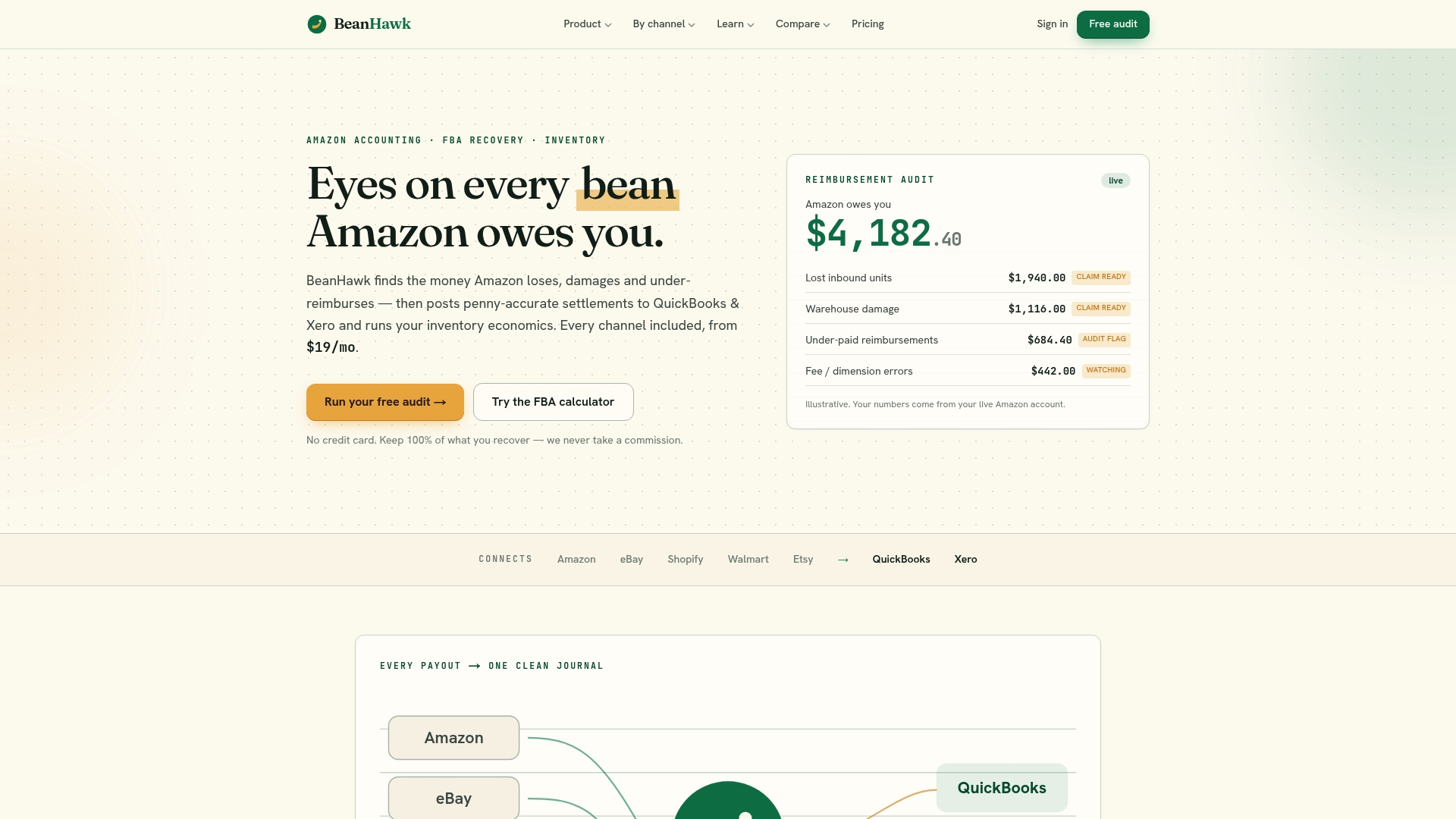
If you’ve read this far because reimbursements have been slipping through the cracks or your settlement entries look like guesswork, that’s exactly the gap Beanhawk closes. It fits sellers who’ve outgrown manual reconciliation but don’t want to hire a full internal accounting team yet, and accountants who’d rather review clean exception reports than rebuild journal entries from scratch every month.
Start by finding out whether Amazon owes you money right now for lost or damaged inventory sitting unclaimed in your account. It’s the fastest way to see what automated monitoring would have caught already.
Sources
A few primary sources back the accounting principles covered in this guide, and they’re worth bookmarking directly rather than relying on secondhand summaries.
- Guide to business expense resources | IRS
- FASB standards
- Amazon Seller Central , settlements and disbursements
- FBA Tactics , accrual accounting and COGS guidance
FAQ
Is FBA Still Profitable in 2026?
FBA remains profitable for sellers who track true landed cost and actual reimbursement recovery rather than relying on rough margin estimates; profitability now depends more on accounting precision than it did when fees were simpler and competition was thinner.
Is Zoho Accounting Really Free?
Zoho Books offers a free tier for very small businesses under specific revenue and invoice thresholds, but most growing Amazon sellers outgrow the free tier’s limits once settlement volume and SKU complexity increase.
What Are the Top Accounting Software Options for Amazon Sellers?
The strongest options fall into distinct categories rather than a single ranked list: automated settlement and reimbursement tools like BeanHawk, core platforms like QuickBooks Online and Xero paired with a connector, outsourced bookkeeping, and free entry-level software for sellers just starting out.
Is AI Replacing Bookkeepers?
AI-driven automation is replacing the manual work of matching settlements to journal entries, but it isn’t replacing the judgment bookkeepers and CPAs apply to exceptions, tax strategy, and financial planning; the practical shift is bookkeepers reviewing automated output instead of building it from scratch.
Do I Need a Connector if I Already Use QuickBooks or Xero?
Yes. Neither platform natively parses Amazon’s settlement reports, so without a connector or automated posting tool, you’re left manually breaking out fees, refunds, and reimbursements from a single lump-sum deposit.