
The Best Amazon Reimbursement Software for Recovering Lost Funds

The best approach for most Amazon sellers is automated reimbursement recovery software that connects directly to your accounting system, not a spreadsheet you update once a quarter or a hands-off agency that takes a cut of every dollar. Beanhawk is built around that model: it continuously monitors inbound shipments and FBA ledger events, files claims within Amazon’s windows, and posts settlements straight into QuickBooks or Xero without commission fees.
That said, this approach isn’t universal:
- If you run fewer than 50 SKUs and check your Reimbursements report monthly anyway, manual audits may cover you fine.
- If you have zero time for oversight and don’t care about accounting granularity, a managed agency working on commission can still make sense.
- For everyone scaling past a few hundred orders a month, software that reconciles automatically is the only option that keeps pace.
Key Takeaways
Automated reimbursement software with direct accounting integration recovers more money and creates less bookkeeping work than manual audits or commission-based agencies.
| Point | Details |
|---|---|
| Match solution to scale | Manual audits suit under 50 SKUs; automated software fits growing catalogs; agencies suit zero-bandwidth sellers. |
| Watch the 60-day window | Manual claims for losses auto-reimbursement misses must be filed within Amazon’s eligibility window. |
| Document manufacturing costs | Supplying invoice-backed manufacturing costs can increase reimbursement amounts under current Amazon policy. |
| Evaluate on five dimensions | Score vendors on detection accuracy, speed, integrations, pricing model, and audit trail before signing. |
| Beanhawk fits accounting-first sellers | Continuous monitoring plus automated QuickBooks/Xero posting with no commission, backed by a free audit. |
Table of Contents
- What Kind of Amazon Reimbursement Solution Fits Your Business?
- How Do You Compare Amazon Refund Tools Fairly?
- What to Ask a Reimbursement Vendor Before You Sign
- How Does Amazon Reimbursement Actually Work?
- How Beanhawk Handles Reimbursement Recovery and Accounting Together
- What Should You Do Next?
- Why Most Reimbursement Advice Gets the Priority Backward
- Get a Free Reimbursement Audit From Beanhawk
- Sources
- FAQ
What Kind of Amazon Reimbursement Solution Fits Your Business?
Three categories exist, and picking the wrong one costs you either money or time. Here’s how they actually differ once you get past the marketing copy.
DIY and manual audits mean pulling your Adjustments and Reimbursements reports yourself, cross-referencing FNSKUs against inbound shipment records, and filing cases by hand. It works, but it’s slow: a seller running 500 SKUs can burn 5 to 10 hours a month just tracking discrepancies, and most people quietly stop doing it after the second quarter. This route only makes sense for sellers under roughly 50 SKUs with simple, low-velocity catalogs and enough spare time to actually stay consistent.
Software automation is the middle path, and it’s where most growing sellers land. Tools in this category scan your Adjustments report, Reimbursements report, and inbound shipment data continuously, prepare or file claims automatically, and post the recovered amounts into your books as journal entries. Because the scanning never stops, you rarely miss the narrow windows Amazon enforces. This is the fit if you want scale without losing visibility into your own numbers.
Managed agencies handle everything hands-off, usually for a commission on whatever they recover. That trade can work if you genuinely have no internal bandwidth and don’t mind giving up a percentage indefinitely, but it usually means your accounting team has to manually reconcile whatever lump sum shows up in your bank account weeks later.
- Under 50 SKUs, low order volume: manual tracking is tolerable.
- Growing catalog, wants clean books: automated software.
- No internal ops capacity, comfortable with commission: managed agency.
Pro Tip: Before picking a category, pull your last three months of Amazon Reimbursements reports. If the total recovered looks suspiciously low compared to your return and damage rates, that gap is your signal to move off manual tracking.
How Do You Compare Amazon Refund Tools Fairly?
Skip the marketing pages and evaluate any vendor, whether it’s a subscription tool or a full-service shop, on the same five dimensions every time.
- Detection accuracy and claim coverage: does it catch lost inbound units, warehouse damage, customer return discrepancies, and fee overcharges, or just one or two categories?
- Speed: how quickly does it flag a discrepancy after it appears in your reports, and does that leave enough runway before Amazon’s claim windows close?
- Accounting integrations: does it post directly to QuickBooks or Xero, or does someone still have to manually enter recovered amounts?
- Pricing model: subscription, commission, or flat fee, and what happens to that number as your order volume grows?
- Audit trail: can you pull case IDs, evidence, and reconciliation records months later if Amazon or your accountant asks questions?
Weight these based on where your business actually hurts. A seller doing $2 million a year with an in-house bookkeeper should weight accounting integrations and audit trail heavily, because manual reconciliation at that volume is where hours disappear. A newer seller with simpler books might weight detection accuracy and pricing first, since raw recovery matters more than automation polish at low volume. Reviews on sites like Trustpilot can offer a rough signal on vendor reliability, but they vary too much to substitute for your own demo evidence.
What to Ask a Reimbursement Vendor Before You Sign
Run every vendor through the same script, whether you’re comparing software for Amazon sellers or a full-service claims shop.
- Ask for sample case results. Request real case IDs and evidence from claims similar to your loss types, not generic screenshots.
- Confirm the integration workflow. Get specific about how settlements post to QuickBooks or Xero: as a single lump journal entry, or itemized by case?
- Ask who owns the recovered-money records. If you cancel, do you keep your claim history and audit trail, or does it disappear with the vendor?
- Clarify the pricing structure. Commission-based providers commonly charge 15 to 25 percent of recovered funds, while subscription tools charge a flat monthly rate regardless of what gets recovered. Push for a written cap if commission is involved.
- Check contract length and exit terms. Month-to-month beats a 12-month lock-in, especially before you’ve seen a full recovery cycle.
Pro Tip: Ask directly whether the vendor auto-files claims or only prepares them for you to submit. Some tools stop at claim prep and leave you to click submit, which quietly adds back the manual workload you were trying to eliminate.
Watch for red flags: vendors that won’t show documentation for past claims, contracts with exclusivity clauses locking you out of switching, or anyone vague about how they validate a claim before filing it with Amazon. Invalid claims can trigger account-level scrutiny, so documentation isn’t optional.
How Does Amazon Reimbursement Actually Work?
Recovery starts with monitoring five data sources: the Adjustments report, the Reimbursements report, inbound shipment discrepancies, customer return entries, and fee audits. Miss any one of these and you leave money on the table.
Amazon has shifted more of this toward automatic payouts, but manual claims are still very much part of the process:
- Since November 1, 2024, Amazon has proactively reimbursed certain FBA items lost in fulfillment centers without a seller filing anything.
- A 60-day window still applies to many manual-claim loss types, meaning discrepancies auto-reimbursement misses need to be caught and filed fast.
- Removal-related losses and certain damage cases still require manual review, so relying on auto-reimbursement alone leaves gaps.
Continuous scanning matters because it catches discrepancies the day they appear rather than at month-end review, when the clock on that 60-day window is already running. Once a claim is approved, the harder problem starts: getting that recovered amount correctly logged in your books instead of sitting as an unexplained deposit. Automation that posts settlements directly as journal entries solves the reconciliation half of the problem, not just the recovery half.
How Beanhawk Handles Reimbursement Recovery and Accounting Together
Most reimbursement tools stop at “we found you money.” Beanhawk was built to close the loop on what happens after that money lands.
- Continuous monitoring of inbound shipments and FBA ledger events, catching discrepancies as they happen rather than at a monthly review.
- Automated settlement posting to QuickBooks and Xero, so recovered amounts show up as itemized journal entries instead of unexplained deposits.
- Cross-channel reconciliation, useful for sellers running Amazon alongside other sales channels who need one consolidated financial picture.
- No commission on recovered funds, which means the incentive is accurate reconciliation rather than maximizing claim volume.
Amazon’s March 2025 policy shift means certain inventory reimbursements are now based on product manufacturing cost, and sellers who supply their own invoice-backed manufacturing cost can influence the reimbursement amount they receive. That single detail is why documentation, not just detection, has become the differentiator in this category.
Beanhawk offers a free audit so you can see actual detection results on your own account before committing to anything.
What Should You Do Next?
Automation paired with accounting integration is the only approach that scales past a few dozen SKUs without turning into a part-time bookkeeping job. Manual tracking works for tiny catalogs; commission-based agencies work if you’re fully hands-off and accept the cut. For everyone else, software that reconciles what it recovers wins.
- Request a free audit. This shows detection accuracy on your actual account, not a demo account, before you commit to anything.
- Gather your purchase invoices and FNSKU list. Manufacturing cost documentation directly affects reimbursement amounts under Amazon’s current policy.
- Enable continuous scanning or schedule onboarding. This is what protects you against the 60-day manual claim window going forward.
- Expect initial reconciled recoveries within a few weeks, arriving as case IDs, recovered dollar amounts, and matching journal entries in your accounting platform.
Once that first reconciled batch lands, you’ll have a clear before-and-after picture of what your books looked like without automated recovery.
Why Most Reimbursement Advice Gets the Priority Backward
Most guides on this topic obsess over recovery rate: which tool finds the most money. That’s the wrong first question. The right first question is what happens to that money once it’s found, because a recovered claim that lands as an unexplained lump deposit in your bank account is just a new bookkeeping problem wearing a different hat.
I’d argue the accounting integration is actually the harder, more valuable engineering problem, not the detection scanning. Plenty of tools can flag a lost unit in an Adjustments report. Far fewer can turn that flag into a correctly categorized journal entry that your accountant doesn’t have to untangle at tax time. That gap is exactly where commission-based agencies tend to fall short: they’re paid to recover, not to reconcile, so the incentive to make your books clean simply isn’t built into their model.

If you take one thing from this, prioritize the accounting connection over the headline recovery number. A tool that recovers slightly less but reconciles perfectly will save you more real hours than one that chases every last dollar and leaves your ledger a mess.
Get a Free Reimbursement Audit From Beanhawk
If you’ve been weighing manual tracking against a commission-hungry agency, there’s a third path that skips both problems: Beanhawk finds what Amazon owes you and posts it straight into your books, with no percentage taken off the top.
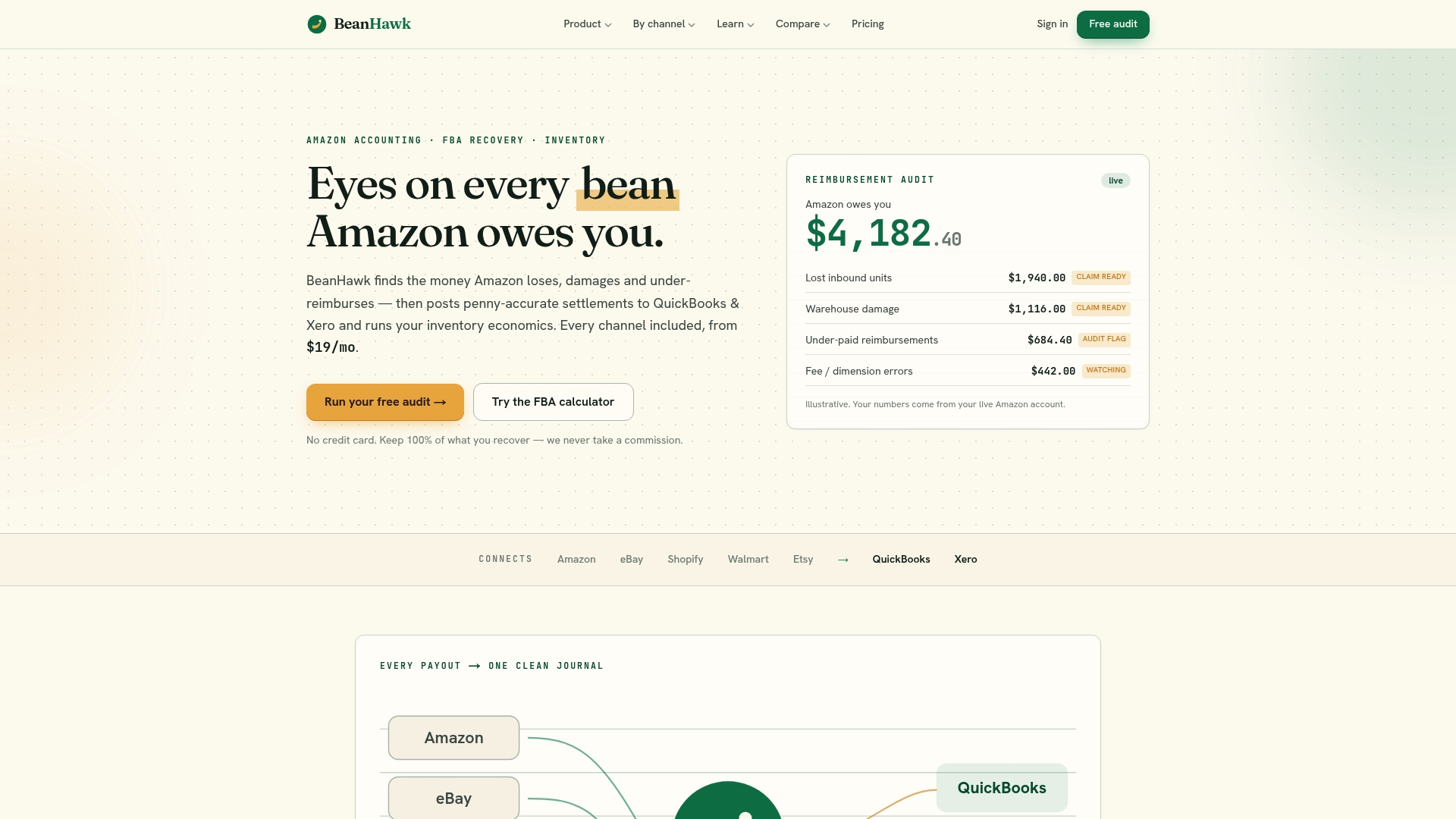
That matters most for sellers who’ve already been burned by a “recovery” that showed up as a mystery deposit nobody could categorize correctly. Beanhawk’s continuous monitoring catches lost, damaged, and under-reimbursed inventory across your inbound shipments and ledger events, then posts settlements directly into QuickBooks or Xero as itemized entries your accountant can actually work with. It also pulls together data across sales channels, so if you sell beyond Amazon, you’re not stitching together separate reports by hand. Pair it with Osellpa’s profit tracking tools if you want recovered funds reflected in your broader P&L picture right away.
Start with a free audit to see exactly what Amazon currently owes your account before you commit to anything.
Sources
FAQ
Does Amazon Reimburse Sellers for Lost or Damaged Inventory?
Yes. Amazon has proactively reimbursed certain lost FBA inventory since November 2024, though many loss types still require a manual claim filed within a 60-day window.
Can I Make $1,000 a Month Selling on Amazon?
It’s realistic for many sellers, but it depends heavily on product margin, ad spend, and how much revenue leaks out through unclaimed reimbursements. Recovering lost or damaged inventory reimbursements is one of the few profit levers sellers can pull without adding inventory or ad spend.

Does Amazon Use FIFO or LIFO for Inventory?
Amazon’s FBA system generally follows a first-in, first-out model for fulfilling orders from a given warehouse, though inventory can be distributed and picked from multiple fulfillment centers, which affects how losses show up in your reports.
Which Accounting Software Works Best With Amazon Reimbursements?
QuickBooks and Xero are the two platforms most Amazon reimbursement software integrates with directly. Beanhawk posts settlement data to both automatically, so recovered amounts appear as reconciled journal entries instead of unexplained deposits.
How Long Does It Take to Recover an Amazon Reimbursement?
Timelines vary by claim type, but continuous monitoring tools typically flag and file eligible claims within the eligibility window, with reconciled recoveries often appearing within a few weeks of the underlying loss event.