
Best Ecommerce Accounting Software for Multi-Channel Sellers

For multi-channel sellers who need settlement-level reconciliation and SKU-accurate COGS, Beanhawk is the strongest fit. It automates settlement posting directly to QuickBooks and Xero, monitors FBA ledger events continuously, and recovers reimbursements most sellers never knew they owed. If your main problem is that your books don’t reflect what actually happened across Amazon, Shopify, and eBay, Beanhawk solves that at the source.
For sellers whose priorities differ, here are the top picks by use case:
- Beanhawk , Best for multi-channel reconciliation, FBA reimbursement recovery, and settlement-level posting to QuickBooks/Xero
- QuickBooks Online , Best as a core general ledger for sellers who want CPA-friendly financials and broad app integrations
- NetSuite , Best for enterprise brands with multi-warehouse inventory, MRP workflows, or complex landed cost needs
- Wave , Best for micro-sellers or solo operators who need basic bookkeeping at minimal cost
Connectors and settlement translators typically cost a modest monthly fee depending on transaction volume, but they often replace far more in bookkeeping labor. That cost range is the floor for any multi-channel seller who wants accurate margins.
Table of Contents
- What is the best ecommerce accounting software for your store?
- Why Beanhawk is the recommended pick for ecommerce sellers
- Why many ecommerce CPAs still recommend QuickBooks Online as the core ledger
- How Xero fits as a ledger alternative for growing sellers
- When does NetSuite make sense for ecommerce inventory accounting?
- What A2X does and when to use it over other connectors
- FreshBooks and Wave: when simple bookkeeping is enough
- How to choose the best ecommerce accounting software for your store
- Inventory accounting and settlement reconciliation: an expert deep dive
- Which tool should you actually pick? A use-case map
- What ecommerce accounting software should do to protect your data
- Which accounting tools have a useful mobile app?
- How much can you customize reports and workflows?
- Key Takeaways
- The mistake most sellers make with their accounting setup
- Beanhawk gives you reconciliation and recovery in one place
What is the best ecommerce accounting software for your store?
The table below compares all 14 tools across the dimensions that actually drive the purchase decision. Pricing models reflect publicly available tiers; “tiered” means volume-based subscription pricing.

| Tool | Best For | Pricing Model | Integrations | Automated Reconciliation | Inventory / COGS | Sales Tax | Reporting | Ease of Use | Support / Accountants |
|---|---|---|---|---|---|---|---|---|---|
| Beanhawk | Multi-channel reconciliation + FBA reimbursement | Tiered subscription | Amazon, Shopify, eBay, WooCommerce → QuickBooks, Xero | Yes , settlement-level posting | Yes , COGS, landed cost, PO tracking | Yes | Ecommerce-specific dashboards | Moderate | Dedicated support + accountant access |
| QuickBooks Online | Core ledger, CPA-familiar financials | Tiered subscription | Broad (via connectors) | Requires connector | Basic (Advanced plan) | Via integrations | Strong general reporting | High | Large CPA network |
| Xero | Growing sellers, app-ecosystem workflows | Tiered subscription | Strong app marketplace | Requires connector | Basic | Via integrations | Good | High | Partner accountant network |
| NetSuite | Enterprise, multi-warehouse, ERP | Custom / annual contract | Broad ERP integrations | Yes (ERP-native) | Advanced , multi-warehouse, MRP | Yes | Advanced | Low (complex) | Enterprise support |
| A2X | Settlement-to-GL translation | Tiered subscription | Amazon, Shopify, eBay, Etsy, Walmart → QB, Xero | Yes , journal entry mapping | Partial | Partial | Limited | High | Email/chat support |
| FreshBooks | Solo sellers, service-oriented micro-businesses | Tiered subscription | Limited ecommerce | No | Minimal | Basic | Basic | Very high | Chat/email |
| Wave | Micro-sellers, freelancers | Free / paid add-ons | Very limited | No | No | No | Basic | Very high | Community/email |
| FreeAgent | Small teams, straightforward bookkeeping | Tiered subscription | Limited | No | Basic | Basic | Basic | High | Email/chat |
| Sage Accounting | SMB to mid-market, payroll integration | Tiered subscription | Moderate | Partial | Moderate | Yes | Good | Moderate | Phone/chat |
| Finaloop | Marketplace bookkeeping automation | Tiered subscription | Amazon, Shopify, others | Yes , marketplace focus | Yes | Yes | Ecommerce-focused | High | Dedicated bookkeeping team |
| Bench | Outsourced bookkeeping with human review | Monthly managed service | Limited direct integrations | Partial (human-assisted) | Partial | Partial | Standard | Very high | Dedicated bookkeeper |
| FinancialForce | Salesforce-native enterprise ERP | Custom / annual contract | Salesforce ecosystem | Yes (ERP-native) | Advanced | Yes | Advanced | Low (complex) | Enterprise support |
| Link My Books | Marketplace settlement connector for QB/Xero | Tiered subscription | Amazon, Shopify, eBay, Etsy → QB, Xero | Yes , settlement mapping | Partial | Partial | Limited | High | Email/chat |
| Tofu | Ecommerce bookkeeping specialization | Not publicly listed | Ecommerce-focused | Partial | Partial | Partial | Basic | Moderate | Standard |
Pro Tip: Before committing to any tool, ask the vendor to show you a raw marketplace settlement mapped line-by-line to a journal entry and a bank deposit. If they can’t demonstrate that in under five minutes, the reconciliation is probably manual.
Tools like A2X and Link My Books automate settlement-to-GL mapping, replacing hours of manual bookkeeping for growing operations. But they are connectors, not full accounting platforms. Understanding that distinction shapes every decision in this comparison.
Why Beanhawk is the recommended pick for ecommerce sellers
Beanhawk sits in a category most accounting software comparisons underserve: it is not a general ledger, and it is not just a connector. It is a reconciliation and recovery platform that posts settlement-level journal entries to QuickBooks or Xero while simultaneously monitoring your FBA ledger for lost, damaged, or under-reimbursed inventory.

Most sellers discover they are owed money they never claimed. Beanhawk’s continuous inbound shipment monitoring catches those discrepancies automatically, without you filing manual cases or cross-referencing spreadsheets.
Strengths for multi-channel ecommerce:
- Automated settlement posting to QuickBooks and Xero at the fee-level (gross sales, refunds, platform fees, reimbursements posted as separate journal lines)
- Continuous FBA ledger monitoring with automated reimbursement recovery
- Landed cost support: PO tracking, inbound freight allocation, and COGS management
- Multi-channel coverage across Amazon, Shopify, eBay, and WooCommerce
- Reorder alerts tied to inventory economics, not just stock counts
- Subscription pricing tiered by order volume, with a free limited audit available
Limitations to know upfront:
- Beanhawk is not a standalone general ledger; it writes to QuickBooks or Xero, so you still need one of those as your core books
- Best value for sellers already on Amazon FBA or running multiple channels; single-channel Shopify-only sellers may find a simpler connector sufficient
Onboarding typically takes a few days to connect your marketplace accounts and map your chart of accounts. The free audit is the fastest way to see whether your current reconciliation has gaps.
Pro Tip: During your free audit, ask Beanhawk to trace one actual settlement from the raw Amazon payout report through to the journal entry in your ledger. Verify that gross sales, refunds, FBA fees, and any reimbursements appear as separate lines, not a single net deposit. That single check tells you more about reconciliation accuracy than any feature list.
Why many ecommerce CPAs still recommend QuickBooks Online as the core ledger
QuickBooks Online is the most CPA-familiar general ledger in the US market. When your accountant opens your books at tax time, they already know where everything is. That familiarity has real value: it reduces billable hours and cuts the risk of misclassification during review.
For ecommerce sellers, though, QuickBooks alone is not enough.
QuickBooks is often the first accounting system ecommerce sellers use, and for good reason , it’s reliable, easy to use, and widely supported. But it was built as a general ledger, not a marketplace reconciliation engine. Posting a raw Amazon payout as a single sales entry is the default behavior without a connector, and that single entry destroys your ability to analyze fees, refunds, or channel-level margins.
The fix is a connector like Beanhawk or A2X that parses settlements before they hit the ledger. Without one, you get a bank deposit that says “$4,312.18” and a QuickBooks entry that says “Sales” , and your gross margin is fiction.
Ecommerce-specific pros and cons:
- Pros: Broad third-party app ecosystem, strong bank feeds, excellent financial reporting, large CPA network, solid sales tax integrations via TaxJar or Avalara
- Cons: No native settlement parsing, limited inventory valuation (FIFO/average cost only on higher plans), multi-channel reconciliation requires additional connectors
Pricing runs on a tiered subscription model. The Plus and Advanced plans add inventory tracking and more users, but neither handles marketplace settlement parsing natively. Budget for a connector on top of your QuickBooks subscription if you sell on Amazon or Shopify. For a detailed comparison of QuickBooks versions, QuickBooks Online vs Desktop covers the tradeoffs for ecommerce workflows specifically.
How Xero fits as a ledger alternative for growing sellers
Xero’s strongest argument for ecommerce sellers is its app marketplace. The Xero App Store carries hundreds of connectors, and several of the best ecommerce reconciliation tools, including A2X and Link My Books, integrate natively with it. If your accountant or bookkeeper prefers Xero’s workflow, the ecosystem supports it well.
Key strengths and limitations:
- Strong bank feed handling and clean reconciliation UI
- App marketplace with deep ecommerce connector support
- Multi-currency built into higher-tier plans, useful for international sellers
- No native settlement parsing for Amazon or Shopify payouts
- Inventory management is basic; high-SKU sellers need a dedicated inventory app
Xero pairs well with A2X for Amazon settlement mapping, and with Beanhawk for sellers who also need FBA reimbursement recovery on top of reconciliation. The combination covers what neither tool handles alone. For a direct comparison of how Xero and QuickBooks handle Amazon seller workflows, Xero vs QuickBooks for Amazon sellers breaks down the practical differences.
Pricing is tiered by features and users. Onboarding is generally faster than QuickBooks for sellers starting fresh, partly because Xero’s bank feed matching is more intuitive for non-accountants.
When does NetSuite make sense for ecommerce inventory accounting?
NetSuite is ERP-grade software. That means it handles things QuickBooks and Xero simply cannot: multi-warehouse inventory, matrix item management, landed cost allocation across complex PO workflows, MRP, and consolidated financials across multiple legal entities. For a brand doing $10M+ in revenue across several fulfillment centers, those capabilities matter.
For everyone else, NetSuite is almost certainly the wrong choice. Implementation typically takes months, requires a dedicated administrator, and costs multiples of what a ledger-plus-connector stack runs. The NetSuite vs QuickBooks comparison for Amazon sellers covers this tradeoff in detail.
| Dimension | Threshold Where NetSuite Earns Its Cost |
|---|---|
| Revenue scale | Generally $5M+ annually |
| SKU count | Hundreds to thousands with complex variants |
| Fulfillment complexity | Multi-warehouse, 3PL, or MRP workflows |
| Entity structure | Multiple legal entities needing consolidated reporting |
| Implementation time | 3,6+ months typical |
| Cost | Custom annual contract; significantly higher than SMB tools |
Below that threshold, a well-configured QuickBooks or Xero setup with a reconciliation connector delivers the same financial visibility at a fraction of the cost and complexity. FinancialForce occupies a similar enterprise tier, built on the Salesforce platform for organizations already deep in that ecosystem.
What A2X does and when to use it over other connectors
A2X is a connector, not an accounting platform. It sits between your marketplace (Amazon, Shopify, eBay, Etsy, Walmart) and your ledger (QuickBooks or Xero) and translates each settlement into a structured journal entry. Instead of one net deposit hitting your books, you get gross sales, refunds, platform fees, advertising costs, and reimbursements posted as separate lines.
That matters because a single payout can bundle gross sales, refunds, platform fees, and reimbursements into one net figure. Posting that as a single sales entry makes your P&L look clean while making your margins completely unreliable.
A2X pros for ecommerce sellers:
- Automates the most tedious part of marketplace bookkeeping: settlement parsing
- Supports Amazon, Shopify, eBay, Etsy, and Walmart
- Works with both QuickBooks and Xero
- Reduces manual bookkeeping hours significantly for growing sellers
A2X limitations:
- Does not recover FBA reimbursements; it only maps what Amazon already paid out
- Does not handle landed cost allocation or PO tracking
- Adds a monthly subscription cost on top of your ledger subscription
- No inventory subledger; COGS accuracy still depends on your ledger setup
Link My Books covers similar connector territory with a slightly different mapping approach. Both tools solve the settlement-parsing problem. Neither solves the reimbursement recovery problem, which is where Beanhawk’s continuous FBA ledger monitoring adds a layer those connectors don’t provide.
FreshBooks and Wave: when simple bookkeeping is enough
FreshBooks and Wave are not ecommerce accounting platforms. They are bookkeeping tools built for freelancers, consultants, and single-channel micro-businesses. That is not a criticism; it is a scope definition.
FreshBooks handles invoicing, expense tracking, and basic P&L reporting well. If you run a single Shopify store with under a few hundred orders per month and no inventory complexity, FreshBooks covers the basics without overwhelming you. Wave goes further toward the budget end: its core bookkeeping is free, making it genuinely useful for sellers who are just starting out and need to track income and expenses before they have the volume to justify a paid platform.
Where both fall short for multi-channel sellers is predictable. Neither parses marketplace settlements. Neither supports a proper inventory subledger. Neither handles landed cost allocation. If you sell on Amazon FBA, run more than one channel, or carry meaningful inventory, you will outgrow both tools before your business is large enough to need NetSuite. The gap between Wave/FreshBooks and a proper reconciliation stack is not a matter of features you might want someday; it is a matter of whether your margins are real numbers or estimates.
FreeAgent sits in a similar category: straightforward bookkeeping for small teams, with UK roots that limit its relevance for US-specific sales tax workflows.
How to choose the best ecommerce accounting software for your store
The right tool depends on two things: what your current reconciliation actually looks like, and where the gaps are. Most sellers who think they have an accounting problem actually have a reconciliation problem. Fix the reconciliation layer first.
Decision criteria checklist
Before evaluating any tool, confirm it handles these:
- Settlement-level posting: Does it parse gross sales, refunds, fees, and reimbursements into separate journal lines, or does it post a single net deposit?
- Inventory subledger tied to GL: Does the inventory balance in your accounting system match your actual stock on hand monthly? If it doesn’t, your gross margins are essentially non-functional for decision making.
- Landed cost support: Does it capitalize inbound freight, duties, and brokerage into SKU cost, or does it expense them separately?
- Multi-channel coverage: Does it handle all your active sales channels, including Amazon FBA, Shopify, eBay, WooCommerce, and BigCommerce?
- Sales tax automation: Does it integrate with a US sales tax engine (TaxJar, Avalara, or similar) for multi-state reporting? Learn more about streamlined tax automation on TaxBench.
- Multi-currency support: If you sell internationally, does it handle currency conversion at the transaction level?
- Scalability: Will it handle 10x your current order volume without requiring a platform migration?
- Security and compliance: Does it meet SOC 2 or equivalent data security standards?
- Accountant access: Can your CPA or bookkeeper access the platform directly?
Questions to ask during a vendor demo
- Show me a raw Amazon settlement mapped line-by-line to a journal entry and a bank deposit.
- How does your platform handle FBA reimbursements , are they posted automatically or manually?
- What happens when a settlement spans two accounting periods?
- How do you allocate landed costs to individual SKUs?
- Can I run a channel-level P&L that separates Amazon from Shopify margins?
- What is the reconciliation process if a settlement amount doesn’t match the bank deposit?
Red flags to watch for
- Single-line settlement entries in the ledger (one “Sales” line per payout)
- No landed cost allocation capability
- No SKU-level reconciliation; only order-level or channel-level totals
- Manual mapping required every month to match settlements to journal entries
- No audit trail for changes to journal entries or chart of accounts mappings
Accrual accounting is the correct basis for ecommerce financials. Cash-basis entries hide inventory timing and distort COGS, which matters both for internal decisions and for lender or investor scrutiny. The Tax Cuts and Jobs Act raised the gross receipts threshold for requiring accrual-based accounting, but accrual remains the professional standard for determining true ecommerce profitability.
Inventory accounting and settlement reconciliation: an expert deep dive
This is where most ecommerce books break. Not at the ledger level, and not at the tax level. At the reconciliation and inventory layer, where the numbers that feed your P&L are generated.
Landed cost: what it includes and how to allocate it
Landed cost must include inbound freight, duties, and brokerage. Excluding any of those components biases COGS and makes gross margin analysis misleading. Here is how a proper allocation works:
| Landed Cost Component | Description | Allocation Method |
|---|---|---|
| Product cost | Supplier invoice price per unit | Direct per SKU |
| Inbound freight | Ocean, air, or ground shipping to warehouse | Allocate by weight or cubic volume per SKU |
| Customs duties | Import tariffs assessed at port of entry | Allocate by declared value per SKU |
| Customs brokerage | Broker fees for clearing customs | Allocate by shipment line item count or value |
| Insurance | Cargo insurance on the shipment | Allocate by declared value per SKU |
| 3PL receiving fees | Warehouse receiving and put-away costs | Allocate by unit count per SKU |
Every one of those components belongs in your inventory asset account, not in an operating expense line. Expensing freight separately while capitalizing only the supplier cost understates COGS when units sell and overstates it in the period you receive the shipment.
Why posting a bundled payout as one sales entry destroys your P&L
Here is what a real Amazon settlement looks like before parsing:
Bank deposit: $4,312.18
And here is what that deposit actually contains:
If you post $4,312.18 as “Sales,” your revenue is understated by $2,527.82, your fees are invisible, and your reimbursements are buried. You cannot calculate a real gross margin, you cannot see your advertising cost as a percentage of sales, and you cannot identify whether your refund rate is trending up. Every downstream decision rests on a number that means nothing.
The correct approach is to parse each settlement into its component lines and post matching journal entries. Inventory subledgers that don’t tie to the general ledger make gross margins essentially non-functional for decision making. Settlement parsing is the step before that: if the revenue side of your P&L is wrong, the margin calculation never had a chance.
Monthly close cadence and reconciliation controls
A defensible month-end close for ecommerce requires at minimum:
- Reconcile the inventory subledger to the GL balance monthly; investigate any variance before closing the period
- Confirm all settlements for the period are posted with fee-level detail
- Verify landed cost allocations are applied to units received during the period
- Document the methodology for returns and write-downs
- Check FBA reserved inventory for units that have been in “reserved” status longer than 30 days; those often represent reimbursement opportunities
Pro Tip: FBA reserved inventory is one of the most overlooked line items in Amazon accounting. Units stuck in reserved status for more than 30 days frequently indicate a routing problem, a lost shipment, or an uninvestigated reimbursement case. Pull your FBA inventory tracking report monthly and flag any reserved units that haven’t moved. Beanhawk monitors this continuously, but even a manual monthly check recovers real money.
Version-controlled or auditable mapping of settlement-to-journal workflows reduces surprises at year-end and makes changes to landed-cost policy or refund handling reviewable. For high-volume sellers, scripted or automated settlement translation is not a convenience; it is a control.
How we evaluated and ranked these tools
Rankings reflect an evaluation across six criteria: integration fidelity (tested with Shopify and Amazon settlements), reconciliation automation depth, inventory and COGS accuracy, sales tax support, reporting usability, and cost relative to scale. Each tool was assessed against a sample settlement from Amazon and a Shopify payout to verify whether it produced fee-level journal entries or aggregated deposits.
Tools were weighted most heavily on settlement-level reconciliation and inventory subledger accuracy, because those are the failure points that produce materially wrong financials. Inventory valuation, landed cost allocation, and platform reconciliation are the main failure points that make margins unreliable, and the rankings reflect that priority.
Pricing and integration data were last reviewed in early 2026. Vendor pricing changes frequently; confirm current plan tiers directly with each vendor before purchasing.
Which tool should you actually pick? A use-case map
The right answer depends on your situation, not on which tool has the most features.
- Growth-stage multi-channel seller (Amazon + Shopify or eBay, $10K,$1M/month): , QuickBooks Online or Xero as your ledger, plus Beanhawk for settlement reconciliation and FBA reimbursement recovery. This stack gives you CPA-ready books and accurate channel-level margins.
For sellers whose main problem is that their Amazon payouts don’t reconcile cleanly to their books, start with a free audit from Beanhawk to see exactly where the gaps are before spending time evaluating other tools.
What ecommerce accounting software should do to protect your data
Security in accounting software is not optional, and for ecommerce sellers it carries specific risks: your platform holds payment data, sales volumes, supplier costs, and bank account connections. A breach exposes not just your financials but your competitive position.
The baseline standard for cloud accounting software is SOC 2 Type II certification, which verifies that a vendor’s security controls have been independently audited over a sustained period. QuickBooks, Xero, and NetSuite all maintain SOC 2 compliance. When evaluating smaller or newer tools, ask directly for their SOC 2 report or equivalent third-party audit documentation.
Beyond certification, look for: data encryption in transit and at rest (TLS 1.2 or higher, AES-256 at rest), role-based access controls so your bookkeeper can’t accidentally delete journal entries, multi-factor authentication on all user accounts, and a clear data retention and deletion policy. For sellers connecting marketplace APIs, confirm that the tool uses OAuth-based API connections rather than storing your marketplace credentials directly.
GDPR and CCPA compliance matter if you have customers in the EU or California. Most major accounting platforms have published compliance documentation; request it before connecting any customer-linked data.
Which accounting tools have a useful mobile app?
Mobile access matters most for sellers who need to approve expenses, check cash flow, or review a P&L between warehouse visits. It matters less for the reconciliation and settlement-posting workflows, which are almost always desktop tasks.
QuickBooks Online offers a strong mobile app that supports expense capture via receipt photo, invoice creation, basic P&L access, and bank feed review on iOS and Android. Xero’s mobile app covers similar ground with a slightly cleaner interface for bank reconciliation on the go. FreshBooks and Wave both have capable mobile apps suited to their core invoicing and expense use cases.
NetSuite’s mobile experience is functional but limited relative to its desktop capabilities; complex inventory and reporting tasks still require a full browser. Bench, as a managed bookkeeping service, provides a client portal that works on mobile but is not a full accounting app.
For Beanhawk, the core reconciliation and monitoring workflows are designed for desktop review, which is appropriate given the complexity of settlement parsing and journal entry verification. Checking reimbursement recovery status and reviewing reconciliation summaries are the most common mobile use cases.
How much can you customize reports and workflows?
Reporting customization separates tools built for ecommerce from tools adapted to it. A general ledger like QuickBooks produces standard financial statements well. Getting a channel-level P&L that separates Amazon margins from Shopify margins, or a SKU-level COGS report, requires either a connector that tags transactions at the source or a custom report built on top of the ledger data.
QuickBooks Advanced and Xero both support custom report building with filtered views by class, location, or tag. That works if your transactions are tagged correctly at entry, which requires a connector that applies those tags during settlement posting. Without that upstream tagging, custom reports in the ledger are only as good as the data going in.
NetSuite and FinancialForce offer the deepest customization: saved searches, custom KPI dashboards, and report builders that can slice data by warehouse, channel, entity, or any custom field. The tradeoff is implementation complexity.
Beanhawk’s reporting is purpose-built for ecommerce: channel-level margin views, reimbursement recovery summaries, and settlement reconciliation status are available without custom configuration. For sellers who need those specific views without building them from scratch in a general ledger, that specificity saves meaningful setup time.
Finaloop takes a similar approach, with ecommerce-focused dashboards designed around marketplace reconciliation. Bench provides standard financial reports generated by its bookkeeping team, with limited self-serve customization.
Key Takeaways
For multi-channel ecommerce sellers, settlement-level reconciliation is the single most important capability to verify before choosing any accounting tool.
| Point | Details |
|---|---|
| Settlement-level reconciliation is non-negotiable | Posting a bundled payout as one sales entry makes gross margins unreliable; every tool must parse fees, refunds, and reimbursements separately. |
| Inventory subledger must tie to the GL monthly | If your inventory balance doesn’t match your GL, your COGS is wrong and every margin decision downstream is based on fiction. |
| Connectors and landed cost handling determine usable margins | Landed cost must include freight, duties, and brokerage capitalized into SKU cost; connectors that skip this produce misleading COGS. |
| Run a sample settlement trace in every demo | Ask any vendor to map one raw settlement to a journal entry live; if they can’t do it in five minutes, the reconciliation is manual. |
| Beanhawk covers reconciliation and recovery together | For FBA and multi-channel sellers, Beanhawk automates settlement posting to QuickBooks/Xero and recovers reimbursements most sellers miss. |
The mistake most sellers make with their accounting setup
The most common error I see in ecommerce accounting is treating the bank deposit as the revenue number. A seller gets a $4,312 Amazon payout, books it as $4,312 in sales, and moves on. The books balance. The tax return gets filed. And the gross margin on that channel is completely wrong.
Here is what that single aggregated entry actually costs you: you cannot see your FBA fee rate as a percentage of sales, so you cannot tell whether a price change improved or hurt your net margin. You cannot isolate your refund rate by SKU, so a product with a 15% return rate looks identical to one with a 2% return rate in your P&L. And you cannot identify reimbursements as a separate revenue line, so money Amazon owes you either gets buried in “sales” or disappears entirely.
The second most common error is omitting landed costs. A seller buys units at $8 each, pays $1.20 per unit in freight and $0.40 in duties, and books COGS at $8. Their gross margin looks like 40%. Their real gross margin, once you capitalize the full $9.60 landed cost, is closer to 36%. That 4-point gap compounds across every SKU, every channel, and every month. By the time a lender or acquirer runs due diligence, the margin restatement is a serious problem.
The fix for both errors is the same: parse settlements at the source, capitalize landed costs into inventory, and reconcile the inventory subledger to the GL every month. If you’ve been posting aggregated deposits, the unreconcile guide in QuickBooks is a practical starting point for correcting historical entries before you rebuild the workflow correctly.
Beanhawk gives you reconciliation and recovery in one place
Most sellers reading this article are running QuickBooks or Xero already. The ledger is not the problem. The problem is what hits the ledger: bundled payouts, missing reimbursements, and COGS that doesn’t reflect actual landed cost. Beanhawk fixes that layer without replacing your existing accounting setup.
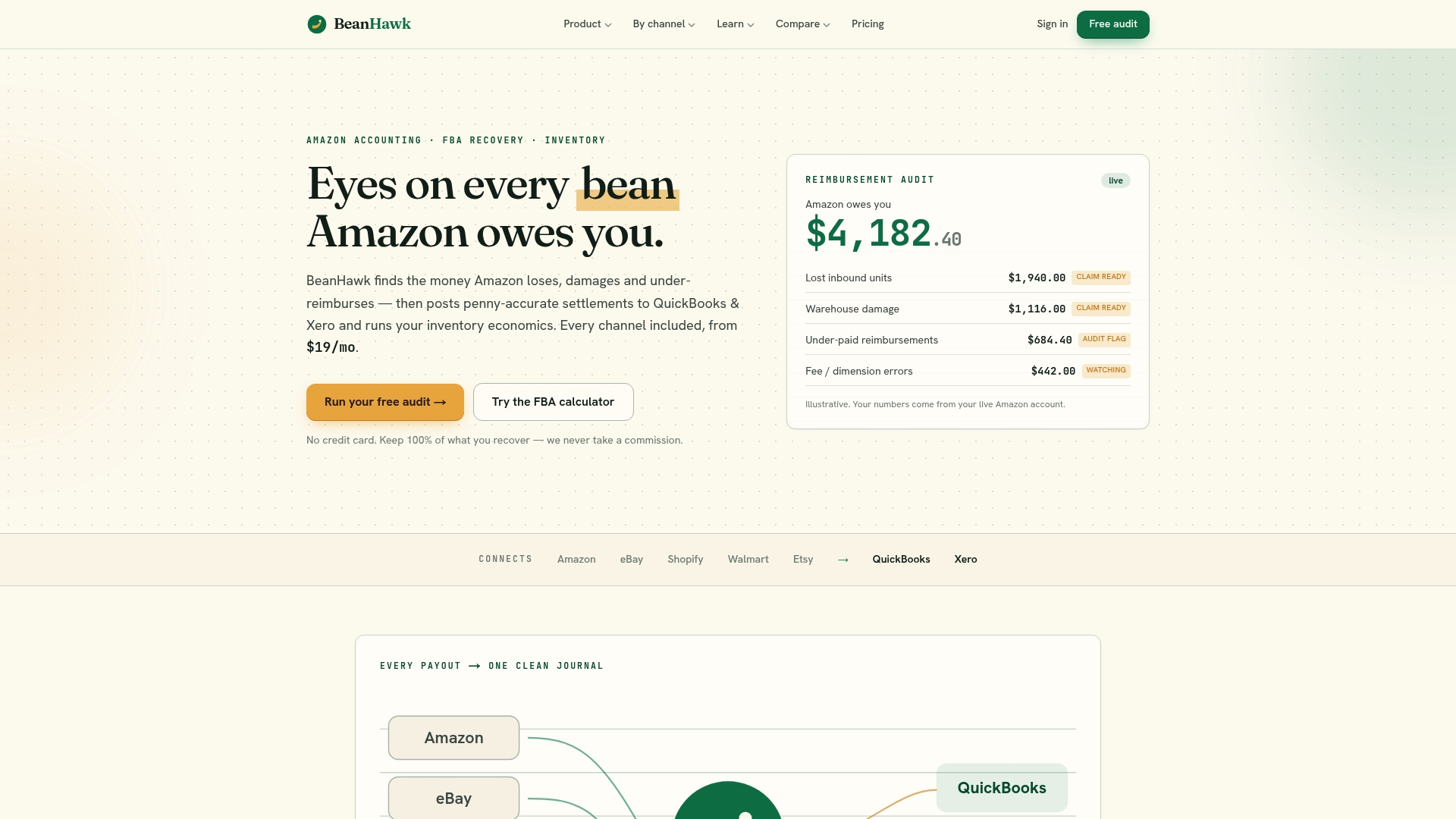
Beanhawk connects to Amazon, Shopify, eBay, and WooCommerce, then posts settlement-level journal entries directly to your QuickBooks or Xero account. Gross sales, refunds, FBA fees, advertising costs, and reimbursements each get their own line. At the same time, Beanhawk monitors your FBA ledger continuously for lost, damaged, or under-reimbursed inventory and files recovery claims automatically. No commissions, no hidden fees, just a subscription that pays for itself in recovered reimbursements most sellers didn’t know they were owed.
The fastest way to see whether your current reconciliation has gaps is to run a free audit with Beanhawk. You’ll see exactly which settlements are posting incorrectly and which reimbursements are outstanding before you commit to anything.
Sources and further reading
A short note before the list: the most useful thing you can do before choosing any tool is run a live settlement trace in the vendor demo. Ask them to map one real payout to a journal entry on screen. The Beanhawk learning center has practical how-tos for FBA bookkeeping, reconciliation workflows, and reimbursement recovery.
- E-Commerce Inventory Accounting With 3PLs and Multi-Channel Fulfillment , Beancount
- Ecommerce Accounting Guide for Online Sellers , Acuity
- Inventory, COGS & Margin: Why Your P&L Doesn’t Tie to Reality , Ledgify CPA
- What is Landed Cost? , Buske
- Good Deal, Bad Deal: The 2017 Tax Law vs the 2024 Tax Welfare Bill , Heritage Foundation
- How to Reconcile Amazon Payouts in QuickBooks , Beanhawk
- Amazon FBA Bookkeeping: A Practical Guide , Beanhawk