
COGS Reconciliation for Amazon Sellers: Monthly Workflow

Accurate COGS reconciliation for Amazon means recognizing the full landed cost per unit at the moment of sale, matching every Amazon settlement and inventory event to its purchase batch, posting batch-level COGS journal entries to QuickBooks Online or Xero, and resolving FBA reimbursements or lost/damaged inventory as separate adjustments before you close the month.
Here is what to do this month:
- Pull four reports from Amazon Seller Central: Settlement/Payments (Reports > Payments > All Statements), Date Range Transaction report, FBA Inventory Ledger, and FBA Inventory Events/Adjustments
- Map each SKU sold during the period to its purchase batch and the landed cost you calculated for that batch
- Post batch-level COGS journal entries when units ship to customers, not when you paid the supplier invoice
- Pull the Reimbursements report and record each reimbursement separately (as inventory recovery or other income, depending on type)
- Reconcile the net settlement deposit to your bank and confirm the gross sales, fees, and refunds match your accounting records
- Flag any unit count discrepancy greater than 1% or $500 for investigation before closing
Tools that belong in this workflow: Amazon Seller Central for the source reports, QuickBooks Online or Xero for journal posting, and Beanhawk for automated settlement mapping, continuous ledger monitoring, and reimbursement recovery.
Key Takeaways
Accurate COGS reconciliation for Amazon requires landed cost per unit at the batch level, recognized at the time of sale, reconciled monthly against Seller Central reports, and posted to QuickBooks Online or Xero with reimbursements and write-offs classified separately.
| Point | Details |
|---|---|
| Use landed cost, not invoice price | Include freight, duties, prep, and inbound shipping in every unit’s COGS calculation. |
| Recognize COGS at the time of sale | Post COGS when the unit ships to the customer, not when you paid the supplier invoice. |
| Start reconciliation from the Settlement report | The bank deposit is net; the Settlement report contains the gross detail your P&L needs. |
| Track and post reimbursements separately | Classify each reimbursement as inventory recovery or other income before closing the month. |
| Beanhawk automates the workflow | Continuous ledger monitoring, automated journal posting, and reimbursement recovery replace manual monthly report pulls. |
Table of Contents
- Why accurate COGS reconciliation changes your P&L and business decisions
- What should go into COGS for an Amazon FBA seller?
- Accrual vs cash and when to recognize COGS for Amazon
- How Amazon FBA inventory moves and the reconciliation gaps that cause mismatches
- A step-by-step monthly COGS reconciliation process for QuickBooks Online or Xero
- How to treat reimbursements, returns, and unsellable inventory in your P&L
- Inventory valuation methods: FIFO, weighted average, and batch costing
- How to reconcile Amazon data into QuickBooks Online and Xero
- A concise month-end checklist and timeline for closing COGS and inventory
- What sellers consistently get wrong about COGS reconciliation
- Beanhawk automates what this workflow costs you in manual hours
- Sources
Why accurate COGS reconciliation changes your P&L and business decisions
Your P&L flows from gross revenue down through COGS to gross profit, then through operating expenses to net profit. COGS sits at the top of that stack, which means a small error there compounds through every margin metric you use to make decisions.
The most common distortion: sellers use the supplier invoice price as COGS and leave out inbound freight, duties, and prep costs. This omission can inflate gross margin significantly, enough to misrepresent profitability and affect pricing decisions. It is the difference between a product that looks like a winner and one that is barely covering its costs once you add advertising and storage.

Bad COGS also corrupts restocking decisions. If your margin looks 12 points higher than reality, you will reorder aggressively, tie up cash in inventory, and miss the signal that the product needs a price increase or a supplier negotiation.
The P&L impact is real at the category level too. NYU Stern margin data shows that retail gross margins across product categories vary widely, and even a few percentage points of margin distortion can shift a product from profitable to breakeven when operating costs are applied.
The downstream effects of inflated margins include:
- Pricing decisions based on false headroom (you think you can afford to discount; you cannot)
- Restock quantities that exceed what cash flow can actually support
- Inaccurate contribution margin by SKU, making it impossible to cut underperformers
- Tax exposure if COGS is understated on your return
Margin reality check: A product with a $25 sale price, $12 invoice cost, and $3 in freight/duties/prep has a 40% true gross margin. Using invoice-only COGS inflates that to 52%. Twelve points of phantom margin is enough to make a losing product look like your best SKU.
What should go into COGS for an Amazon FBA seller?
COGS for an Amazon seller is not the price on the supplier invoice. It is the full landed cost per unit: every dollar spent to get that unit from the supplier’s dock to an Amazon fulfillment center, ready to ship to a customer.
Under U.S. tax rules, specifically IRC §471 and §263A (the uniform capitalization rules), direct and allocable indirect costs of acquiring inventory and getting it ready for sale belong in COGS, not in operating expense. That is not just good accounting practice; it is the legal standard for U.S. inventory reporting.
| Cost category | Example source document | Notes |
|---|---|---|
| Supplier unit price | Supplier invoice / purchase order | Base cost per unit |
| Inbound international freight | Freight forwarder invoice | Allocate by weight or cubic volume across units in the shipment |
| Customs duties and brokerage | Customs entry / broker invoice | Include ISF filing fees |
| Cargo insurance | Insurance certificate | Allocate pro-rata across shipment value |
| Prep, labeling, and packaging | Prep center invoice / FNSKU label costs | Per-unit prep charges |
| Domestic inbound freight to Amazon | Carrier invoice (UPS, FedEx, LTL) | From prep center or warehouse to Amazon FC |
| Payment processing / FX spread | Bank or payment provider statement | Relevant when paying overseas suppliers in foreign currency |
| Inbound placement fees (where applicable) | Amazon Seller Central fee report | Allocate per unit when Amazon charges for FC placement |
What does NOT belong in COGS: Amazon referral fees, FBA fulfillment fees, advertising spend, storage fees, and return processing fees. Those sit below gross margin as selling expenses or operating expenses. Mixing them into COGS understates gross margin and makes it impossible to compare your product economics to industry benchmarks.
A quick numeric example: you import several hundred units. The supplier invoice totals several thousand dollars with significant additional freight, duties, and prep costs. Using invoice price alone understates your true cost per unit, leading to overstated gross profit that can be substantial in aggregate.
Use Beanhawk’s FBA fee and profit calculator to model these components before you finalize a purchase order.
Pro Tip: Allocate inbound freight by weight when your shipment contains multiple SKUs with significantly different weights. For SKUs with similar weights, cubic volume works just as well. The key is to pick one method and apply it consistently across every batch so your per-unit costs are comparable over time.
Landed cost vs invoice cost: Sellers who use invoice-only COGS routinely inflate gross margin and make restocking decisions based on phantom profit. The fix is a landed-cost calculation at the batch level, applied before the first unit sells.
Accrual vs cash and when to recognize COGS for Amazon
The short answer: use accrual accounting for management reporting and recognize COGS when the unit ships to the customer, not when you paid the supplier.

Cash accounting records revenue when cash arrives and expenses when cash leaves. For an Amazon seller, that means a $50,000 inventory purchase in March hits your P&L in March even if those units sell in May, June, and July. Your March looks terrible; your summer looks artificially profitable. That is cash-timing noise masquerading as business performance, and it makes month-to-month comparison meaningless.
Accrual accounting matches COGS to the period in which the sale occurs. The inventory purchase is an asset on your balance sheet until units sell. When a unit ships, the asset converts to COGS expense. That is the correct treatment under both GAAP and the IRC §263A rules cited above.
Key timing distinctions for FBA sellers:
- Purchase date: inventory hits the balance sheet as an asset (debit Inventory, credit Accounts Payable or Cash)
- Inbound receipt at Amazon FC: no P&L impact; inventory remains an asset
- Customer shipment date: COGS recognized (debit COGS, credit Inventory)
- Return received: reverse the COGS entry if the unit is resellable; write down to net realizable value if unsellable
Perpetual vs periodic inventory systems:
A perpetual system updates inventory and COGS in real time with each transaction. It is the right choice for active FBA sellers with multiple SKUs and high order volume because it catches discrepancies immediately and supports batch-level costing. QuickBooks Online and Xero both support perpetual inventory when set up correctly.
A periodic system counts inventory at set intervals (monthly or quarterly) and calculates COGS as: Beginning Inventory + Purchases minus Ending Inventory. It is simpler but produces COGS only at the count date, which means mid-period margin data is unreliable. Suitable for very low-volume sellers or those just starting out, but it creates the timing distortions that make month-end closes difficult when Amazon settlement timing and inventory events don’t align with calendar months.
Recognition rule: COGS follows the unit, not the invoice. Recognize COGS in the period the unit actually sells, not the period you paid for it. Monthly closes prevent timing distortions from stacking up across periods.
How Amazon FBA inventory moves and the reconciliation gaps that cause mismatches
Understanding the physical and financial flow of FBA inventory is the prerequisite for finding reconciliation gaps. The flow looks like this:
Purchase order issued → supplier ships → inbound shipment created in Seller Central → units received at Amazon FC (inventory event) → units available for sale → customer order placed → units shipped → returns and disposition events
Each transition in that chain generates a data record in Seller Central. The reconciliation problem is that your accounting system only sees what you post to it, while Amazon’s records reflect what actually happened in the warehouse. The gap between those two is where mismatches live.
Reports to pull every month from Seller Central:
- Settlement/Payments report (Reports > Payments > All Statements): the master document for gross sales, fees, refunds, and reimbursements in the settlement period
- Date Range Transaction report: itemized transactions by date, useful for matching individual orders to settlement periods
- FBA Inventory Ledger report: opening balance, receipts, customer shipments, adjustments, and closing balance by SKU
- Inventory Adjustments report: lost, damaged, found, and disposed units with reason codes
- Reimbursements report: all reimbursements Amazon has issued, by type and SKU
- Inbound Shipment Summary: units shipped vs units received, useful for catching in-transit discrepancies
Common reconciliation gaps:
- In-transit inventory: units shipped to Amazon but not yet received appear in your purchase records but not in the FBA ledger. They should sit in an “Inventory in Transit” asset account, not COGS.
- Stranded inventory: units at an FC that are not active listings. They remain in inventory on your books but generate no revenue. Stranded inventory needs a separate review to determine if it should be relisted, removed, or written down.
- Reimbursed but not recorded: Amazon issues reimbursements for lost or damaged units, but those credits appear in the settlement net figure. If you only post the net deposit, the reimbursement never hits your books as a separate line, and your inventory account stays overstated.
- Timing differences: Amazon’s settlement periods (typically 14 days) do not align with calendar months. Sales that occur in the last days of a month may settle in the next period. Accrual accounting requires you to recognize those sales in the correct month regardless of when the settlement deposits.
A step-by-step monthly COGS reconciliation process for QuickBooks Online or Xero
This workflow assumes accrual accounting, perpetual inventory, and batch-level landed costs. Run it within the first five business days after month-end.
Step 1: Download all required reports Pull the Settlement/Payments report, Date Range Transaction report, FBA Inventory Ledger, Inventory Adjustments, and Reimbursements report for the closed month. Start from the Settlement report, not the bank statement , the bank deposit is already net of fees and refunds, so working backward from it means you will miss the gross detail you need.
Step 2: Reconcile gross sales, fees, and refunds From the Settlement report, extract: gross product sales, referral fees, FBA fulfillment fees, advertising fees, storage fees, refunds, and reimbursements. These are the line items that map to your Chart of Accounts. Confirm the sum equals the net settlement deposit in your bank.
Step 3: Match units sold to purchase batches From the FBA Inventory Ledger, pull the units shipped (sold) by SKU for the month. Match each SKU’s sold units to its purchase batch(es) and apply the batch landed cost per unit. If a SKU sold from two batches in one month (partial-batch shipment), split the COGS proportionally between the two batch costs.
Step 4: Post COGS journal entries For each SKU, post the batch-level COGS to your accounting system. See the journal entry examples below.
Step 5: Record reimbursements and adjustments From the Reimbursements report, classify each reimbursement (see Section 7) and post the appropriate entry. Record inventory adjustments (lost, damaged, disposed) as write-offs or recoveries.
Step 6: Reconcile inventory balance Compare the closing FBA Inventory Ledger balance (units × batch landed cost) to the Inventory asset account in QuickBooks Online or Xero.
Step 7: Close and file Lock the period in your accounting system. File any open reimbursement claims before Amazon’s claim window closes (typically 18 months for lost inbound units, 60 days for customer return reimbursements).
Sample journal entries:
| Transaction | Debit | Credit | Account names |
|---|---|---|---|
| Units sold (COGS recognition) | COGS , Product Cost | Inventory Asset | Batch landed cost × units sold |
| Amazon reimbursement (inventory recovery) | Inventory Asset | COGS , Product Cost | Restores inventory value for recovered units |
| Amazon reimbursement (cash, no unit return) | Cash / Accounts Receivable | Other Income , Reimbursements | Administrative reimbursement |
| Storage fee accrual | Storage Expense | Accrued Liabilities | Monthly long-term storage charge |
| Unsellable unit write-off | COGS , Inventory Write-Off | Inventory Asset | Net realizable value adjustment |
| Customer return (resellable) | Inventory Asset | COGS , Product Cost | Reversal of original COGS entry |
Anything above that threshold warrants a line-by-line review of the Inventory Adjustments report and, if units are missing, a reimbursement claim filed through Seller Central.
Pro Tip: Build a simple spreadsheet template with columns for SKU, batch number, batch landed cost per unit, units sold this month, COGS this month, and cumulative units remaining. Update it monthly. This single document is the audit trail that makes your COGS defensible to a CPA or acquirer.
How to treat reimbursements, returns, and unsellable inventory in your P&L
Amazon issues reimbursements for several distinct reasons, and each one lands in a different account. Getting this wrong is one of the most common ways sellers understate COGS or overstate other income.
Decision flow for reimbursements:
- Did Amazon return a physical unit to your inventory? → Debit Inventory Asset, Credit COGS (inventory recovery). The unit is back; your COGS reverses.
- Did Amazon pay cash but keep or dispose of the unit? → Debit Cash/AR, Credit Other Income , Reimbursements. No inventory impact.
- Did Amazon reimburse for a lost inbound shipment unit? → Debit Cash/AR, Credit Inventory Asset (the unit was never received, so it was sitting in Inventory in Transit). This clears the transit asset.
Sample journal entries for reimbursements and write-offs:
| Scenario | Debit | Credit |
|---|---|---|
| Unit returned to sellable inventory | Inventory Asset | COGS , Product Cost |
| Cash reimbursement, unit not returned | Cash | Other Income , Reimbursements |
| Lost inbound unit reimbursed | Cash | Inventory in Transit |
| Unsellable unit, no reimbursement | COGS , Write-Off | Inventory Asset |
| Partial reimbursement (below cost) | Cash + COGS , Write-Off | Inventory Asset |
Practical steps to stay current on reimbursements:
- Pull the Reimbursements report monthly and compare it to your Inventory Adjustments report. Every lost or damaged unit in the Adjustments report should have a corresponding reimbursement or an open claim.
- Cross-reference inbound shipment summaries: units shipped to Amazon minus units received equals potential lost inbound units eligible for a claim.
- File claims within Amazon’s windows. Lost inbound units: file between 15 and 18 months after the shipment was created. Customer return reimbursements: file within 60 days of the return window closing.
- Post successful reimbursements to the correct account immediately. Do not let them accumulate in the settlement net figure unclassified.
Amazon’s reimbursement process is documented at Beanhawk if you want a detailed breakdown of what qualifies and the claim timelines.
Inventory valuation methods: FIFO, weighted average, and batch costing
How you assign cost to units sold determines your COGS in any given period. Three methods are in common use for Amazon sellers, and each has real trade-offs.
FIFO (First In, First Out):
- Assigns the cost of the oldest batch to units sold first
- Produces COGS that reflects older (often lower) costs when prices are rising, which means gross profit is higher in inflationary periods
- Audit-friendly because the cost flow matches the physical flow of most consumer goods
- Requires tracking batch receipt dates and costs separately
- Commodity and raw-material price shifts mean FIFO can produce COGS that significantly understate the current cost of replacing inventory during periods of freight or input cost volatility
Weighted average cost:
- Blends all batch costs into a single average, updated with each new receipt
- Simpler to maintain than FIFO; no need to track which specific units sold from which batch
- The risk: a forever-blended average obscures the true cost of recent purchases and can mask margin deterioration when costs are rising
- Acceptable for sellers with very stable landed costs and low SKU counts
Explicit batch costing (specific identification):
- Assigns the exact cost of a specific batch to the units that sold from it
- The most accurate method for sellers with meaningful cost variation between purchase orders
- Requires a batch-level tracking system (a spreadsheet or an integrated tool like Beanhawk)
- Most defensible in an audit or acquisition due diligence because every COGS dollar traces to a specific receipt
- The right choice for any seller with more than two or three active SKUs and variable freight or duty costs
Implementation notes: QuickBooks Online supports average cost and FIFO natively for inventory items. Xero uses average cost by default. Neither platform natively supports explicit batch costing at the SKU-receipt level without a connected integration or manual journal entries. If you switch valuation methods mid-year, you need to restate prior periods to maintain comparability. Do that in a single journal entry at the start of the new period, documented in your workpapers.
The practical guidance from The FBA Guys is clear: freight and duty variability means sellers should update landed cost per receipt and let each sale draw down the specific batch it shipped from. A forever-blended rate is convenient but produces inaccurate per-period margins whenever costs change between orders.
How to reconcile Amazon data into QuickBooks Online and Xero
The core challenge is that Amazon settlement deposits are net figures, not gross revenue. The bank sees one number; your P&L needs the gross sales, every fee type, refunds, and reimbursements broken out separately. Posting the net deposit as revenue is one of the most common and damaging Amazon accounting errors.
Chart of Accounts mapping:
| Amazon report line item | QuickBooks Online / Xero account | Account type |
|---|---|---|
| Gross product sales | Revenue , Product Sales | Income |
| Refunds / returns | Revenue , Refunds (contra) | Income (negative) |
| Referral fees | Amazon Fees , Referral | Cost of Sales or Operating Expense |
| FBA fulfillment fees | Amazon Fees , FBA Fulfillment | Cost of Sales or Operating Expense |
| Advertising fees | Advertising Expense | Operating Expense |
| Long-term storage fees | Storage Expense | Operating Expense |
| Reimbursements (cash) | Other Income , Reimbursements | Other Income |
| COGS , landed cost | Cost of Goods Sold | Cost of Sales |
| Inventory asset | Inventory Asset | Current Asset |
| Inventory in transit | Inventory in Transit | Current Asset |
Integration setup , best practice sequence:
- Set up your Chart of Accounts in QuickBooks Online or Xero before connecting any integration. Mapping to the wrong account type at setup creates months of reclassification work.
- For reconciling Amazon payouts in QuickBooks, the recommended sequence is: import the Settlement report, map each line item to its account, post gross sales and fees separately, then reconcile the net to the bank deposit.
- Manual posting works for sellers with one or two settlements per month and low SKU counts. For active sellers, the volume of line items makes manual posting error-prone.
- Automated posting through Beanhawk eliminates the manual mapping step: it reads the settlement detail, applies your account mapping rules, and posts journal entries to QuickBooks Online or Xero automatically. It also monitors inbound shipment and ledger events continuously, flagging reimbursement opportunities that manual review typically misses.
Multi-currency settlements: if you purchase inventory in a foreign currency (CNY, EUR, GBP) and sell in USD, the FX spread between your purchase rate and the settlement rate creates a gain or loss. Record the inventory asset at the USD equivalent on the purchase date (using the exchange rate on that date). When the unit sells, COGS is the USD cost already recorded. Any difference between the purchase-date rate and the payment-date rate is an FX gain or loss, posted to a separate “Foreign Exchange Gain/Loss” account, not to COGS. This keeps your product margin clean and your FX exposure visible as a separate line.
Automation impact: Sellers who automate settlement posting and reimbursement monitoring typically recover funds that manual monthly reviews miss entirely, particularly for lost inbound units and customer return discrepancies. Beanhawk’s continuous ledger monitoring catches these events in near-real-time rather than waiting for a monthly report pull.
A concise month-end checklist and timeline for closing COGS and inventory
Active sellers should run a weekly settlement spot check and a full monthly close. The weekly check takes 20,30 minutes and catches timing errors before they compound. The monthly close is the full reconciliation.
Month-end close timeline:
| Task | Who | When |
|---|---|---|
| Pull Settlement, Date Range, Inventory Ledger, Adjustments, Reimbursements reports | Seller / bookkeeper | Day 1,2 after month-end |
| Reconcile gross sales, fees, refunds to settlement net | Bookkeeper | Day 2,3 |
| Match settlement net to bank deposit | Bookkeeper | Day 2,3 |
| Update batch landed costs for any new receipts | Seller / ops | Day 2,3 |
| Post COGS journal entries by SKU and batch | Bookkeeper | Day 3,4 |
| Classify and post reimbursements | Bookkeeper | Day 3,4 |
| Reconcile FBA Inventory Ledger closing balance to Inventory Asset account | Bookkeeper | Day 4,5 |
| File open reimbursement claims in Seller Central | Seller | Day 4,5 |
| Lock the period in QuickBooks Online or Xero | Bookkeeper | Day 5 |
| Review inventory performance and flag stranded or aged inventory | Seller | Day 5 |
Weekly cadence (for active sellers):
- Download the most recent settlement statement and confirm the deposit matches your bank
- Check the Inventory Adjustments report for any new lost or damaged events
- Review open reimbursement claims for status updates
- Update your batch tracking spreadsheet if new purchase receipts arrived
Balance sheet tie-out: at month-end, the Inventory Asset account balance in your accounting system should equal the sum of (units on hand by SKU × batch landed cost per unit) plus any units in transit at their allocated landed cost. If those two numbers don’t match, the discrepancy is either an unposted receipt, an unposted COGS entry, or a reimbursement that was not recorded. Work through the FBA Inventory Ledger line by line until you find it.
For sellers using third-party logistics providers (3PLs) alongside FBA, reconcile the 3PL’s inventory report to your books separately, then combine for a total inventory balance. Multi-channel COGS accounting for Amazon and other channels requires a channel-level split in your Chart of Accounts so you can see margin by channel, not just in aggregate.
What sellers consistently get wrong about COGS reconciliation
Most of the margin problems I see in Amazon seller financials trace back to a small set of mistakes, and almost all of them are fixable in a single month-end close cycle.
The most common mistakes:
- Using the supplier invoice price as COGS and ignoring freight, duties, and prep costs entirely
- Expensing the full purchase order value when the invoice is paid, rather than capitalizing it as inventory and recognizing COGS at sale
- Maintaining one blended COGS rate forever, never updating it when a new shipment arrives at a different landed cost
- Ignoring the Reimbursements report and letting Amazon’s credits disappear into the net settlement deposit unclassified
- Treating customer returns as revenue reversals without adjusting inventory or COGS
Quick wins you can implement this month:
- Set up a batch-level landed cost tracking spreadsheet (SKU, PO number, receipt date, units received, total landed cost, cost per unit). Populate it for your last three months of receipts and recalculate COGS for those periods.
- Run a weekly settlement spot check: download the settlement, confirm the net matches the bank deposit, and flag any reimbursement line you have not yet posted.
- Pull the Reimbursements report right now and compare it to your Inventory Adjustments report for the last six months. Any lost or damaged unit in Adjustments without a corresponding reimbursement is a potential claim.
- Allocate long-term storage fees back to the SKUs they apply to, once per month. Storage is not a general overhead cost; it is a carrying cost tied to specific inventory.
Pro Tip: The highest-leverage change most sellers can make in the first month is implementing batch landed-cost tracking and reconciling the last three months against it. You will almost certainly find margin distortions that change how you think about your best and worst SKUs.
The sellerboard guide on Amazon seller P&L is one of the clearest breakdowns of these mistakes and why they persist. Worth reading alongside this workflow.
Beanhawk automates what this workflow costs you in manual hours
Running this reconciliation manually every month works, but it scales poorly. As order volume grows, the Settlement report gets longer, the Inventory Adjustments report gets more complex, and the reimbursement opportunities get easier to miss. That is the problem Beanhawk solves.
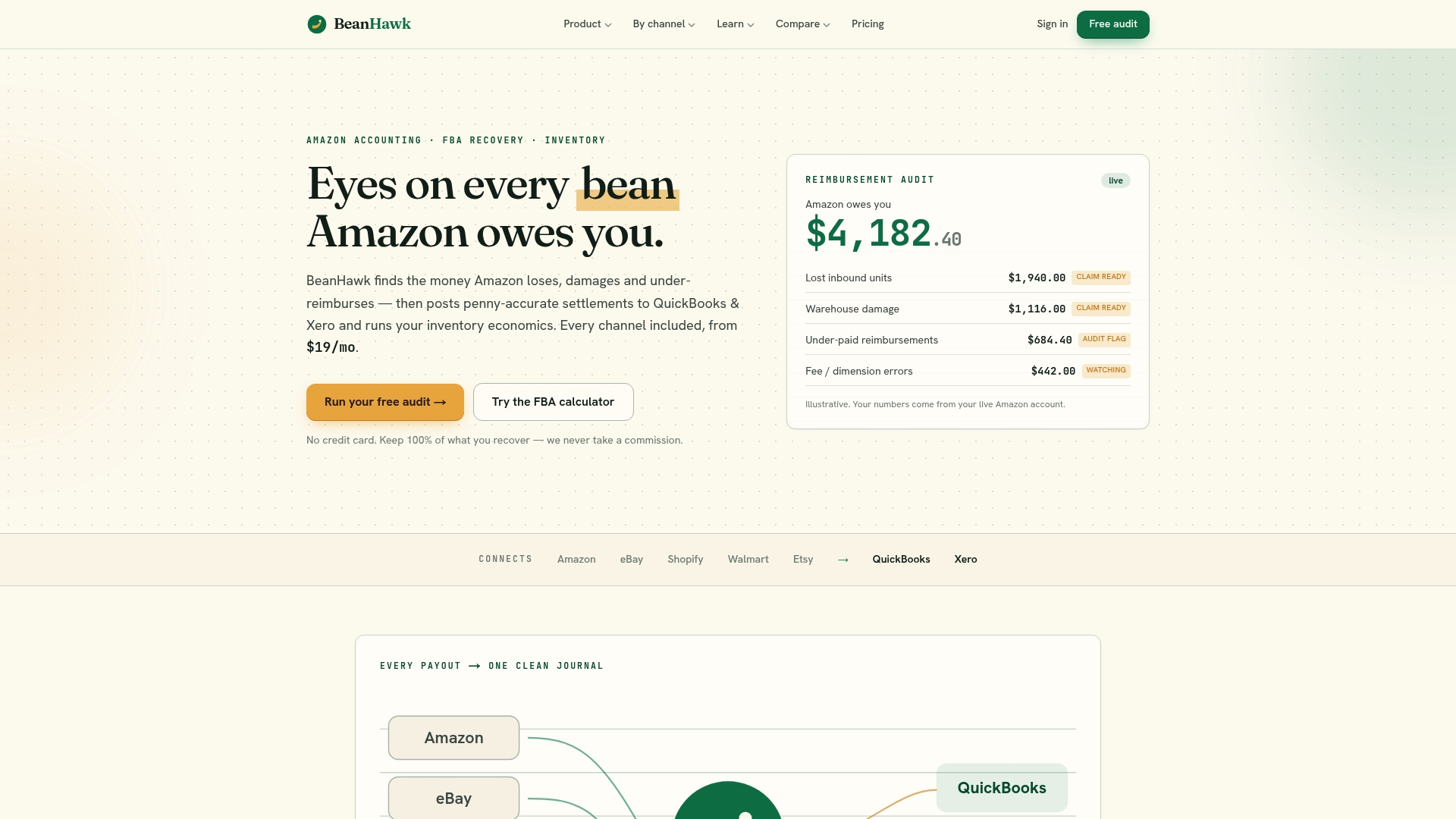
Beanhawk monitors your inbound shipments and FBA ledger events continuously, not just when you remember to pull a report. It maps settlement line items to your QuickBooks Online or Xero Chart of Accounts automatically, posts journal entries with the correct account splits, and flags reimbursement opportunities as they appear in the ledger rather than weeks later in a monthly report. There are no commissions on recovered funds and no hidden fees.
For sellers who want the reconciliation workflow described in this guide without the manual hours:
- Automated settlement posting to QuickBooks Online or Xero, with gross sales, fees, refunds, and reimbursements mapped to the correct accounts
- Continuous inbound shipment monitoring to catch lost units before the claim window closes
- Batch-level landed cost support and PO tracking built into the reconciliation workflow
- Reimbursement claims workflow that identifies, documents, and tracks claims through resolution
Run a free audit to see what Beanhawk finds in your last 18 months of FBA ledger events. Most sellers discover open reimbursement opportunities they did not know existed.
Sources
The sources below were used directly in building this guide. Each one covers a specific part of the reconciliation workflow.
- The Amazon Seller P&L: How to Build One That Tells the Truth (and the COGS Mistakes That Distort It.) - Blog | sellerboard
- Amazon FBA Accounting Best Practices: Settlement Reports, COGS, Fees, And Taxes - CPA Tax Accounting And Bookkeeping Firm Toronto
- Amazon Seller Accounting: What Makes It Different | Inventory Hero
- How to Track COGS for Amazon FBA: Make the Cost Follow the Unit, Not the Invoice - The FBA Guys
This article is general information, not a substitute for advice from a qualified financial advisor. Consult a qualified financial professional about your own circumstances before acting on anything here.