
Small Sellers: FIFO vs Weighted Average and the $50 COGS Gap

FIFO typically lowers cost of goods sold and raises profit when prices are rising; weighted average smooths out those swings instead of chasing them. Pick FIFO when you need your balance sheet to reflect current replacement costs or your physical stock actually moves oldest first. Pick weighted average when your SKUs are fungible, high-volume, and you want fewer moving parts in your books.
TL;DR:
- FIFO provides a more accurate reflection of current inventory costs on the balance sheet, especially during periods of rising prices, by valuing inventory at recent purchase costs.
- Weighted average smooths out cost fluctuations over time, making it ideal for high-volume fungible goods where tracking specific layers offers little benefit.
- The $50 difference in COGS between FIFO and weighted average in a typical example results from timing, not total expenditure, affecting profit reporting in volatile markets.
- During inflation, FIFO reports higher gross profit and inventory value, whereas in falling prices, weighted average may yield higher profits, influencing tax and cash flow management.
- Consistency in valuation methods across channels is essential, particularly in multi-channel e-commerce, as separate cost queues can lead to unreliable COGS if not properly integrated.
Table of Contents
- FIFO vs Weighted Average: How FIFO Actually Works
- FIFO vs Average Cost: The Weighted Average Method Explained
- FIFO vs Weighted Average: Side-by-Side Results
- How FIFO and Weighted Average Reshape Your Financials
- How to Choose Between FIFO and Weighted Average
- Perpetual vs. Periodic: Why the System Matters
- Multi-Channel Sellers: Where Valuation Consistency Breaks Down
- What I’d Tell a Small Seller Choosing Their First Method
- Keep Your COGS Accurate Across Every Channel
- Sources
- FAQ
FIFO vs Weighted Average: How FIFO Actually Works
FIFO, or first-in, first-out, assumes the oldest inventory costs hit your cost of goods sold first, regardless of which physical box a warehouse worker grabs off the shelf. That distinction trips up a lot of accounting students: FIFO is a cost-flow assumption, not a description of your loading dock. You can run FIFO accounting while your team pulls inventory in whatever order is fastest, as long as the cost layers get consumed oldest-first on paper.
Here’s how the math runs in practice. Say you sell a single SKU and your purchase history looks like this:
- January 5: buy 100 units at $10 each ($1,000 total)
- January 18: buy 100 units at $12 each ($1,200 total)
- January 25: sell 150 units
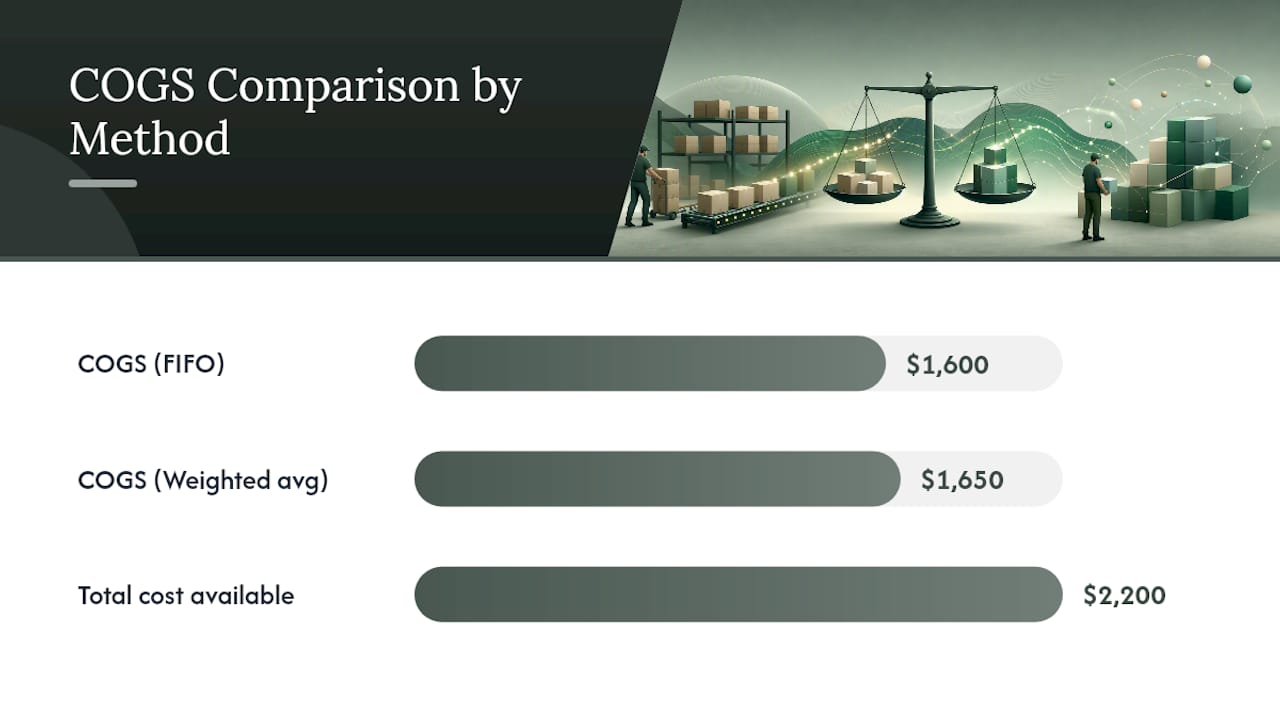
Under FIFO, that sale draws first from the $10 layer, then dips into the $12 layer. COGS equals (100 × $10) + (50 × $12) = $1,000 + $600 - this example illustrates FIFO allocation. The 50 units left in inventory carry the newer $12 cost, so ending inventory reflects recent purchases. Total goods available for sale were $2,200; you’ve allocated $1,600 to the income statement and left $600 on the balance sheet.
The journal entry mechanics stay simple: each sale debits COGS and credits inventory for the FIFO-calculated amount, layer by layer, while purchases just add new cost tranches to the inventory account. Nothing exotic happens behind the scenes. It’s bookkeeping arithmetic applied consistently.
FIFO tends to match reality well for perishables (produce, dairy, anything with a shelf life), for warehouses that physically rotate stock, and for most e-commerce sellers whose picking process naturally favors older inventory to avoid write-offs. If you’ve ever wondered why grocery chains and pharmacies lean on FIFO almost universally, that’s the reason. For a fuller breakdown of the mechanics, see what FIFO means in practical terms.
FIFO vs Average Cost: The Weighted Average Method Explained
Weighted average takes a different philosophy entirely: instead of tracking which cost layer a unit came from, it blends every dollar spent on inventory into one number per unit. The formula is straightforward: total cost of goods available for sale divided by total units available. Every unit, old or new, carries that identical blended cost.
There are two flavors, and mixing them up is a common source of confusion:
- Periodic weighted average recalculates once, at the end of the reporting period, using all purchases and the beginning balance together.
- Moving weighted average (sometimes called perpetual weighted average) recalculates after every single purchase, so the average cost shifts continuously as new inventory arrives.
Now run the identical numbers from the FIFO example. You start with 100 units at $10 ($1,000), then buy 100 more at $12 ($1,200). Total units available: 200. Total cost: $2,200. Divide the two and you get a weighted average cost of $11 per unit.
When you sell 150 units, COGS equals 150 times the weighted average cost per unit. Ending inventory is the remaining units times that average cost. Total cost allocated matches total goods available, consistent with FIFO for total value over the inventory’s life.
Notice the COGS figure landed at $1,650 under weighted average versus $1,600 under FIFO. That $50 gap is the entire story of this comparison, and it comes purely from timing, not from any difference in total spending.
Weighted average tends to shine for commodities, raw materials, fuel, and any high-volume fungible goods where tracking individual purchase layers would be pointless busywork. If your ERP already runs moving average cost calculations automatically, that operational simplicity is often reason enough to stick with it for the right product categories.
FIFO vs Weighted Average: Side-by-Side Results
Lay the two outcomes next to each other and the pattern becomes obvious immediately.
| Metric | FIFO | Weighted Average |
|---|---|---|
| Units sold | 150 | 150 |
| Cost of goods sold | $1,600 | $1,650 |
| Ending inventory (50 units) | $600 | $600 |
| Gross profit (at $20/unit sale price) | $1,600 | $1,650 |
The swing between the two methods results from timing differences in cost allocation, affecting taxable income for the period. FIFO typically produces higher gross profit in rising price environments because it assigns older, lower costs to COGS first, whereas weighted average blends costs.
The delta is timing, not truth. Total cost of goods available for sale is identical under both methods ($2,200), and once all 200 units eventually sell, both methods report the exact same cumulative COGS and profit over the life of that inventory. What differs is which period gets to claim which slice of the cost. In a single high-volatility quarter, that timing difference can swing your reported gross profit enough to change a lending covenant test or a tax bill, even though the long-run economics never changed at all.
How FIFO and Weighted Average Reshape Your Financials
The COGS and inventory gap from the worked example above ripples through every financial statement you produce, and it moves in a predictable direction depending on whether prices are climbing or falling. During inflationary stretches, FIFO consistently produces lower COGS, higher gross profit, and a fatter ending inventory balance, because it’s still selling off cheaper, older stock on paper. Reverse the price trend and the relationship flips: in a falling-price environment, weighted average tends to report the higher profit instead, while FIFO’s older, pricier layers drag COGS up.
That timing shift touches more than just your income statement:
- Current ratio and working capital both look stronger under FIFO during inflation, since ending inventory carries a higher balance-sheet value.
- Gross margin percentage swings with whichever method is currently allocating cheaper costs to COGS, which matters if your loan covenants reference margin thresholds.
- Inventory turnover ratio gets distorted slightly because the denominator (average inventory value) differs between methods even with identical unit counts.
- Taxable income shifts in the same direction as gross profit, meaning your method choice has a real, immediate cash impact on what you owe.
Both FIFO and weighted average are acceptable cost formulas under GAAP guidance for interchangeable inventory items, and both remain subject to the lower-of-cost-or-net-realizable-value rule, so you can’t just pick whichever number looks best this quarter and switch back next year. Changing methods is a formal accounting policy change. It generally requires disclosure in your financial statements and, for many businesses, IRS notification via Form 3115 before the change takes effect. That paperwork exists specifically to stop companies from method-shopping to manipulate short-term earnings.
Pro Tip: Auditors and acquirers reviewing a company’s books tend to favor FIFO precisely because ending inventory reflects something closer to current replacement cost. A weighted-average balance sheet can understate inventory value during a long inflationary run, which shows up as a red flag during due diligence when a buyer tries to reconcile book value against what replacing that stock would actually cost today.
How to Choose Between FIFO and Weighted Average
Run through this checklist before locking in a method, ideally with your accountant in the room rather than after you’ve already filed a return.
Decision checklist:
- Does your inventory actually move oldest-first physically (perishables, date-coded goods)? Lean FIFO.
- Are your SKUs truly interchangeable, with no meaningful cost variation batch to batch? Lean weighted average.
- How volatile are your input prices right now? High volatility magnifies the reporting gap between methods.
- Can your ERP or accounting software track FIFO layers per SKU, or does it only support blended averaging?
- Do you sell across multiple channels (Amazon, Shopify, retail) that need one consistent valuation, or several disconnected ones?
- Are you preparing for a loan application, acquisition, or audit where current-cost inventory valuation matters to the other side?
Questions worth asking your accountant or your inventory system vendor:
- Does the system support per-SKU FIFO layer tracking, or does everything default to a blended average regardless of my preference?
- If I switch methods later, what’s the disclosure and Form 3115 process, and what will it cost in accountant hours?
- How does the platform handle landed costs (freight, duties) when layering them into either method?
Watch for these red flags during a review: separate cost queues per sales channel for the same SKU, manual spreadsheet averaging outside the ERP, or a method change nobody documented in writing. Any one of those is a sign your valuation numbers can’t be trusted at face value, and KPMG’s inventory guidance specifically flags e-commerce operations as needing extra judgment here, since multi-channel selling creates more places for inconsistency to creep in unnoticed.
Perpetual vs. Periodic: Why the System Matters
FIFO produces identical results whether you run it perpetually (recalculating after every transaction) or periodically (calculating once at period end). The oldest-cost-first logic doesn’t care about timing, so perpetual and periodic FIFO always match.
Weighted average is different. Moving weighted average recalculates the blended cost after each purchase, so a sale made right after a price increase reflects that new average immediately. Periodic weighted average waits until period end and calculates one average across the whole stretch. Run the same purchase and sale data through both and you’ll get two different COGS figures, purely from recalculation timing.
That divergence has real consequences for audit trails:
- Moving average creates a cleaner, transaction-by-transaction trail that’s easier to reconcile against ERP records.
- Periodic average is simpler to compute manually but harder to tie back to any single sale.
- Auditors reviewing weighted-average books need to confirm which variant you’re using, since the two aren’t interchangeable for verification purposes.
Multi-Channel Sellers: Where Valuation Consistency Breaks Down
Sellers running inventory across Amazon, Shopify, and a wholesale channel simultaneously hit a problem accounting textbooks rarely mention: the same SKU can end up with different reported costs depending on which channel’s ledger you’re looking at. That happens when each sales channel maintains its own separate cost queue instead of pulling from one unified valuation record, and it’s a surprisingly common gap in e-commerce inventory accounting.

The fix is structural, not a formula change. A single per-SKU valuation queue, fed by every channel simultaneously, keeps FIFO layers or weighted-average calculations consistent no matter where a unit actually sells. Pair that with automated reconciliation between your FBA ledger and your accounting platform, so settlement events (reimbursements, returns, adjustments) post against the correct inventory record instead of sitting in a separate spreadsheet somewhere. Continuous monitoring of inbound shipment and ledger events, tied to automated settlement posting, is exactly the kind of control that keeps FBA inventory tracking accurate across channels instead of drifting apart quarter by quarter. Without that structure, your reported COGS is only as good as whichever channel’s spreadsheet you happened to update most recently.
What I’d Tell a Small Seller Choosing Their First Method
If you’re a small seller setting up your books for the first time, I’d point you toward FIFO more often than not, and here’s the practical reasoning behind it, not just convention. Most small e-commerce operations sell discrete, trackable units rather than truly fungible commodities, and lenders and buyers generally want to see inventory valued closer to current cost if you’re ever raising capital or selling the business. FIFO gives you that by default.
That said, weighted average is genuinely the better tool once you’re dealing with high-volume, interchangeable goods, like raw materials or bulk commodity inventory, where tracking individual purchase layers adds cost without adding insight. The mistake isn’t picking either method. The mistake is picking one, never writing down why, and then letting your ERP default settings quietly drift away from what your financial statements claim.
Whichever you choose, document the policy in writing and make sure your accounting platform’s actual configuration matches what your financial statements say you’re doing. The number that should stick with you from this entire comparison is $50, the exact gap between FIFO and weighted average COGS in the worked example above. That’s not a rounding error. It’s the entire effect of the method choice, and it only ever changes timing, never the total dollars your business actually spent.
, Tim
Pro Tip: Auditors and acquirers reviewing a company’s books tend to favor FIFO precisely because ending inventory reflects something closer to current replacement cost, a key insight discussed in AddBack’s pre-deal intelligence for understanding financial due diligence and transaction analysis.
Keep Your COGS Accurate Across Every Channel
Choosing between FIFO and weighted average only matters if the underlying numbers feeding your COGS calculation are actually correct, and for Amazon sellers, that’s where things usually break down first. Lost units, damaged inbound shipments, and under-reimbursed FBA settlements quietly distort your inventory costs before you’ve even applied a valuation method to them. Beanhawk continuously monitors your inbound shipments and FBA ledger events, flags what Amazon owes you, and posts reconciled settlements directly into QuickBooks or Xero, so the cost figures running through your FIFO or weighted-average calculations reflect what actually happened, not what a settlement report glossed over.
That matters most for sellers juggling multiple channels, where inconsistent settlement data is exactly the kind of gap that makes your COGS numbers unreliable across SKUs. If you’re not sure how much Amazon currently owes you in unreimbursed lost or damaged inventory, start with a free audit and see the actual dollar figure before you decide it isn’t worth fixing.
Sources
FAQ
Should I use FIFO or weighted average cost?
Use FIFO if your inventory has variable costs and you want your balance sheet to reflect current replacement value; use weighted average if your goods are interchangeable and you want simpler, smoother accounting. Both are acceptable under GAAP for interchangeable items, so the right choice depends on your operations, not on which one is “correct” universally.
What is the difference between weighted average and FIFO in process costing?
In process costing, FIFO separates beginning inventory costs from current-period costs and calculates equivalent units accordingly, while weighted average blends beginning inventory costs with current-period costs into one combined equivalent-unit rate. The core distinction mirrors the periodic-inventory version: FIFO tracks layers separately, weighted average blends everything together.
What are the disadvantages of FIFO?
FIFO can overstate profit and taxable income during inflationary periods since it matches older, cheaper costs against current revenue. It also requires more detailed record-keeping to track cost layers, can create a mismatch between reported profit and actual cash flow, and produces less predictable margins when input prices swing sharply from period to period.
Is it better to use FIFO or LIFO?
FIFO is permitted under both US GAAP and IFRS, while LIFO is allowed under US GAAP but prohibited under IFRS, which makes FIFO the more universally usable choice if you ever operate internationally or seek foreign investment. FIFO also tends to align better with actual physical inventory flow for most e-commerce and retail businesses.
Does switching between FIFO and weighted average require approval?
Yes. Changing your inventory costing method is a formal accounting policy change that generally requires disclosure in your financial statements and, in many cases, IRS notification through Form 3115. You can’t switch methods opportunistically from one period to the next to manage reported earnings.