
Best Seller Investigators Alternatives for FBA Sellers in 2026

Beanhawk is the strongest alternative to Seller Investigators for sellers who want continuous automated detection and direct posting to QuickBooks or Xero without handing over a slice of every recovered dollar. If you’d rather stay fully hands-off and don’t mind a commission, GETIDA remains the closest match to what Seller Investigators offers. If you already pay for Helium 10 or Sellerboard, their bundled refund tools cost nothing extra and cover the basics. And if your monthly recoveries run under a few hundred dollars, a subscription tool almost always beats a contingency cut.
Here’s the fast selector:
- Want zero commission and accounting automation? Beanhawk.
- Want fully hands-off filing and appeals, commission accepted? GETIDA.
- Already running Helium 10 or Sellerboard? Use the bundled refund feature before paying for anything else.
- Running small volume (under $2,000/month in likely discrepancies)? Stick with a subscription tool; a 25% cut isn’t worth the convenience yet.
Key Takeaways
Sellers who want automated detection without a commission get the most net cash from a subscription tool with accounting integration, not a contingency provider.
| Point | Details |
|---|---|
| Commission math adds up fast | A 25% contingency fee on $25,000 recovered costs $6,250, far more than most monthly subscriptions. |
| Detection overlaps significantly | Automated scanning catches most standard discrepancies; manual review mainly helps with contested edge cases. |
| Access matters | Contingency services often need secondary Seller Central access, while software connects through API tokens you control. |
| Bundled tools work for small volume | Sellerboard and Helium 10 Refund Genie cover basic detection at no extra cost if you already subscribe. |
| Beanhawk fits automation-first sellers | It combines continuous monitoring with automated QuickBooks and Xero posting, with no contingency commission. |
Selected Reading and Vendor Pages
Jarvio’s reimbursement comparison for detection overlap; BeanHawk’s free audit to check what’s owed; BeanHawk’s reimbursement glossary for quick definitions.
Table of Contents
- Seller Investigators Alternatives Compared: Nine Options Reviewed
- How Do These Alternatives Compare on Price and Support?
- What Should You Ask Before Choosing a Reimbursement Service?
- How Much Money Could You Actually Recover?
- What Makes Beanhawk’s Approach Different?
- What This Comparison Gets Right (and What Most Guides Skip)
- A Different Way to Handle Reimbursement Recovery
- Sources
- FAQ
Seller Investigators Alternatives Compared: Nine Options Reviewed
Each of these tools or services approaches FBA reimbursement recovery differently. Some scan your account and file automatically; others assign a human case manager who fights appeals on your behalf. Here’s how the field breaks down.
-
Beanhawk runs continuous monitoring of inbound shipments and FBA ledger events, then posts settlements directly into QuickBooks or Xero. It’s subscription-based with no contingency fee, and it’s built for sellers who treat reimbursement recovery as part of their accounting workflow, not a side project. US availability is full, with native integrations for both accounting platforms.
-
GETIDA is the closest like-for-like to Seller Investigators: contingency pricing, dedicated case managers, and a done-for-you filing and appeals process. It suits large-volume sellers who’d rather outsource the entire headache and accept the commission as the cost of not touching Seller Central.
-
Jarvio bundles reimbursement scanning into a broader operational suite that also covers PPC and listing management. Its scanning carries no commission since it’s part of a flat subscription, making it a reasonable pick for sellers who want the detection layer without a dedicated recovery vendor. A detailed comparison against Seller Investigators breaks down where the two overlap on detection.
-
Refunzo positions itself as a lower-cost contingency or hybrid alternative for sellers who want a service model but balk at 25% rates elsewhere.
-
Sellerboard bundles basic refund detection into its profit analytics subscription, starting at low monthly tiers. It won’t catch everything a dedicated service might, but for sellers already using it for profit tracking, the reimbursement layer is close to free.
-
Helium 10 Refund Genie works the same way, folded into Helium 10’s higher subscription tiers. If you’re already paying for Diamond, there’s no added cost for DIY filing.
-
Sellerise shows up in vendor roundups as a niche contingency or hybrid provider, though it has less market presence than GETIDA or Seller Investigators.
-
Seller Investigators charges a straightforward 25% commission and leans on manual case review with dedicated managers who handle appeals. It’s a solid fit if hands-off convenience matters more than fee optimization.
-
TrueOps appears as an alternative service provider in category comparisons, generally positioned as a hybrid or niche option that is worth evaluating alongside the larger names.
How Do These Alternatives Compare on Price and Support?
The real decision usually comes down to three variables: how much you’re recovering, how much control you want to keep over Seller Central, and whether you’d rather pay a commission or a flat fee.
| Dimension | Beanhawk | Contingency services (GETIDA, Seller Investigators, Sellerise, Refunzo, TrueOps) | Subscription-bundled tools (Jarvio, Sellerboard, Helium 10 Refund Genie) |
|---|---|---|---|
| Pricing model | Subscription | Contingency | Subscription (bundled) |
| Commission or price | No commission, tiered monthly plan | 15% to 25% of recovered funds | Included in existing plan tier |
| Service model | Automated, done-for-you detection | Done-for-you, human case review | DIY, self-managed |
| Filing & appeals | Automated filing; posts settlement | Files claims and manages appeals | Seller files, limited appeal support |
| Accounting integrations | QuickBooks, Xero | Typically none | Typically none |
| Best-for seller profile | Sellers wanting automation plus clean books | Sellers wanting fully outsourced recovery | Sellers already paying for the parent tool |
| US availability | Full | Full | Full |
Contingency fees commonly land in the 15% to 25% range, with most established providers, including Seller Investigators, sitting at the top of that band. That means a seller recovering $8,000 in a quarter could hand over $2,000 to a 25% contingency provider, while a flat monthly subscription in the range Sellerboard or Helium 10 charge would cost a fraction of that regardless of recovery size.
Subscription pricing wins once your recoverable discrepancies climb past a few thousand dollars a month, because the fee stays fixed while the contingency cut keeps growing. Contingency still makes sense for sellers who genuinely won’t do the filing themselves and have no interest in reviewing a dashboard. The break-even point moves with your recovery volume, not your revenue, so it’s worth tracking discrepancies for a month before committing to either model.
What Should You Ask Before Choosing a Reimbursement Service?
Before signing up with any provider, run through a short checklist:
- Detection breadth: does it catch lost, damaged, returned, and fee-overcharge discrepancies, or just one category?
- Appeals process: is there documented follow-up when Amazon denies a claim, or does the case simply close?
- Case ownership and permissions: does the vendor need secondary Seller Central access, or does it connect through an API token you control?
- Accounting integrations: does it post recovered funds to QuickBooks or Xero, or leave you to reconcile manually?
- Pricing transparency: is the fee structure published, or do you have to ask a sales rep?
Watch for red flags: no visible appeals documentation, vague language around “case review fees,” or no US-based support contact. Contingency providers typically require secondary user access on your Seller Central account, while software connects through API tokens that keep account control with you. That distinction alone should shape which vendors you even consider.
Ask each vendor directly: “What percentage of filed claims get denied on first submission, and what happens next?” A vendor with no answer probably has no appeals process worth paying for.

Pro Tip: Run a free audit from a subscription tool alongside a contingency provider’s trial for 30 days, then compare their case lists side by side. The overlap in detected discrepancies tells you how much the human case manager is actually adding.
How Much Money Could You Actually Recover?
Recoverable discrepancies typically fall into four buckets: lost inventory, warehouse-damaged units, customer returns that were never restocked or refunded correctly, and fee overcharges tied to dimensional weight or category misclassification. The dollar amount depends entirely on your shipment volume and how often Amazon’s warehouse network mishandles your inventory.
- A recovered amount of a few thousand dollars can result in hundreds or thousands lost to a 25% contingency fee, whereas a subscription tool’s fixed monthly cost would leave more net recovery for the same period.
- With higher recovered amounts, the contingency fee increases proportionally, while subscription fees remain fixed, making the subscription option more favorable as recovery amounts grow.
- At $25,000 recovered, a 25% commission means $6,250 gone, a number that dwarfs any reasonable monthly software fee.
Contingency rates commonly sit between 15% and 25%, and the math above uses the higher end most legacy providers still charge. Beyond dollars, factor in the non-monetary cost too: granting a third party secondary access to your Seller Central account carries governance risk that a token-based integration avoids entirely.
What Makes Beanhawk’s Approach Different?
Most reimbursement vendors stop at “we found money and filed a claim.” Beanhawk treats recovery as an accounting problem, not just a detection problem.
- Continuous monitoring of inbound shipments and FBA ledger events, so discrepancies get flagged as they happen rather than during a quarterly audit.
- Automated settlement posting directly into QuickBooks or Xero, closing the loop between what Amazon owes you and what your books show.
- Multi-channel settlement reconciliation, useful if you sell beyond Amazon and need one accurate picture of COGS and profitability.
Recovered money that never gets reconciled into your books is only half the job done. Posting settlements automatically into QuickBooks or Xero is what actually keeps your profit numbers honest.
A free audit typically asks for read access to your Seller Central reports; have your inventory ledger and recent settlement reports on hand to get the clearest first look at what’s owed.
What This Comparison Gets Right (and What Most Guides Skip)
Most “alternatives” roundups just rank contingency providers against each other and call it a day. That misses the actual decision most sellers are facing: it’s not GETIDA versus Seller Investigators versus Sellerise, it’s whether you should be paying a commission at all once your recovery volume clears a few thousand dollars a month.
The conventional advice, “get a hands-off service so you don’t have to think about it,” undersells how much of the detection work is now genuinely automatable. Manual case review still earns its keep on genuinely ambiguous claims, chargebacks, and inbound routing disputes where a human arguing with Amazon support beats a form submission. But for the bulk of lost, damaged, and fee-overcharge claims, software catches the same patterns a case manager would flag.
What gets underweighted almost everywhere is the accounting side. Recovering $10,000 and never reconciling it against your COGS just creates a different bookkeeping problem. That’s the piece Beanhawk was built to solve, and it’s why sellers who care about clean financials, not just recovered cash, should start there before ever signing a contingency agreement.
, Tim
A Different Way to Handle Reimbursement Recovery
If you’ve been weighing GETIDA’s case managers against Seller Investigators’ 25% commission, there’s a simpler question worth asking first: how much of that recovery could you keep if nobody took a cut at all? Beanhawk runs continuous monitoring on your inbound shipments and FBA ledger events, catches the same lost, damaged, and fee-overcharge discrepancies a contingency provider would flag, and then posts the recovered settlement straight into QuickBooks or Xero.
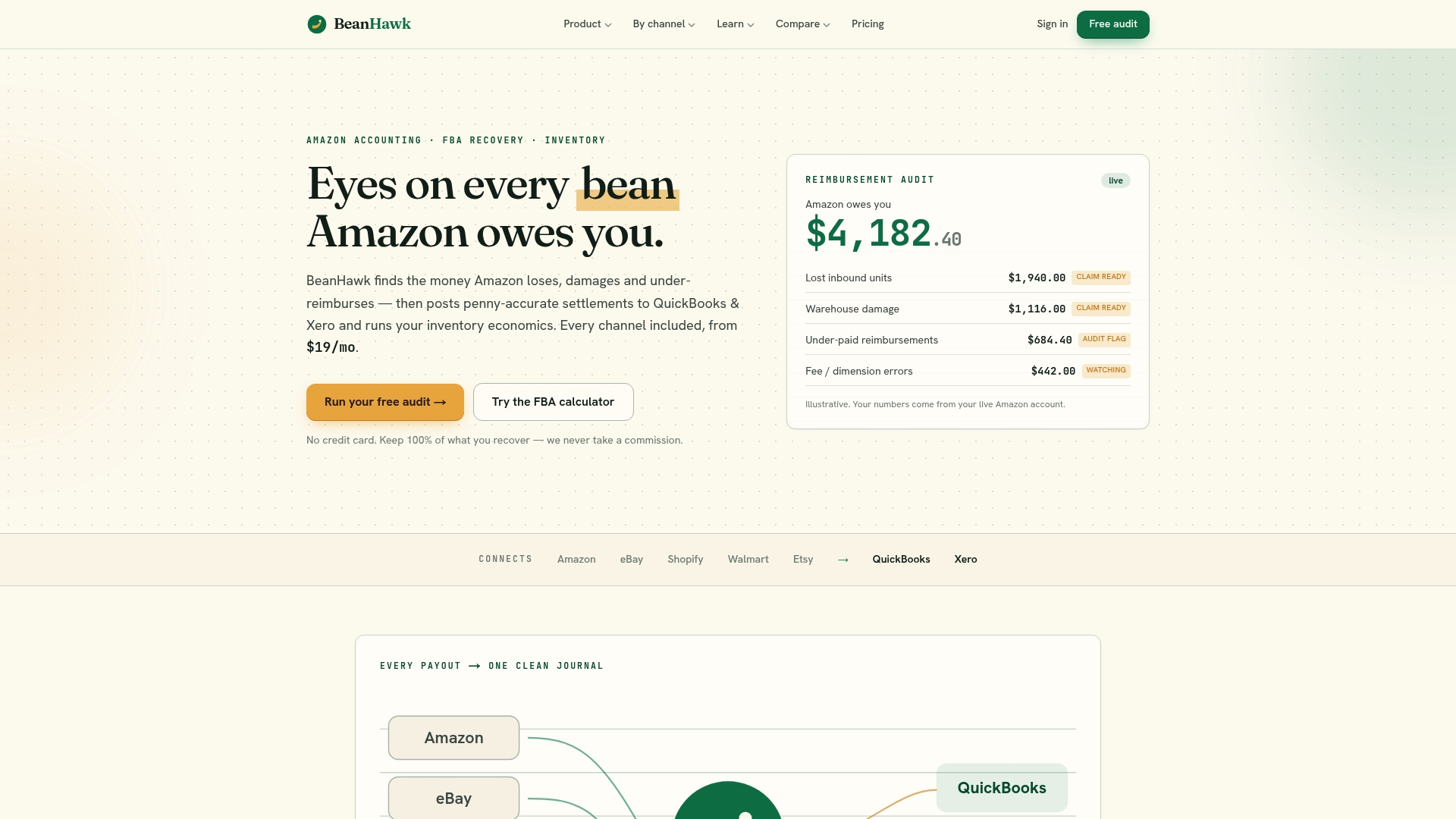
No secondary Seller Central access required, no commission taken off the top, just a subscription and a system that keeps your books as accurate as your recovery. That matters most for sellers who are already reconciling revenue manually and don’t want reimbursement money to become yet another spreadsheet line item. Start with a free audit to see what Amazon may already owe you for lost or damaged inventory, and check whether the numbers justify moving off a contingency provider altogether.
Sources
- Jarvio vs Seller Investigators (Carbon6): Reimbursements Compared | Jarvio
- Best Amazon Refund Recovery Services (2026): Contingency vs DIY Break-Even Math for FBA Reimbursements , BagEngine
- FBA Reimbursement Audit: Find Money Amazon Owes You
FAQ
How much does Seller Investigators charge?
Seller Investigators operates on a contingency model, typically charging around 25% of whatever funds it successfully recovers on your behalf.
What are some free alternatives to Seller Amp?
For reimbursement specifically, you can run a manual audit by cross-referencing your Customer Returns, Inventory Ledger, and Reimbursements reports in Seller Central at no cost, or start with Beanhawk’s free audit to see recoverable discrepancies before committing to a paid plan.
How much does Amazon take from a $100 sale?
Amazon’s referral fees vary by category, typically running 8% to 15% of the sale price, plus FBA fulfillment fees that depend on product size and weight; there’s no single flat rate across all listings.
Can I make $1,000 a month selling on Amazon?
It’s possible depending on your margins, product category, and volume, but it depends heavily on your niche, ad spend, and how tightly you manage costs like storage fees and reimbursement leakage.