
The Best Synder Alternatives for Ecommerce Sellers in 2026

If you sell on Amazon or run a multi-channel storefront, the strongest Synder alternatives break down by what you actually need: BeanHawk for sellers who need automated FBA reimbursement recovery alongside penny-accurate QuickBooks or Xero posting, A2X for accountants who want the most granular settlement decomposition, Webgility for high-volume QuickBooks users running five or more sales channels, MyWorks Sync for Shopify-first merchants, and Bookkeep for sellers who want a managed bookkeeping layer on top of automated posting.
Here’s the one-line case for each:
- BeanHawk , catches missed FBA reimbursements while posting settlements, so you recover cash and close your books in one motion.
- A2X , breaks every Amazon and Shopify settlement into audit-ready journal lines accountants can trust at month-end.
- Webgility , handles order-level posting across the most marketplaces if QuickBooks is your system of record.
- MyWorks Sync , maps Shopify orders and customers into QuickBooks or Xero with fewer mapping headaches than generic connectors.
- Bookkeep , pairs rule-based posting with optional human bookkeepers for sellers who want less hands-on maintenance.
Roughly two-thirds of U.S. small and medium businesses now run dedicated software for accounting and financial operations, which is exactly why picking the right connector, rather than settling for the first one that syncs, has become a real competitive lever. The fastest way to test fit is a short trial: connect one sales channel, run a real settlement through the tool, and see what lands in your ledger. If you’re an Amazon seller specifically, BeanHawk’s free audit will show you whether you’re leaving reimbursement money on the table before you commit to anything.
Key Takeaways
The best Synder alternative depends on whether your priority is reimbursement recovery, settlement granularity, or channel breadth, and BeanHawk leads specifically for Amazon sellers needing recovery plus posting accuracy.
| Point | Details |
|---|---|
| Match tool to seller profile | Single-channel sellers need simple connectors; multi-channel and FBA sellers need settlement parsing. |
| Order-level vs. batch posting | Batch settlement parsing scales better for high-volume sellers than order-by-order posting. |
| Test before you commit | Run a real settlement through a sandbox QuickBooks or Xero company before signing any contract. |
| Reimbursements are recoverable cash | Unclaimed FBA reimbursements distort COGS and margin until they’re recovered and posted correctly. |
| BeanHawk fits Amazon-focused sellers | BeanHawk combines automated reimbursement recovery with QuickBooks/Xero settlement posting, best suited to FBA sellers who want both in one tool. |
Table of Contents
- Top Synder Alternatives Compared Side by Side
- What Each Synder Replacement Option Actually Offers
- How Do You Choose the Right Synder Substitute?
- Why Settlement Parsing and Reimbursement Recovery Change Your Bottom Line
- Get a Free Reimbursement Audit With BeanHawk
- Sources
- FAQ
Top Synder Alternatives Compared Side by Side
Before you pick a tool, it helps to know what “reconciliation method” actually means on this list. Some tools post every marketplace order as its own line item in your ledger (order-level posting), which gives you granular visibility but can clutter your chart of accounts if you sell at volume. Others take a marketplace settlement, a batch of hundreds of orders bundled by Amazon or Shopify into one deposit, and decompose it into summarized journal entries (batch or settlement parsing). Accountants generally prefer the second approach for anything beyond a few dozen orders a day, because it mirrors how the money actually lands in your bank account.
Software adoption among U.S. small businesses is already high, but the tools people adopt vary widely in how they handle this exact distinction, which is where most buyer regret comes from.
| Tool | Best for | Pricing | Accounting platforms | Ecommerce/marketplace coverage | Reconciliation method | FBA-specific features |
|---|---|---|---|---|---|---|
| BeanHawk | Amazon sellers needing reimbursement recovery plus posting | Tiered by order volume, free audit | QuickBooks, Xero | Amazon, Shopify, multi-channel | Settlement parsing with journal posting | Continuous inbound shipment and ledger monitoring, reimbursement claims |
| A2X | Accountants wanting granular settlement detail | Tiered by order volume, free trial | QuickBooks, Xero | Amazon, Shopify | Settlement parsing, line-level | Detailed fee and reimbursement breakdown |
| Webgility | High-volume multi-channel QuickBooks sellers | Tiered plans, demo available | QuickBooks | Amazon, eBay, Shopify, Walmart, Magento | Order-level posting | Basic FBA fee mapping |
| MyWorks Sync | Shopify-first merchants | Tiered by order volume, free trial | QuickBooks, Xero | Shopify primarily | Order-level, real-time sync | Limited, Shopify-focused |
| Bookkeep | Sellers wanting managed bookkeeping | Tiered plans, demo available | QuickBooks, Xero | Amazon, Shopify, multi-channel | Rule-based batch posting | Settlement summarization |
| QuickBooks Connector / Connex | Small sellers wanting direct QuickBooks posting | Tiered by order volume | QuickBooks | Shopify, Amazon, WooCommerce | Order-level posting | Minimal |
| SyncTools | Cost-conscious marketplace sellers | Lower-cost tiered plans | QuickBooks | Amazon, eBay, Walmart | Batch sync | Basic |
| LedgerPort | Accountants needing audit-grade traceability | Tiered plans | QuickBooks, Xero | Amazon, Shopify | Line-level journal posting | Fee-level detail, limited reimbursement tracking |
| QuickBooks Connector | Simple direct-to-ledger posting | Tiered by order volume | QuickBooks | Shopify, Amazon | Order-level posting | Minimal |
Notice how few of these tools actually touch FBA reimbursement recovery as a core function rather than a side feature. That gap matters more than most comparison charts let on, since a missed reimbursement is cash you’ve already earned and simply haven’t collected.
What Each Synder Replacement Option Actually Offers
Not every seller needs the same thing from a connector, so treat these as profiles to match against your own setup rather than a ranked list.
BeanHawk was built specifically around the problem Amazon sellers hit most often: reimbursements that never get claimed. It continuously monitors inbound shipments and FBA ledger events, flags discrepancies, and files claims automatically, then posts the reconciled settlements straight into QuickBooks or Xero with proper journal entries. It also tracks purchase orders and landed cost, which matters if your COGS tracking has been a spreadsheet exercise until now.
- Best for: Amazon-heavy sellers who want reimbursement recovery and accounting automation from the same tool
- Standout feature: Continuous shipment and ledger monitoring that surfaces reimbursements other tools simply don’t look for
- Platforms: QuickBooks, Xero, Amazon, Shopify, multi-channel
- Pricing: Tiered by order volume, with a free limited audit to start
- Trial: Free audit, no long-term commitment required upfront
A2X is the accountant’s favorite for a reason. It takes every Amazon or Shopify settlement and decomposes it into a detailed, line-level journal entry that maps cleanly to your chart of accounts. If your bookkeeper insists on seeing exactly where every dollar of a settlement went, this is the tool built for that conversation.
- Best for: Sellers whose accountants demand granular settlement audit trails
- Standout feature: Fee-by-fee breakdown built for reconciliation, not just syncing
- Platforms: QuickBooks, Xero, Amazon, Shopify
- Pricing: Tiered by monthly order volume, free trial available
- Trial: Yes, typically 30 days
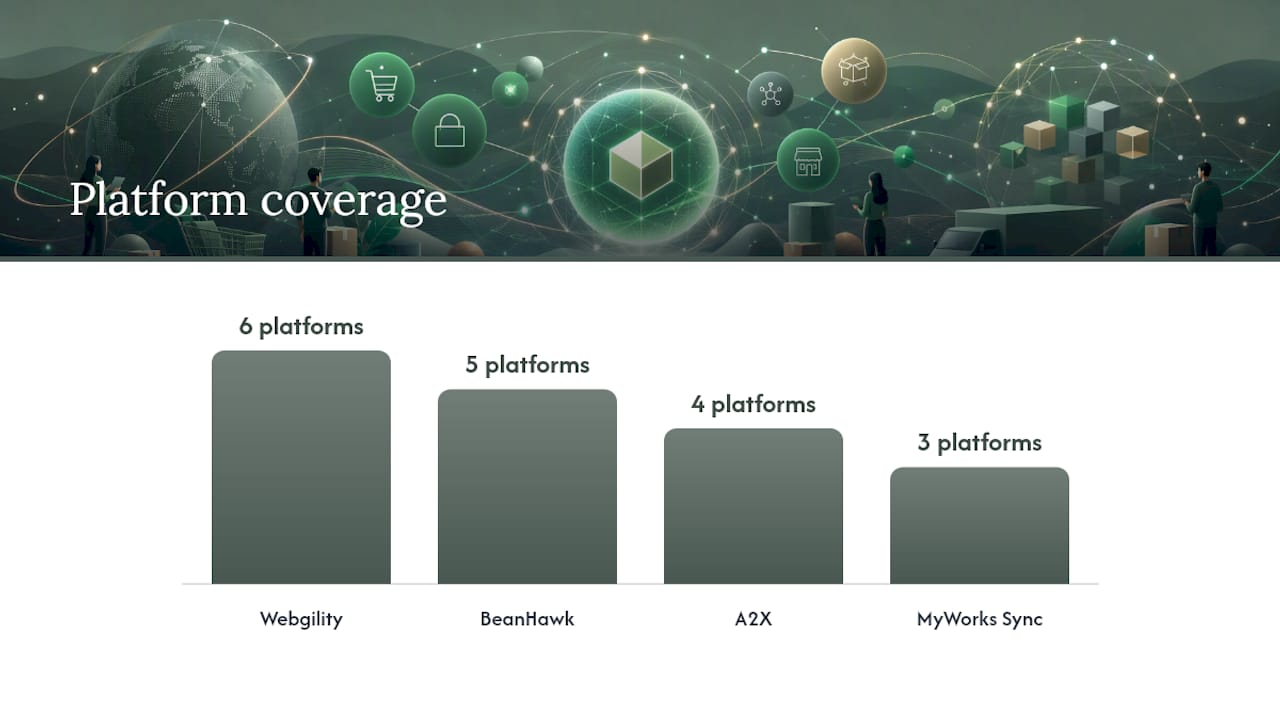
Webgility covers more marketplaces than almost anyone else on this list and posts at the order level, which some QuickBooks users prefer for visibility even if it means a busier ledger. It has one of the largest review bases among ecommerce connectors, with users repeatedly citing its multi-channel breadth as the reason they stuck with it.
- Best for: Sellers running five or more channels who live inside QuickBooks
- Standout feature: Broad marketplace coverage with deep QuickBooks-native workflows
- Platforms: QuickBooks, Amazon, eBay, Shopify, Walmart, Magento
- Pricing: Tiered subscription, demo available
- Trial: Demo-based onboarding rather than a self-serve free trial
MyWorks Sync focuses almost entirely on Shopify, and that focus shows in how cleanly it maps custom fields, tags, and customer data into QuickBooks or Xero. If you run a Shopify store with a few sales channels bolted on, the native field mapping saves real setup time compared to a generic multi-platform tool trying to do everything.
- Best for: Shopify merchants who want native field mapping without a generic connector’s compromises
- Standout feature: Shopify-specific sync reliability and customer data mapping
- Platforms: QuickBooks, Xero, Shopify
- Pricing: Tiered by order volume, free trial offered
- Trial: Yes
Bookkeep takes a different approach: instead of just syncing data, it applies configurable posting rules and offers managed bookkeeping as an add-on. That combination appeals to accounting firms managing multiple ecommerce clients who want consistent rule application without manually reviewing every batch.
- Best for: Firms or sellers who want rule-driven automation with a human bookkeeping option
- Standout feature: Rule-based posting engine plus optional managed services
- Platforms: QuickBooks, Xero, Amazon, Shopify
- Pricing: Tiered plans, demo available
- Trial: Demo required before signup in most cases
QuickBooks Connector / Connex and the standalone QuickBooks Connector both take the simplest path: mapping ecommerce orders directly into QuickBooks as invoices or sales receipts, with no separate reconciliation layer. That simplicity is the appeal for a seller doing a few hundred orders a month who doesn’t need settlement-level detail yet, though it means less protection against posting errors as volume grows.
SyncTools positions itself explicitly as a lower-cost Synder alternative, trimming the feature set down to core marketplace-to-ledger syncing at a lighter price point. It suits sellers on a tight software budget who need basic reconciliation and can live without deep FBA-specific tooling.
LedgerPort leans into auditability, producing line-level journal exports built for accountants who need to defend every posted entry. It’s a reasonable pick for sellers under active audit scrutiny or firms managing compliance-heavy clients, though its reimbursement tracking is thinner than tools built specifically around Amazon’s FBA mechanics.
Pro Tip: Before signing any contract, connect a sandbox QuickBooks or Xero company and run one real settlement through the tool end to end. Watch exactly how it categorizes fees, refunds, and shipping, because that behavior is nearly impossible to change after 5,000 transactions are already posted.
Onboarding friction varies more than the marketing pages suggest. Tools with native settlement parsing, like BeanHawk, A2X, and LedgerPort, generally take a few days longer to configure because they’re mapping fee categories to your specific chart of accounts. Simpler order-level connectors like QuickBooks Connector can be reconciling within hours, but you’ll pay for that speed later if your order volume grows and batch parsing becomes necessary.
How Do You Choose the Right Synder Substitute?
Ranking criteria matters more than feature checklists here. In order of importance for most Amazon-heavy sellers:
- Reconciliation accuracy , does the tool correctly decompose settlements, or does it approximate?
- Posting granularity , order-level or batch, and does that match how your accountant wants to see the ledger?
- Amazon FBA settlement parsing , can it break down FBA fees, reimbursements, and reserves specifically?
- Inventory and COGS automation , does it connect landed cost to what’s actually sold?
- Accounting platform compatibility , QuickBooks Online, Xero, or both?
- Pricing model , flat tier, per-order, or per-channel?
- Managed-service support , is there a human to call when something breaks?
When you get on a vendor demo, ask for these specifically:
- A sample journal entry from a real settlement, not a mocked-up demo account
- Their process for handling refunds, chargebacks, and returned inventory
- Whether FBA reimbursements post as separate line items or get buried in a lump sum
- What happens when a settlement fails to parse (manual review queue? silent skip?)
Watch for these red flags during evaluation:
- Pricing that’s only available “on request” with no published tiers
- No sandbox environment or sample export you can inspect before paying
- No mention of FBA fee decomposition if you sell primarily through Amazon
- Support that’s ticket-only with no live demo or onboarding call
A practical action plan: run a 7 to 14 day trial with your busiest sales channel connected, or start with BeanHawk’s free audit to see what reimbursement dollars you might already be missing before you evaluate anything else.
Why Settlement Parsing and Reimbursement Recovery Change Your Bottom Line
Settlement decomposition isn’t a nice-to-have line item on a feature comparison. It determines whether your channel-level P&L is real or fictional. When a connector lumps an entire Amazon settlement into one deposit without breaking out fees, refunds, and reimbursements, your gross margin by channel becomes a guess dressed up as a number.
Consider a seller doing $80,000 a month through FBA. A single misposted reimbursement or an unclaimed lost-inventory event can distort COGS by a meaningful percentage for that month, which then throws off reorder calculations and pricing decisions for the following quarter. Multiply that across twelve months and the error compounds into decisions made on bad data.
Penny-perfect reconciliation isn’t about tidiness. It’s about knowing which SKUs are actually profitable before you reorder them, and about recovering cash Amazon already owes you but won’t proactively pay out.
The practical benefits of getting this right:
- Faster month-end close because journals arrive pre-reconciled instead of needing manual adjustment
- Cleaner channel-level P&Ls that reflect real fee and reimbursement activity
- Fewer year-end audit adjustments because the trail is already line-level
- Reimbursement dollars added back to cash flow instead of silently written off
This is the exact gap BeanHawk’s continuous ledger monitoring targets: catching the reimbursement and fee-posting errors before they distort a full quarter of reporting, rather than discovering them during a year-end cleanup.
A Straight Answer on Which Tool to Pick
If you run FBA and haven’t checked for missed reimbursements in the last few months, try BeanHawk first. It’s the only tool on this list built specifically around recovering money Amazon already owes you while it handles the posting. For early-stage, single-channel sellers doing simple order volume, a lighter connector like MyWorks Sync or QuickBooks Connector will get you reconciled without overpaying for features you won’t use yet. Mid-market multi-channel sellers juggling five or more marketplaces should lean toward Webgility or A2X, depending on whether QuickBooks workflow depth or settlement granularity matters more to your accountant. And if you’d rather hand bookkeeping off entirely, Bookkeep’s managed option is worth a demo.
Whichever you pick, the deciding test is the same: connect a real channel, run a real settlement, and look at what actually lands in your ledger. Everything else is marketing copy until you’ve seen that.
Get a Free Reimbursement Audit With BeanHawk
If you’re an Amazon seller weighing these options, the sharpest advantage BeanHawk offers over a standard connector is simple: it doesn’t just sync your data, it actively finds money Amazon owes you and recovers it while posting clean journals to your ledger.
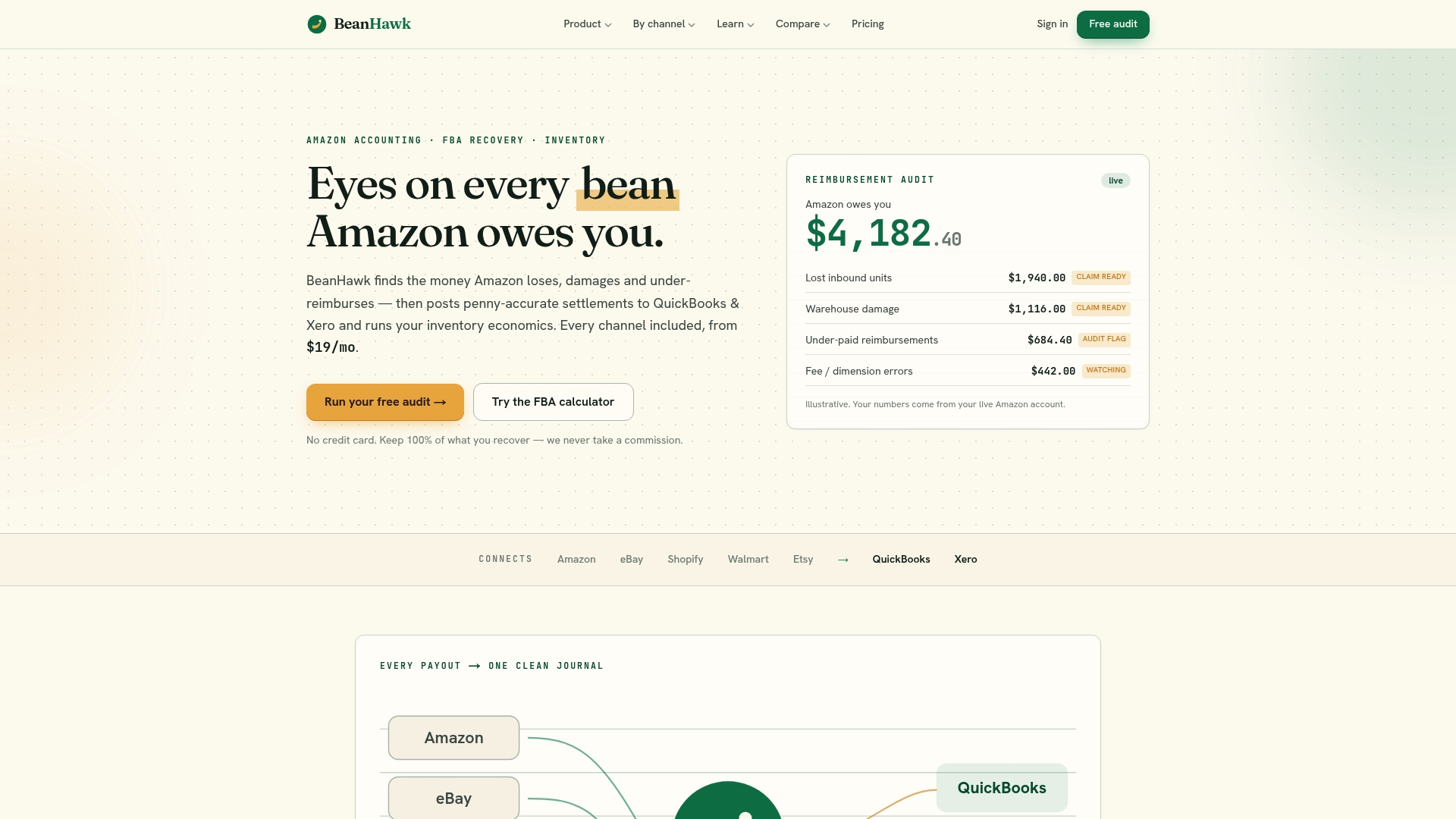
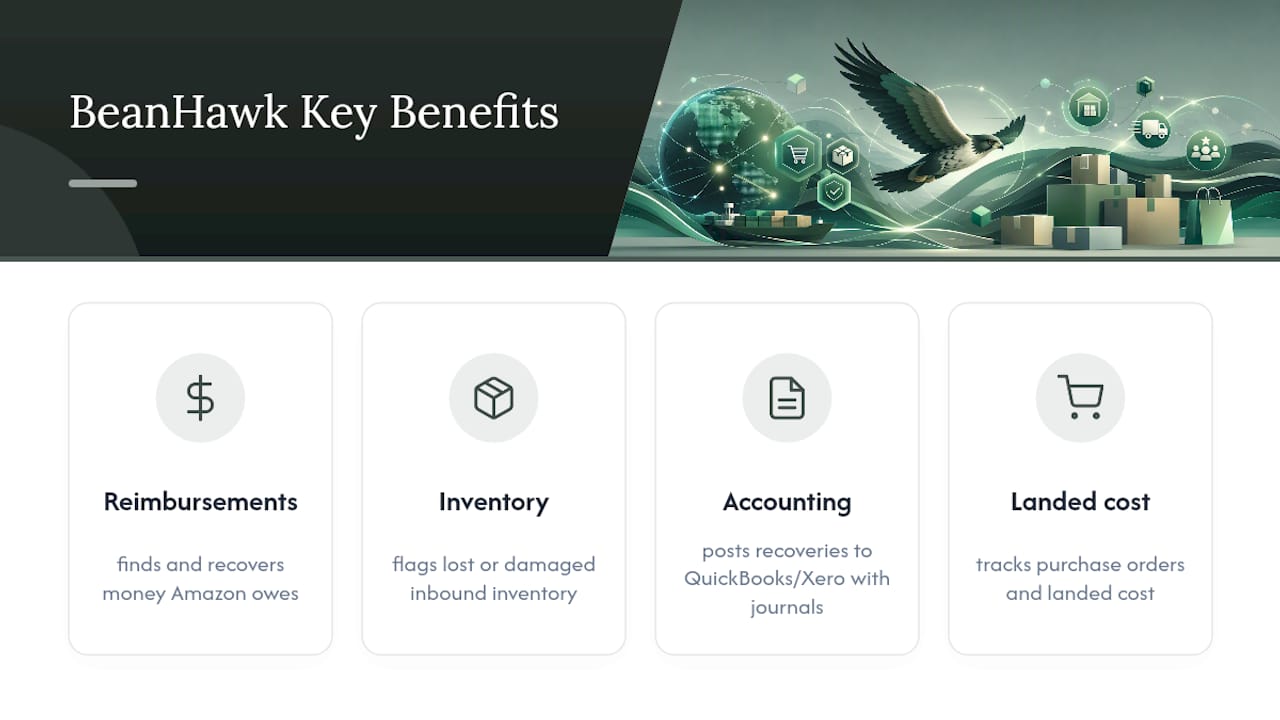
BeanHawk continuously monitors your inbound shipments and FBA ledger events, flags lost or damaged inventory, and files reimbursement claims automatically. Every recovered settlement posts directly to QuickBooks or Xero with proper journal entries, so your channel P&L and inventory COGS stay accurate without a manual review every month. It also tracks purchase orders and landed cost, giving you a fuller picture than a basic settlement parser.
The free audit checks three things: whether you have unclaimed reimbursements sitting in your FBA ledger, whether your inbound shipments match what Amazon actually received, and whether your current settlement posting is accurate. There’s no cost and no commitment to run it.
Pro Tip: Bring one full month of Amazon settlement data and a sample QuickBooks or Xero company to your demo. Seeing your actual numbers flow through the tool tells you more in ten minutes than any feature list can.
Request your free BeanHawk audit and see what reimbursement money you might be leaving on the table right now.
Sources
- Statista
- G2
Review sites are useful for spotting patterns across many users, but only a direct trial tells you whether a tool fits your specific chart of accounts and order volume.
FAQ
What is the best replacement for QuickBooks?
QuickBooks itself isn’t typically replaced. Sellers usually add a connector like BeanHawk, A2X, or Webgility on top of QuickBooks to automate order and settlement posting, rather than switching accounting platforms entirely.
What companies are similar to Wolters Kluwer?
Wolters Kluwer serves broader tax and compliance software needs, which is a different category from ecommerce reconciliation tools like Synder, BeanHawk, A2X, or Webgility that focus specifically on marketplace settlement posting.
What is the Synder app?
Synder is an accounting automation tool that syncs ecommerce and payment data into QuickBooks or Xero, aiming to automate transaction categorization and reconciliation for online sellers.
Does QuickBooks have any competitors?
QuickBooks competes primarily with Xero as a core accounting platform, but for ecommerce-specific posting and reconciliation, sellers typically layer on a connector like BeanHawk, A2X, or MyWorks Sync rather than replacing QuickBooks outright.
How long does it take to switch from Synder to a Synder competitor?
Setup time varies by tool complexity. Simple order-level connectors can reconcile within hours, while settlement-parsing tools like BeanHawk or A2X typically take a few days to map fee categories correctly to your chart of accounts.