
Real Time Sync, Landed Cost & Settlement: Best Ecommerce PO Software

The best ecommerce PO software connects purchase orders directly to inventory sync, landed cost, and settlement reconciliation, not just order creation. For multi-channel sellers running QuickBooks or Xero, an integrated approach like BeanHawk’s beats standalone PO tools because it closes the loop between what you ordered, what arrived, and what actually hit your books. Enterprise ERP buyers with complex procurement chains are the exception. Everyone else should start with the evaluation checklist below.
TL;DR:
- Realtime inventory and landing cost integration are essential, especially for accurate stock levels and margin calculations, and should update within minutes or hours.
- Support for partial receipts, ASN handling, and seamless synchronization with accounting platforms like QuickBooks or Xero is critical to prevent reconciliation errors.
- Vendors that support cXML, PunchOut, and multi-warehouse routing improve automation for enterprise suppliers and multi-location operations.
- A scoring matrix focusing on integration depth and receiving accuracy ensures you select a system that truly streamlines order and inventory workflows.
- Continuous monitoring of inbound shipments and marketplace settlements, paired with automated posting, reduces revenue leakage and inventory discrepancies.
Table of Contents
- What Ecommerce PO Software Actually Does: The Full Order Lifecycle
- Key Features Ecommerce Teams Need From PO Software
- Which Integrations Actually Matter for Ecommerce PO Workflows?
- How Do You Choose the Right Ecommerce PO Software?
- Implementation Checklist and Realistic Timelines
- Publisher Perspective: Why BeanHawk Favors Integrated PO and Settlement Reconciliation
- What Do User Reviews Say About PO Software Reliability?
- Scalability and Customization for Different Business Sizes
- Security and Compliance Considerations for PO Systems
- Why Integration Depth Beats Feature Count Every Time
- Get Your Reconciliation and PO Data Working Together
- Sources
- FAQ
What Ecommerce PO Software Actually Does: The Full Order Lifecycle
Purchase order software for online sellers manages one pipeline: create, approve, send, receive, reconcile. That sounds simple until you watch it break in a real warehouse. A PO gets created based on a reorder trigger, someone approves it, it goes to the supplier, product shows up (usually not all at once), and then someone has to match what arrived against what was ordered and paid for. Ordoro’s guide to ecommerce PO management describes this as a system that ties reorder thresholds directly to live inventory, which is the piece most spreadsheet-based sellers get wrong.
Here’s why realtime sync matters more in ecommerce than in traditional retail: your inventory numbers feed live listings across Shopify, Amazon, and wherever else you sell. A stale stock count doesn’t just create an internal headache. It creates an oversell on a marketplace, which triggers a cancellation, which hurts your account metrics. PO software that pushes receiving data back into your order management system (OMS) promptly prevents that chain reaction.
Landed cost is the other piece that changes the math. The price on your supplier invoice isn’t your real cost. Freight, duties, and handling fees all need to get allocated per unit before that inventory hits your books as an asset. Get this wrong and your cost of goods sold (COGS) is wrong, which means your margin reporting is wrong, which means you’re making reorder and pricing decisions on bad data.

So when do you need a full ERP instead of a PO-focused tool? Generally once you’re managing multiple legal entities, complex multi-tier bill-of-materials manufacturing, or procurement across dozens of internal departments. OmniOrders points out that for most ecommerce brands, an OMS with native PO management fits better than a full ERP because the integration with fulfillment and inventory is what actually drives daily operations.
A useful way to think about the lifecycle:
- Create: a reorder point trips (manually or automatically) and a draft PO gets generated.
- Approve: the PO routes through whatever spend rules your team has set.
- Send: the order goes to the supplier, by email, PDF, EDI, or a catalog integration.
- Receive: product arrives, often in partial shipments, and gets logged against the original PO.
- Reconcile: received quantities and landed costs get matched against the supplier invoice and posted to accounting.
Miss a step, especially reconciliation, and you’re left with inventory on the shelf that doesn’t match inventory in your books. That’s the gap BeanHawk’s PO glossary entry exists to explain to sellers who’ve never had to think about this formally.
Key Features Ecommerce Teams Need From PO Software
Not every feature on a vendor’s pitch deck matters equally. Some are dealbreakers. Some are nice-to-haves you’ll never touch. Here’s how to prioritize, roughly in order of how much they affect daily operations.
- Inventory and OMS sync. This is the feature that decides whether the rest of the system works. Ask whether the vendor pushes stock updates in real time or on a batch schedule, and how often that batch runs. A four-hour sync delay might be fine for a slow-moving SKU and disastrous for a bestseller.
- Receiving workflows. Partial deliveries are the norm, not the exception, especially with overseas suppliers shipping in multiple containers. Look for scan-to-receive functionality and proper handling of advance shipment notices (ASNs) so warehouse staff aren’t reconciling by hand.
- Landed cost allocation per unit. Freight, duties, and fees need to spread across units automatically, not get dumped into a general expense account. This is the feature most PO tools handle poorly or not at all.
- Approval workflows with conditional routing. Small reorders under a spend cap should auto-approve. Larger or unusual orders should route to a manager. If every PO needs a human sign-off regardless of size, the automation isn’t actually saving anyone time.
- Supplier connectivity options. Some suppliers still want a PDF over email. Others expect EDI. Larger enterprise trading partners increasingly expect cXML or PunchOut catalog integration, which lets buyers shop supplier inventory directly inside their own procurement system.
- Accounting sync depth. This is the feature that gets glossed over in demos and causes the most pain later. You need the PO, the receipt, and the supplier invoice to match up in QuickBooks or Xero without someone manually re-keying line items.
Pro Tip: *Ask any vendor to walk you through a partial receipt scenario live, not in a slide deck.
Ordoro’s research on supplier management makes a point worth repeating: for ecommerce specifically, how deeply a tool integrates with your existing OMS and inventory stack matters more than how many features it lists. A tool with fewer bells and whistles that syncs cleanly with what you already run will outperform a feature-rich platform that requires you to rebuild your stack around it.
Which Integrations Actually Matter for Ecommerce PO Workflows?
Vendors love to list integration logos on their homepage. Most of them don’t matter to you. Here’s what to actually push on during a sales call.
Shopify or OMS integration. The behavior you want is bidirectional: low-stock alerts and supply-plan recommendations should convert into draft POs, and received quantities should push back into Shopify automatically once product hits your warehouse. Synplex’s Shopify PO app describes exactly this loop, including scan-to-receive and landed-cost tracking built into the same flow. If a vendor’s Shopify integration is one-directional (data goes in but updates don’t come back), you’re still doing manual reconciliation.
QuickBooks and Xero integration. The fields that matter here are PO number, received quantity, unit landed cost, and supplier invoice number. If those four don’t match cleanly across systems, your accountant is spending hours every month untangling discrepancies instead of closing the books on time.
cXML and PunchOut for enterprise suppliers. If you’re buying from larger manufacturers or distributors that operate enterprise procurement systems, they may require PunchOut catalog access rather than accepting a plain PDF purchase order. TradeCentric’s overview of B2B connected commerce notes that managing procurement without these protocols creates errors and blocks automation of acknowledgments and invoices. If your supplier base skews toward larger vendors, ask specifically whether the software supports this.
3PL and multi-warehouse routing. If you fulfill from more than one location, or use a third-party logistics provider, the PO software needs to know which warehouse a shipment is headed to and update the right inventory bucket on arrival.
Marketplace settlement intersections. If you sell on Amazon or another marketplace, your PO and receiving data lives in a different world than your marketplace settlements. Reconciling FBA reimbursements, fees, and payouts against what you actually purchased and received is a separate but related problem, one that a tool like BeanHawk handles on the settlement side while your PO software handles the purchasing side.
A quick checklist for the integration conversation:
- Does inventory update within minutes of a receiving scan, or on a nightly batch?
- Which four to six fields sync to your accounting platform, and can you see a sample mapping?
- Does the vendor support cXML/PunchOut, EDI, or only email and PDF?
- How does the system handle a shipment split across two warehouses?
How Do You Choose the Right Ecommerce PO Software?
Start with a scoring matrix instead of a feature checklist. Vendors are good at making every feature sound essential. A weighted score forces you to rank what actually affects your operation.
- Integration depth (weight: 30%). How well does it connect to your OMS, Shopify or equivalent storefront, and accounting platform? This is the single heaviest factor because a poorly integrated tool creates more manual work than it removes.
- Receiving accuracy (weight: 20%). Does it handle partial shipments, ASNs, and scan-to-receive without manual workarounds?
- Landed cost support (weight: 20%). Can it allocate freight and duties per unit automatically, or does someone need to calculate that in a spreadsheet afterward?
- Audit trail and approval controls (weight: 15%). Can you see who approved what, when, and under what spend rule? This matters for accountability and for your accountant during tax season.
- Cost and contract terms (weight: 10%). What’s the pricing model, and what happens if you outgrow the plan or want to leave?
- Support responsiveness (weight: 5%). How fast do they respond when a sync breaks at 4 PM on a Friday?
Score each vendor on a 1 to 5 scale per category, multiply by the weight, and add it up. A vendor scoring a perfect 5 on flashy features but a 2 on integration depth will still lose to a plainer tool that scores 4s across the board.
During vendor calls, ask these questions directly, and don’t accept vague answers:
- How does a partial receipt update inventory, and does it trigger a replenishment plan recalculation? Synplex’s own guidance flags this as one of the most revealing questions you can ask a vendor, since many platforms handle full receipts cleanly but fumble partial ones.
- What data formats do you support for suppliers: PDF, EDI, cXML?
- How does landed cost get allocated, at the PO level or per unit?
- What happens to my data if I cancel? Can I export everything, including historical PO and receiving records?
- What’s your support SLA, and is it different for critical sync failures versus general questions?
Pro Tip: Watch for vendors who dodge the data export question. If a company won’t clearly explain how you get your historical PO and receiving data out on the way out, that’s a sign they’re counting on switching costs to keep you, not on the product being good enough to earn your loyalty.
If you’re running under $2 million in annual revenue, prioritize integration simplicity and low setup cost over advanced approval routing you probably don’t need yet. Once you cross into multi-warehouse, multi-brand territory, approval workflows and audit trails climb up the priority list fast.
Implementation Checklist and Realistic Timelines
Budget more time than the sales demo suggests. A clean demo with pre-loaded sample data always looks faster than migrating your actual SKU list and supplier relationships.
Start with discovery: map every SKU to a supplier, document which suppliers use PDF versus EDI versus a catalog format, and write down your current receiving rules, including how partial shipments get handled today. OmniOrders recommends mapping master data like supplier names, agreed costs, and lead times before touching automation rules, since automation built on messy data just automates the mess.
Next comes integration testing: connect inventory sync, run a test accounting mapping, and walk through a mock receiving workflow before going live.
Then run a pilot. Pick one supplier and one warehouse and push a real PO through the entire cycle: creation, approval, receiving, and settlement posting to your books. This surfaces problems with landed cost allocation and accounting field mapping while the stakes are still low.
- SMB sellers with a single warehouse and a handful of suppliers: expect two to four weeks from kickoff to live pilot.
- Mid-market sellers with multiple warehouses or ERPs already in place: expect six to ten weeks, and involve someone from finance early.
- Chart-of-accounts alignment often gets skipped and causes the most rework later, so loop in whoever manages your books before the pilot, not after.
Publisher Perspective: Why BeanHawk Favors Integrated PO and Settlement Reconciliation
Most PO tools stop at receiving. They tell you the box arrived and the count matches. What they don’t tell you is whether the money matches, whether your marketplace settlement actually paid out what it should have, or whether a damaged inbound shipment quietly vanished from your reimbursement queue.
Some tools approach this from the reconciliation side outward. Continuous monitoring of inbound shipments and FBA ledger events catches discrepancies between what left the supplier, what Amazon logged as received, and what actually got reimbursed. When a settlement posts, it can map automatically into QuickBooks or Xero, so the PO, the receipt, and the accounting entry stay in sync without someone manually cross-referencing three systems at month end.
That matters most for centralized reconciliation and inventory economics. Multi-channel sellers already juggle enough platforms. Feeding PO and landed cost data into the same financial picture as settlement recovery, rather than treating them as two disconnected workflows, is what closes the revenue leakage most sellers never notice until an accountant flags it. Readers who want a deeper look at how settlement mapping works can review BeanHawk’s guide to reconciling QuickBooks Online.
What Do User Reviews Say About PO Software Reliability?
Reviews of PO and procurement tools tend to cluster around two themes: how well the integration held up after the first month, and how responsive support was when something broke. Sellers who praise a tool almost always cite the same thing, that inventory sync kept working without babysitting after the initial setup. Complaints skew toward the opposite: sync delays that caused an oversell, or a landed cost calculation that quietly drifted from the actual supplier invoice.
A pattern worth noting: tools built specifically for ecommerce workflows tend to score better on ease of receiving and inventory accuracy, while tools originally built for general B2B procurement score better on approval controls and audit trails but often feel clunkier for a warehouse team doing daily receiving. Neither is universally “better.” The fit depends on whether your bigger pain point is operational (getting product counted and synced fast) or financial (tracking who approved what and why).
Support responsiveness comes up constantly in feedback, more than any single feature. A tool that syncs perfectly 95% of the time but takes three days to respond when the other 5% breaks generates far more frustration than a slightly less polished tool with a support team that answers within hours. When you’re evaluating vendors, ask for references from sellers at a similar order volume to yours, not just the flagship enterprise customer on their homepage. Reliability at 500 orders a month looks very different from reliability at 50,000.
Scalability and Customization for Different Business Sizes
A tool that works beautifully for a single-warehouse seller moving 200 orders a month can fall apart at 5,000 orders across three warehouses. The gap usually shows up first in approval routing and second in reporting granularity.
Smaller sellers generally want simplicity: a straightforward reorder trigger, a basic one-step approval, and clean receiving. Piling on conditional approval chains and role-based permissions at this stage adds friction without adding value, since there’s often only one or two people making purchasing decisions anyway.
Mid-market and multi-brand operations need the opposite. Conditional routing by spend threshold, department, or brand becomes necessary once more than a couple of people can create or approve a PO. Reporting needs to break down by warehouse, supplier, and SKU category rather than showing one flat number. Multi-entity support matters if you’re running separate storefronts or subsidiaries under one operational umbrella.
Customization to watch for during evaluation includes configurable approval thresholds, custom fields for supplier-specific terms, and the ability to add new warehouses or sales channels without a lengthy reimplementation. A tool that requires a developer engagement every time you add a new supplier connection type won’t scale well. One built on a rules engine, where thresholds and routing logic are adjustable through settings rather than custom code, tends to grow with the business more comfortably. Ask vendors directly what changes as your order volume grows tenfold. The answer tells you a lot about whether the pricing and architecture were designed with growth in mind or bolted on afterward.
Security and Compliance Considerations for PO Systems
PO software touches sensitive data: supplier pricing agreements, bank and payment details in some setups, and financial records that flow directly into your accounting platform. That makes security posture a real evaluation criterion, not an afterthought.
At minimum, ask whether the vendor supports role-based access controls so warehouse staff can log receiving without seeing supplier cost negotiations, and whether every action, PO creation, approval, edit, cancellation, carries a timestamped audit trail. That audit trail matters beyond internal accountability. If you’re ever audited by a tax authority or need to defend your COGS calculations, a clean, exportable history of every PO and receipt is what makes that process fast instead of painful.
Data encryption in transit and at rest should be standard, and any vendor connecting to your QuickBooks or Xero account via OAuth rather than requesting your raw login credentials is following the safer, more current practice. Ask how long the vendor retains historical PO data and whether you can export it fully if you switch systems later.
Compliance requirements vary by what you sell and where, but the baseline every ecommerce seller should confirm is straightforward: SOC 2 or equivalent security certification for the vendor, clear data ownership terms in the contract, and a documented process for what happens to your data if the vendor is acquired or shuts down. These aren’t exciting questions to ask on a sales call, but skipping them is how sellers end up locked into a system with no clean way out.
Why Integration Depth Beats Feature Count Every Time
The conventional advice on choosing procurement software leans hard on feature comparison charts, count the checkboxes, pick the tool with the most. That advice is backwards for ecommerce. A tool with fewer features that syncs cleanly with your OMS and accounting platform will save you more time than a feature-rich platform that requires manual reconciliation because the integration is shallow.
What gets underestimated most is landed cost accuracy. Sellers obsess over approval workflows and dashboards, then discover eighteen months later that their COGS has been quietly wrong because freight allocation was never handled at the unit level. That’s a margin problem hiding as a software feature.
My honest read: prioritize realtime inventory sync and landed cost first, approval sophistication second, and dashboards last. If you’re already juggling marketplace settlements alongside your PO workflow, look for reconciliation that connects both sides of the ledger rather than treating purchasing and settlement recovery as separate problems. That’s the gap most PO-only tools leave open, and it’s the one worth solving before you add more automation on top of a shaky foundation.
, Tim
Get Your Reconciliation and PO Data Working Together
If you’ve read this far, you already know the real problem isn’t finding a tool that creates purchase orders. It’s finding one where your PO data, your receiving records, and your actual accounting entries all agree with each other. BeanHawk was built for multi-channel and Amazon sellers who need exactly that: continuous monitoring of inbound shipments and settlement events, paired with automated posting to QuickBooks or Xero, so nothing slips through the cracks between what you ordered and what your books say happened.
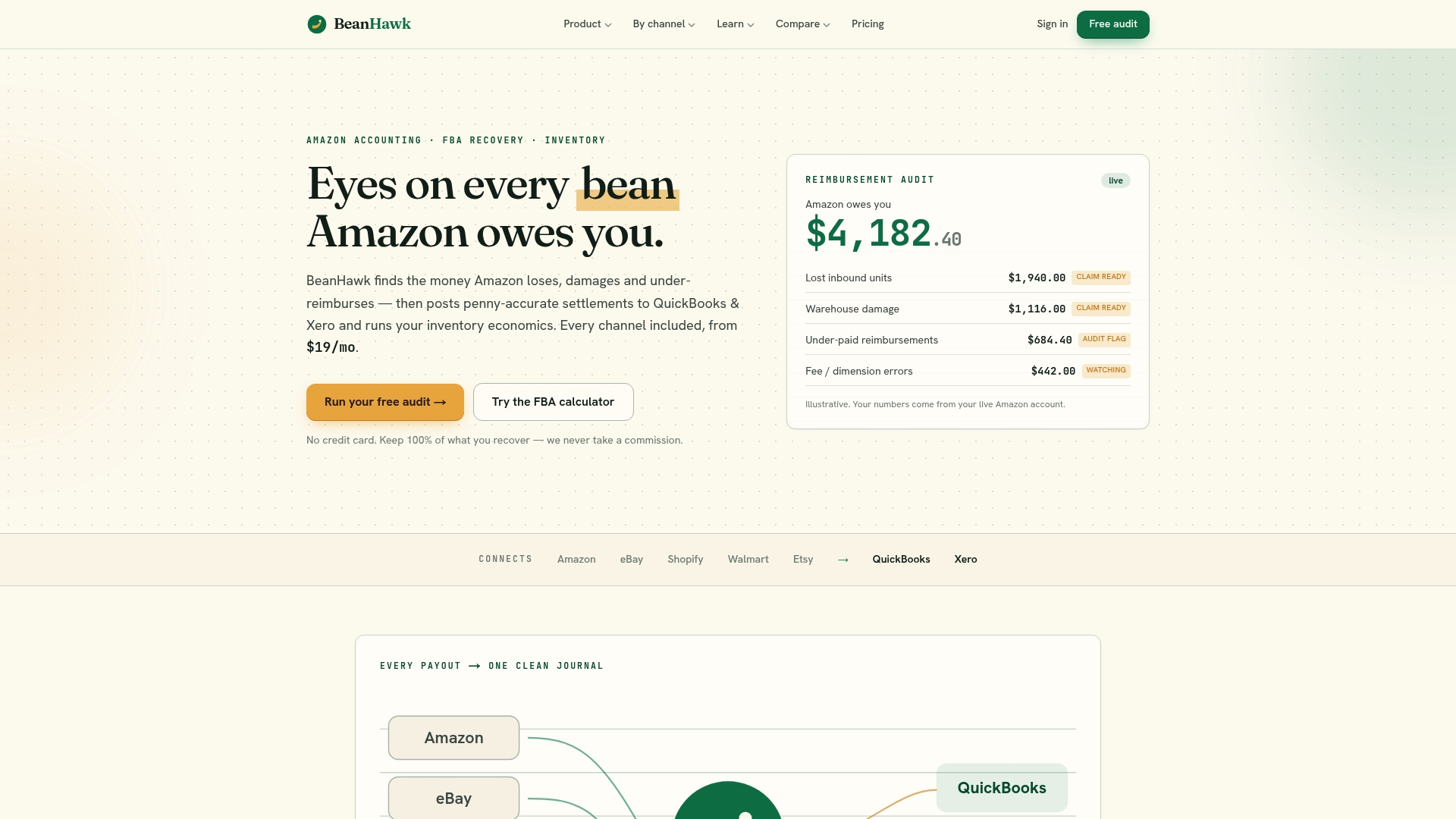
This fits best for sellers running FBA or a mix of marketplace and direct channels who want to reduce manual cross-checking of settlement reports against inventory receipts. A free audit can be a good place to start to identify where reimbursement gaps or reconciliation mismatches exist in your current setup before committing. From there, a demo can show how PO-linked landed cost and settlement posting could map onto your accounting structure. If marketplace settlements are part of your reconciliation headache, BeanHawk’s guide to how FBA works is a good next read before you book time to talk.
Sources
For readers who want to dig into the technical side of supplier catalog integrations, TradeCentric’s overview of cXML and PunchOut explains how enterprise buyers connect to supplier catalogs directly. Ordoro’s complete guide to ecommerce purchase orders covers the practical mechanics of receiving and reorder automation in more depth than fits here. OmniOrders’ breakdown of automating POs without an ERP is worth reading if you’re deciding between a lightweight PO tool and a full enterprise system. For sellers using Shopify specifically, Synplex’s PO feature documentation shows what a tight receiving-to-inventory loop looks like in practice. Teams exploring broader automation in their accounting stack may also find Byram Advisory’s perspective on building versus buying automation useful context.
- Purchase Orders for eCommerce: Complete Guide | Ordoro
- What is cXML? | TradeCentric
- Purchase Order Management: How to Automate POs Without an ERP | OmniOrders Blog
- Shopify Purchase Order Management App | Synplex
FAQ
What Software Is Best for PO Tracking?
The best PO tracking software links purchase orders directly to live inventory counts, so tracking updates automatically as receiving happens rather than requiring manual status changes. For ecommerce sellers, look for a tool that also ties tracking into accounting reconciliation, which is where BeanHawk’s approach differs from standalone tracking tools.
What Is the Best Order Management Software for Ecommerce?
The best order management software for ecommerce syncs inventory in real time across every sales channel and supports native purchase order creation tied to reorder points. Whether an OMS or a dedicated PO tool fits better depends on your order volume and how many warehouses you run, as covered in the feature checklist above.
What Is the Best Purchase Order Software?
For ecommerce specifically, the best purchase order software combines strong OMS and inventory sync, accurate landed cost allocation, and clean accounting integration with QuickBooks or Xero, rather than the tool with the longest feature list. General B2B procurement platforms with heavy approval chains often fit large enterprises better than fast-moving online sellers.
What Is the Best Ecommerce Software?
There’s no single best ecommerce software category since storefront platforms, OMS tools, and PO or reconciliation systems solve different problems. The strongest setup usually combines a storefront like Shopify, an OMS for inventory, and a reconciliation layer like BeanHawk that keeps settlements and purchasing data aligned with your books.