
Amazon Sellers: A2X or Link My Books by Accounting Depth, Run BeanHawk Audit

For most small to midsize sellers on QuickBooks Online or Xero, Link My Books wins on price and setup speed, while A2X wins on accounting depth and subledger detail for accountant-led or enterprise-bound businesses. If you’re on Amazon and losing money to missed reimbursements, run BeanHawk’s free FBA reimbursement audit before committing to either, since neither connector recovers lost or damaged inventory funds. Your next move: match your accounting destination to the tool, not the other way around.
TL;DR:
- Link My Books offers faster setup and lower initial costs, making it ideal for small sellers with a simple channel lineup on QBO or Xero.
- A2X provides more detailed subledger traceability and supports Sage and NetSuite, suited for businesses planning to scale to enterprise ledgers.
- Neither A2X nor Link My Books recovers funds owed from lost or damaged inventory; BeanHawk handles reimbursement claims automatically.
- Pricing can vary significantly based on order volume and channel count, and additional fees may apply for reserve handling or multi-currency posting.
- Careful testing of payout scenarios is essential to ensure the selected tool’s features and cost structure match your specific transaction complexity.
Table of Contents
- A2X vs Link My Books Comparison: The Full Shortlist
- What Actually Changes Your Bookkeeping Accuracy?
- What Will This Actually Cost You Each Month?
- Which Ledgers and Channels Does Each Tool Actually Support?
- How Long Does Setup and Historical Import Take?
- How Do You Choose Between These Tools?
- BeanHawk: Recovery and Reconciliation in One Place
- The Real Trade-Off Nobody States Plainly
- Where These Facts Came From
- A Different Kind of Fix: Recovering What You’ve Already Lost
- Sources
- FAQ
A2X vs Link My Books Comparison: The Full Shortlist
Five tools show up repeatedly when sellers search “a2x vs linkmybooks,” and each solves a slightly different problem. Here’s the quick read on each before the numbers.
BeanHawk is built for sellers who need more than reconciliation. It monitors FBA ledger events continuously, files reimbursement claims for lost or damaged inventory, and posts penny-accurate settlements to QuickBooks Online and Xero. Best for sellers who want recovery and reconciliation handled by the same tool.
A2X built its reputation on subledger traceability. Every transaction line stays visible and auditable, and it supports Sage and NetSuite in addition to Xero and QuickBooks Online. Best for accountant-led businesses or anyone planning to outgrow QBO or Xero.
Link My Books covers the same core job at a lower starting price with a faster setup path. It’s a strong fit for SMB sellers on Xero or QuickBooks Online who run several channels and don’t need enterprise ledger support. Best for founders who want to connect their books themselves in an afternoon.
Taxomate targets a narrower use case: Amazon and Shopify reconciliation with built-in tax workflows. Best for sellers who specifically want a channel-focused connector rather than a broad multi-channel one.
Webgility leans into commerce operations rather than pure bookkeeping, with ERP-style integrations for businesses that need more than a settlement feed. Best for operations-heavy sellers who want their commerce stack and ledger tied together.
A few channel notes worth flagging before you demo anything:
- Link My Books explicitly lists Shopify, Amazon, eBay, Etsy, TikTok Shop, WooCommerce, and Square in its Shopify App Store listing.
- A2X’s broader ledger support (Sage, NetSuite) matters mainly if you’re scaling past QBO or Xero within the next few years.
- BeanHawk’s channel focus is Amazon FBA specifically, where reimbursement recovery is the differentiator, not just reconciliation.
What Actually Changes Your Bookkeeping Accuracy?
The features that sound similar on a pricing page often behave very differently once real transactions hit your ledger.
Settlement mapping and traceability. A2X markets itself around penny-accurate subledger traceability, meaning every fee, refund, and tax line stays separately visible rather than folded into one summary journal entry. Link My Books also posts clean, bank-matched summaries, but the level of subledger detail tends to be lighter, which matters more to accountants running detailed audits than to a founder just trying to match bank deposits.
COGS support by channel. Both tools calculate cost of goods sold from your product costs and post it alongside revenue, but the depth of that mapping varies by plan tier in both products. If you sell bundled kits or multipack SKUs, test COGS mapping specifically during your trial. Don’t assume it works the same way it did on a single-SKU catalog.
Tax mapping. For US sellers, the main question is how each tool handles marketplace-collected sales tax versus tax you’re responsible for remitting yourself. For sellers with UK or EU exposure, VAT handling has historically tilted some sellers toward Link My Books, though that’s less relevant if your business sells exclusively in US markets.
Reporting and accountant controls. Look for tracking categories, class-level reporting, and audit attachment support. This is where accountants earn their keep. A tool that posts a clean summary but strips out the ability to drill into a single order’s fee breakdown creates more year-end cleanup work, not less.
- A2X: detailed subledger lines, stronger audit trail, Sage/NetSuite support
- Link My Books: clean bank-matched summaries, faster reconciliation, lighter subledger depth
- Both: neither replaces a dedicated inventory management system for SKU-level profitability
Pro Tip: Before you commit to either tool, run a payout with a refund and a payout with a chargeback through the trial. That’s where summary-only mapping tends to break down first, and it’s the fastest way to see real subledger depth in action.
What Will This Actually Cost You Each Month?
Sticker price is the least reliable number in this whole comparison. Vendor pricing structures differ enough that the “cheaper” option on the homepage can flip once you plug in your real channel count and order volume, according to independent comparisons of the two tools.
| Scenario | BeanHawk | A2X | Link My Books |
|---|---|---|---|
| Single channel, low volume (Amazon only, under 200 orders/month) | $19/month (Starter) | Entry tier, volume-based | From $20/month |
| Two channels, mid volume (Amazon + Shopify) | $49/month (Growth) | Mid-tier, higher than Link My Books at this volume | Mid tier, typically below A2X |
| High volume, multi-channel (Amazon + Shopify + TikTok Shop) | $99/month (Scale) | Top tier, plus potential reserve/add-on costs | Top tier, may add reserve handling as a separate line |
Two things distort these numbers in practice. First, A2X and Link My Books price differently, one on a straight volume slider, the other with more granular per-channel logic, so the “cheaper” plan at 200 orders can become the pricier one at 2,000. Second, add-ons matter. Reviews note that Amazon reserve or DD+7 handling is bundled into some plans and billed separately in others, which changes total cost of ownership in ways a homepage price never shows.
- Always model your actual order volume and channel count before comparing sticker prices and review guidance on how to pay suppliers overseas without losing money to fees from the IdealRemit Blog.
- Ask specifically whether reserve/DD+7 handling is included or billed as an add-on
- Check whether multi-currency posting is included at your plan tier, not just available on higher ones
Which Ledgers and Channels Does Each Tool Actually Support?
Pick your accounting destination first, then work backward to the connector. That’s the framing accountants use, and for good reason: switching ledgers later is expensive, and the wrong connector choice now can mean redoing your chart of accounts mapping in three years.
- QuickBooks Online and Xero: BeanHawk, A2X, Link My Books, and Taxomate all support both, though multi-currency posting and historical import depth vary by plan.
- Sage and NetSuite: A2X is the practical answer here. If you’re already running Sage or plan to move to NetSuite within a few years, that support alone can decide the vendor question.
- Channel coverage that matters beyond Amazon: Link My Books lists Shopify, TikTok Shop, WooCommerce, and Square explicitly. Webgility leans toward ERP-connected multichannel setups. Taxomate stays narrower, focused on Amazon and Shopify specifically.
- Multi-currency and deferred revenue: confirm during a demo, not after signup. Ask whether the tool posts in original currency or converts everything to your home currency by default, since that single setting can throw off your foreign exchange gain/loss line for a full quarter.
If you’re not sure which ledger you’ll be on in three years, that uncertainty itself is useful information: it usually means you should weight ledger flexibility higher than price.
How Long Does Setup and Historical Import Take?
Trial length and import depth vary more than most sellers expect going in.
- Trial windows run about two weeks industry-wide. Link My Books advertises a 14-day free trial with historical imports reaching up to 24 months depending on plan tier; other connectors follow similar patterns.
- Setup ownership splits by business size. Founders at smaller operations tend to self-serve the mapping; accountants usually take the lead once multiple entities, currencies, or tracking categories enter the picture.
- The most common migration pitfall is mismatched chart-of-accounts mapping, where a fee category posts to the wrong expense line and nobody notices until the quarterly close.
- Run three test payouts during any trial: an Amazon settlement including a reserve hold, a Shopify Payments payout with gateway fees, and a payout containing a refund or chargeback. Confirm each one matches your bank deposit and that fees and COGS land where you expect.
How Do You Choose Between These Tools?
Run this checklist before you sign anything, in this order of priority.
- Accounting destination first. If NetSuite or Sage is in your future, A2X’s support for both narrows the field immediately.
- Channel mix second. Count every sales channel you run today, not just Amazon. If TikTok Shop or Square matters, confirm coverage explicitly.
- COGS complexity third. Bundled SKUs, kits, and multi-pack listings need deeper mapping than single-item catalogs.
- History and support model last. Match trial length and import depth to how far back you need clean books, and decide whether you or your accountant owns setup.
Ask every vendor these three questions on a demo call: How much transaction history will you import on this specific plan? Do you post in original currency or convert automatically? How do you treat Amazon reserves and DD+7 holds, bundled or billed separately?
Pro Tip: Treat a vague answer on reserve handling as a red flag. If a sales rep can’t tell you plainly whether reserve tracking is included or an add-on, assume it’s an add-on and price it in before you compare monthly totals.
Other red flags: no bank deposit matching (you’ll spend hours reconciling manually anyway), opaque add-on pricing that only appears after signup, and missing support for the ledger you’re actually running today.
BeanHawk: Recovery and Reconciliation in One Place
Neither A2X nor Link My Books recovers money Amazon owes you for lost, damaged, or overcharged inventory events. That’s a separate job, and it’s the one BeanHawk was built to do.
- Continuous monitoring of inbound shipments and FBA ledger events to catch underpaid reimbursements automatically
- Automated settlement posting to QuickBooks Online and Xero with penny-accurate journal entries
- Centralized inventory economics across channels, with no commission taken on recovered funds
If you want reimbursement recovery bundled with your reconciliation instead of running two separate tools, start with the free FBA reimbursement audit to see what’s currently uncaptured before you pick a monthly plan.
The Real Trade-Off Nobody States Plainly
Most comparison guides frame this as a feature fight. It’s really a bet on where your business will be in two years. If you’re staying on QBO or Xero with a stable channel mix, price and setup speed should win. If NetSuite or Sage is anywhere on your roadmap, pay for ledger flexibility now rather than migrating later. Accountants often push toward the tool with deeper audit trails, and that instinct is usually right, but it’s worth pushing back if your books are simple enough that the extra detail never gets used. Start with a trial on your real transaction data, not a demo account.
, Tim
Where These Facts Came From
Claims in this comparison draw from vendor pages for A2X and Link My Books, Shopify’s app store listing, and independent third-party reviews cited throughout.
A Different Kind of Fix: Recovering What You’ve Already Lost
A2X and Link My Books both solve the same problem: getting settlement data cleanly into your books. Neither one hunts down money Amazon already owes you for lost or damaged inventory sitting unclaimed in your FBA ledger. That’s a different job entirely, and it’s the one Beanhawk built its whole product around.
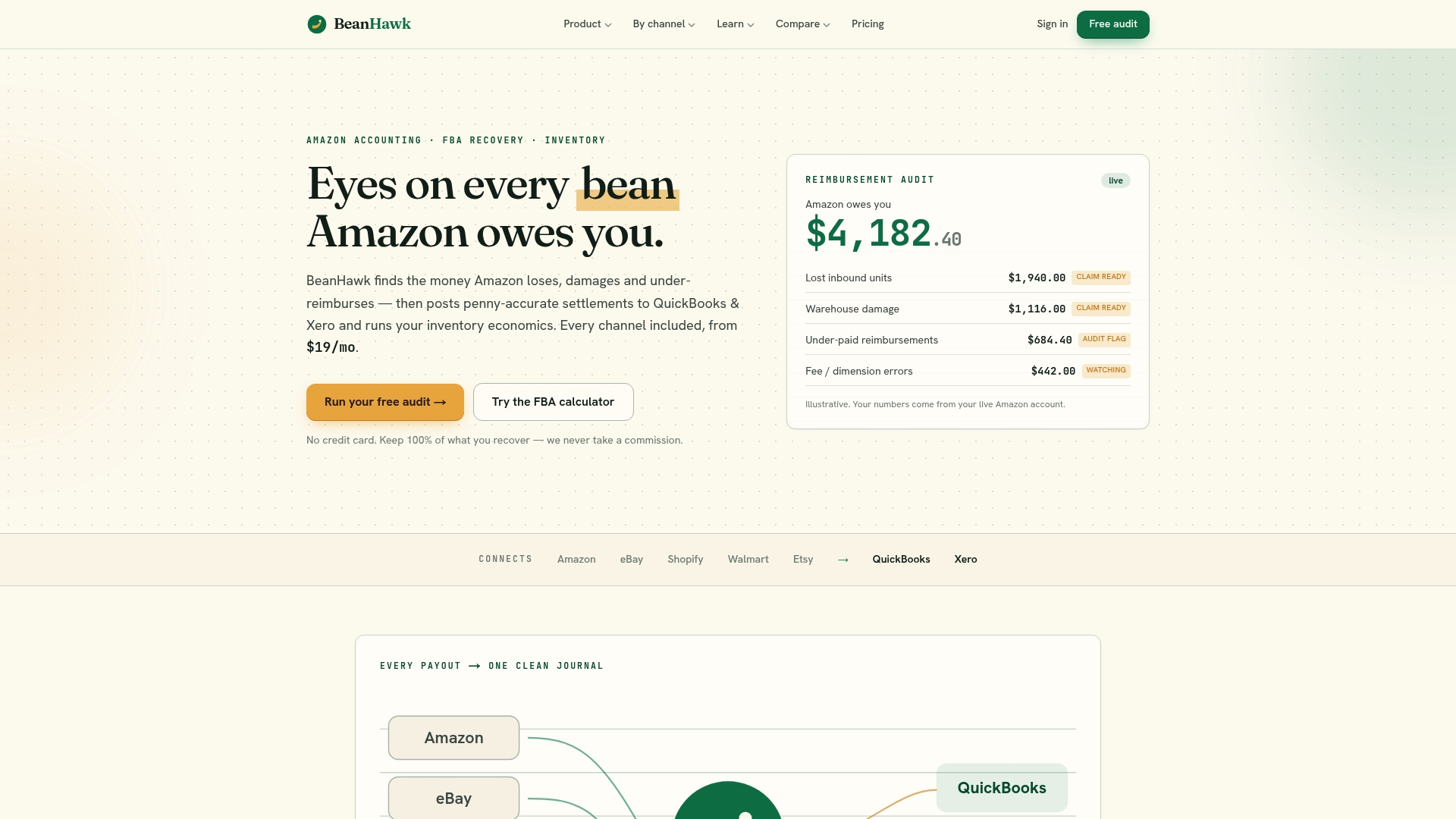
Beanhawk runs continuous monitoring on inbound shipments and ledger events, files reimbursement claims automatically, and then posts the resulting settlements into QuickBooks Online or Xero with a penny-accurate approach, without taking a commission on recovered funds. You don’t need to choose between reconciliation and recovery. Plans start at $19/month on the Starter tier, or you can run the free FBA reimbursement audit first to see exactly how much you’re currently leaving on the table before committing to anything.
Sources
- Link My Books Xero Integration Reviews & Features , Xero App Store US
- A2X vs Link My Books: Compare accuracy, features, and …
- A2X vs Link My Books: which is better for ecommerce accounting?
- Link My Books Review 2026: A Profit-First Verdict | Eightx
FAQ
What Are the Best Alternatives to A2X?
Link My Books is the most commonly cited alternative for sellers wanting lower starting cost and faster setup on Xero or QuickBooks Online. Taxomate and Webgility serve narrower use cases, focused on specific channels or operations-heavy multichannel stacks, while BeanHawk fits sellers who also need automated FBA reimbursement recovery alongside reconciliation.
What Accounting Software Do Most Bookkeepers Use?
Most bookkeepers working with ecommerce clients build around QuickBooks Online or Xero as the core ledger, then layer a reconciliation connector like A2X or Link My Books on top to handle multi-channel settlement data. Larger or scaling businesses sometimes move to NetSuite or Sage, which is why ledger support matters more than most sellers initially assume.
How Much Does A2X Cost?
A2X prices on a volume-based structure that rises with your order count and channel mix, with the exact figure depending on your specific setup. BeanHawk’s pricing, by comparison, is published in flat tiers: Free at $0/month, Starter at $19/month, Growth at $49/month, and Scale at $99/month, all available on the pricing page.
Who Is the Biggest Competitor to QuickBooks Online?
Xero is generally considered QuickBooks Online’s closest competitor for small business accounting, and both are the two ledgers that reconciliation connectors like A2X, Link My Books, and BeanHawk support as core integrations. The real decision for most sellers isn’t which ledger to pick between the two. It’s which connector maps cleanest to the one they already use.
Is Link My Books Better Than A2X for Small Sellers?
For sellers on a single ledger (QuickBooks Online or Xero) running a handful of channels, Link My Books often wins on starting price and setup speed. A2X pulls ahead once you need Sage or NetSuite support or want deeper subledger traceability for audit purposes.