
Amazon Sellers: 8 Alternatives to LinkMyBooks That Recover FBA

For most Amazon and multi-channel sellers, BeanHawk is the strongest LinkMyBooks alternative because it pairs automated settlement posting with continuous FBA reimbursement recovery, something none of the pure connectors do. If your channel mix runs heavier on gateways than marketplaces, Synder or Taxomate cover more ground. A2X wins for accountants who want subledger-level accrual detail, and Bench fits sellers who want the bookkeeping done for them.
TL;DR:
- BeanHawk offers continuous FBA shipment monitoring and automated reimbursement claims, making recovery more efficient than manual audits.
- Synder supports over 30 payment gateways and multiple channels, ideal for sellers with diversified payment sources but less focused on Amazon-specific reimbursements.
- Taxomate provides unlimited channel connections with free historical imports, best suited for multi-channel sellers seeking simplicity without extensive reimbursement features.
- A2X delivers detailed accrual-grade journal entries with subledger traceability, favored by accountants needing precise COGS tracking during audits.
- Bench is a service rather than a tool, replacing DIY reconciliation with professional bookkeeping, useful for sellers wanting to outsource their entire financial management.
Table of Contents
- LinkMyBooks Alternatives Compared: Pricing, Channels, and Ledger Support
- What Each LinkMyBooks Competitor Actually Does
- How to Pick the Right Alternative to LinkMyBooks
- How We Compared These LinkMyBooks Substitutes
- Security and Data Privacy Across Connector Tools
- Scalability When Order Volume Spikes
- Free Trials, Demos, and Refund Terms to Expect
- What I’d Actually Do If I Were Switching This Month
- Try BeanHawk’s Free Reimbursement Audit
- Sources
- FAQ
LinkMyBooks Alternatives Compared: Pricing, Channels, and Ledger Support
The eight tools below split into three camps: settlement connectors that post summarized journal entries to your ledger, a document-capture tool supporting the bookkeeping workflow around them, and a managed service that replaces the DIY stack entirely. Pricing shape varies more than the marketing pages suggest, since almost every connector scales its tier by order volume or channel count rather than charging a flat fee.
| Tool | Pricing model | Integrations / channels | Ledger support | Historical imports | Best for |
|---|---|---|---|---|---|
| BeanHawk | Tiered SaaS subscription by order volume; free audit | Amazon FBA/FBM, multi-channel | QuickBooks, Xero | Continuous ledger monitoring from setup | Amazon sellers needing reimbursement recovery plus automated posting |
| Synder | Tiered by transaction volume, free trial | 30+ gateways and channels | QuickBooks, Xero, NetSuite | Yes, historical sync included | Sellers running many payment gateways at once |
| Taxomate | Tiered by order volume | Unlimited channel connections | QuickBooks, Xero, Wave | Free historical import | Sellers who need many channels without per-channel fees |
| A2X | Tiered by order volume | Amazon, Shopify, Walmart, others | QuickBooks, Xero | Yes, with subledger detail | Accountants needing accrual-grade COGS tracing |
| Dext | Tiered by document volume | Ledger and connector integrations | QuickBooks, Xero | Not applicable (capture tool) | Bookkeeping teams that need receipt/invoice automation |
| Zoho Books + connector | Ledger subscription plus connector add-on | Depends on connector chosen | Zoho Books native | Depends on connector | Cost-conscious sellers already in the Zoho ecosystem |
| Bench | Managed service subscription | Handled by Bench’s team | Bench’s own platform | Handled during onboarding | Sellers who want bookkeeping off their plate entirely |
A few things jump out once you line these up side by side.
- Only BeanHawk and A2X build reimbursement or accrual accuracy into their core pitch rather than treating it as an add-on.
- Taxomate and Synder compete hardest on raw channel count, which matters more if you sell through five marketplaces than if you’re Amazon-only.
- Bench is the only entrant that isn’t really a “tool” at all. It’s a service that replaces the decision entirely.
What Each LinkMyBooks Competitor Actually Does
BeanHawk solves a different problem than most connectors on this list. Instead of just summarizing settlements into journal entries, it continuously monitors your inbound FBA shipments and ledger events, then flags and files claims for lost, damaged, or under-reimbursed inventory. The continuous monitoring approach materially improves recovered dollars compared to sellers who audit their FBA account manually once a quarter. Once a reimbursement lands, BeanHawk posts the settlement to QuickBooks or Xero automatically, so the recovery and the reconciliation happen in the same system rather than two disconnected spreadsheets. It’s built as a subscription SaaS with a free limited audit, which makes it easy to see what you’re currently leaving on the table before committing to anything.
Synder is the pick for sellers whose “center of gravity” is payment gateways rather than a single marketplace. It supports more than 30 integrations across Stripe, PayPal, Amazon, Shopify, and others, with real-time COGS tracking and support for QuickBooks, Xero, and NetSuite. That NetSuite support matters if you’re outgrowing small-business accounting software. The trade-off is that Synder isn’t built specifically around FBA reimbursement mechanics, so sellers relying heavily on Amazon inventory claims will need a separate process for that.
Taxomate leans hard into simplicity for sellers juggling many sales channels. It advertises unlimited channel connections and free historical data imports, which removes the per-channel pricing penalty some competitors charge. Wave support is a nice touch for very small sellers who haven’t graduated to QuickBooks or Xero yet. The limitation: it’s a connector, not a recovery tool, so lost or damaged inventory claims still require a separate workflow.
A2X is the connector accountants tend to request by name. It builds accrual-grade journal entries with subledger traceability, meaning every dollar in a settlement can be traced back to the individual order that generated it. That level of detail is genuinely useful during an audit or a due-diligence review before a business sale. Industry roundups generally frame A2X and LinkMyBooks as occupying the same lane, differing mainly on price at volume and depth of COGS handling. A2X tends to cost more as order volume climbs, which is the price of that extra precision.
Dext doesn’t compete directly as a settlement reconciler. It’s a document capture and bookkeeping workflow tool, best known for pulling data off receipts and invoices and feeding it into your ledger. Sellers often run Dext alongside a connector like BeanHawk or A2X rather than instead of one, since it solves the expense-capture side of bookkeeping rather than the marketplace settlement side.
Zoho Books with an ecommerce connector is the budget play. Zoho’s native ledger is inexpensive compared to QuickBooks or Xero, and pairing it with a connector gives smaller sellers a working stack without a large monthly bill. The catch is that connector options within the Zoho ecosystem are thinner than what QuickBooks and Xero users can choose from, so feature parity with A2X or Synder isn’t guaranteed.
Bench isn’t a tool at all. It’s a managed bookkeeping service that does the reconciliation work for you rather than handing you software to do it yourself. That’s a fundamentally different buying decision: you’re not comparing integrations and pricing tiers, you’re deciding whether you want a human team owning your books instead of a dashboard.
How to Pick the Right Alternative to LinkMyBooks
Start with your channel mix. If Amazon FBA drives most of your revenue, prioritize tools built around FBA fee taxonomy and reimbursement claims over generic multi-channel connectors. If you’re running five or six gateways with no dominant channel, breadth of integrations matters more than reimbursement depth.
- Decide QuickBooks or Xero first. Most connectors support both, but confirm before you commit, since switching ledgers mid-year is painful.
- Weigh volume against pricing sensitivity. Every connector on this list scales price by order count, so run your actual monthly order volume through each vendor’s calculator before comparing sticker prices.
- Ask whether you need accrual-level COGS detail. If your accountant wants subledger traceability for tax filing, that narrows the field toward A2X or BeanHawk.
- Check historical import capability. A free historical import saves real setup time if you’re switching mid-year.
- Decide DIY versus managed. If you’d rather hand the whole process to a team, weigh Bench against the connector-plus-ledger stack.
Ask any vendor for a sample first-post proof before you sign anything. Pro Tip: Run one real payout through the connector’s mapping engine before importing months of historical data. It’s the fastest way to catch a miscategorized fee or missing tax line without redoing a full year of books.
Watch for red flags during trials: no historical import option, pricing that isn’t published anywhere, or a vendor that doesn’t support your primary sales channel at all.
How We Compared These LinkMyBooks Substitutes
Selection came down to five signals: breadth of integrations, ledger support, pricing transparency, historical import capability, and how each vendor’s own claims held up against independent buyer guides. Buyer checklists for ecommerce accounting software consistently flag automatic settlement reconciliation and real-time per-unit COGS as baseline requirements, so every tool here was checked against that bar.
BeanHawk’s inclusion rests on a narrower but harder-to-replicate signal: continuous FBA ledger-event monitoring paired with automated settlement posting to accounting platforms, a combination that addresses reimbursement recovery and reconciliation in one motion rather than two separate tools.
- Integration breadth and named channel support
- Ledger compatibility (QuickBooks, Xero, others)
- Pricing transparency and volume-based scaling
- Historical import or first-post verification capability
- Reimbursement recovery specificity for Amazon sellers
Pricing and integrations shift often, so treat every figure here as a starting point for your own trial, not a locked-in number.
Security and Data Privacy Across Connector Tools
Every connector on this list moves financial data between your sales channels and your ledger, which means read and write access to sensitive revenue and customer information. QuickBooks and Xero both require OAuth-based authorization for any third-party connector, so a legitimate tool never asks for your ledger password directly. If a vendor requests raw login credentials instead of an OAuth connection, that’s a signal to walk away.
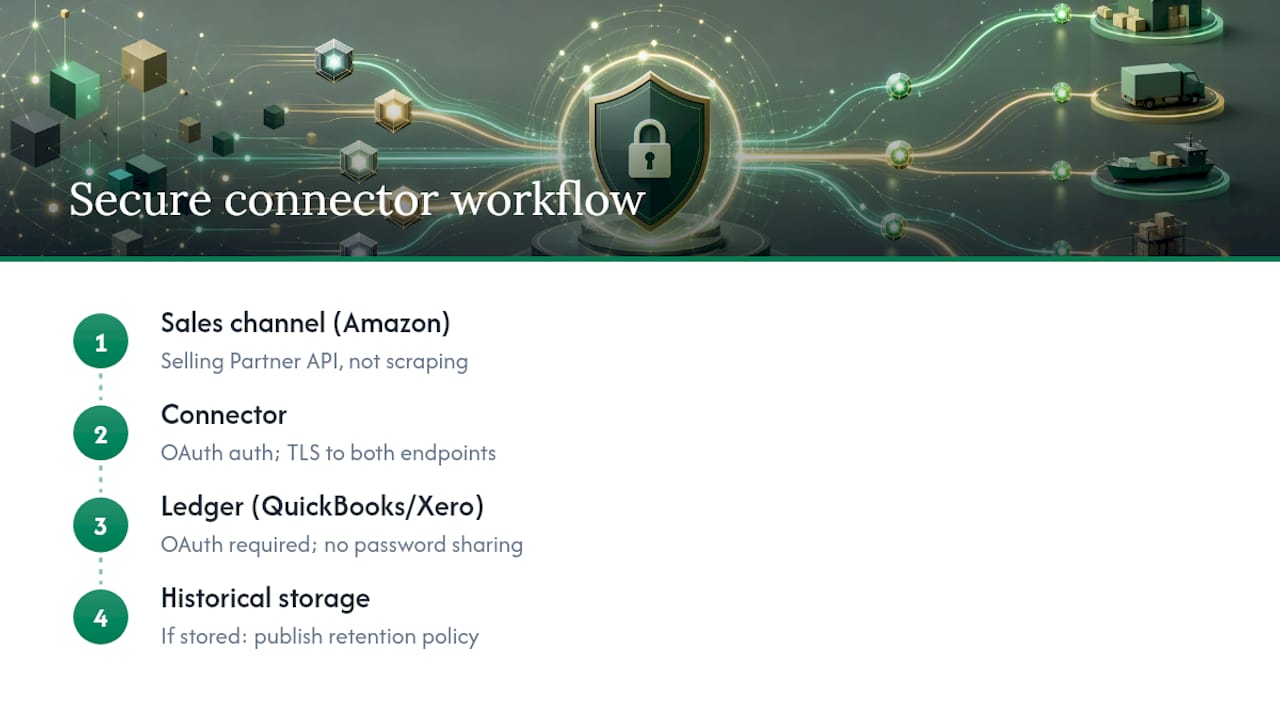
Look for encrypted data transmission (TLS) between the connector and both endpoints, and confirm whether the vendor stores your transaction history on its own servers or only processes it in transit. Connectors that hold historical data for reporting purposes should publish a clear retention and deletion policy. Managed services like Bench handle this differently since a human team, not just software, has access to your full financial picture, so their data-handling agreements deserve a closer read during onboarding.
For Amazon-specific tools, check whether the vendor uses Amazon’s official Selling Partner API rather than scraping seller-facing dashboards. API-based access is more stable and generally more secure than screen-scraping approaches, which can break with every Amazon interface update and often require broader account permissions than necessary.
Scalability When Order Volume Spikes
Connector performance under load isn’t just a pricing-tier question. It’s an accuracy question. During peak seasons like Q4, order volume can jump several times over baseline, and any connector processing settlements in daily or weekly batches needs to keep pace without falling behind on reconciliation.
Tools built around continuous or near-real-time monitoring tend to handle volume spikes more gracefully than those running on scheduled batch jobs, since a backlog during your highest-revenue weeks is exactly when reconciliation errors are most costly. Synder’s real-time COGS tracking and BeanHawk’s continuous FBA ledger monitoring are both built around this principle rather than a nightly sync.
Multi-gateway sellers using Synder should confirm how the platform handles simultaneous settlement batches from several payment processors during a traffic spike. Amazon-heavy sellers should ask how quickly a connector reflects a reimbursement or chargeback after Amazon posts it internally, since lag here directly affects how current your books are during your busiest month.
Free Trials, Demos, and Refund Terms to Expect
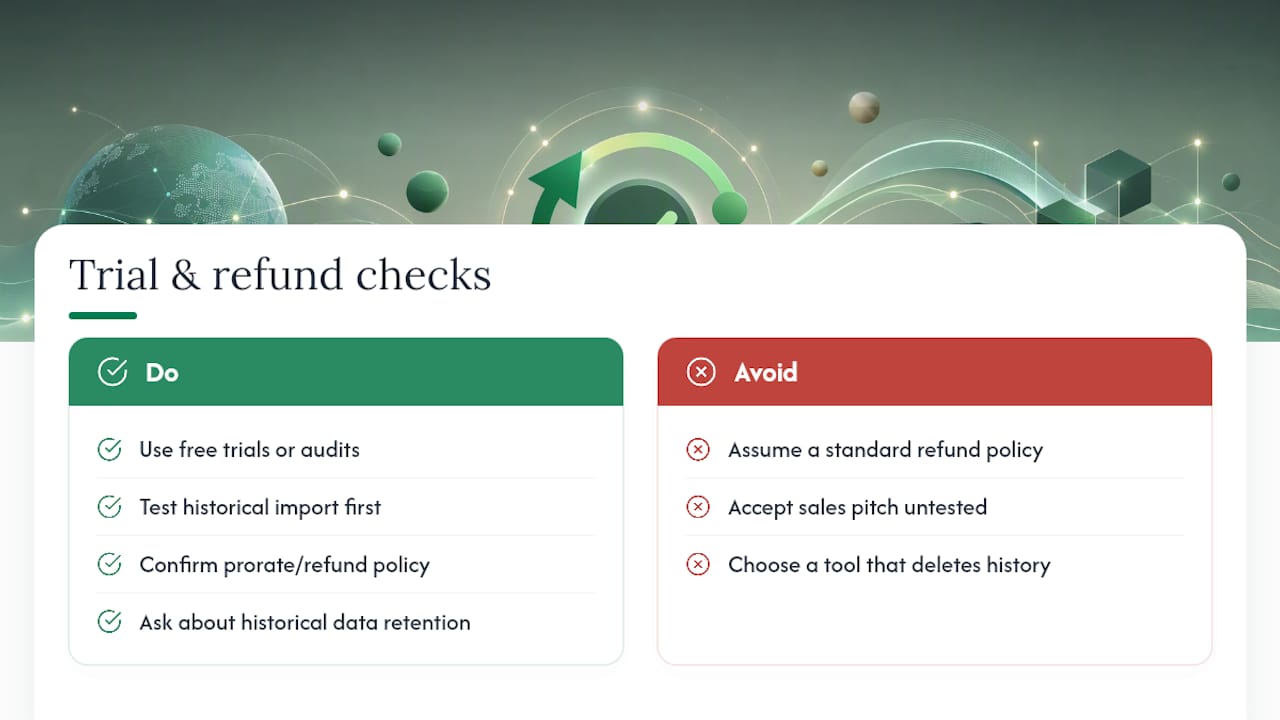
Most connectors on this list offer some form of free trial or limited audit before you commit to a paid tier. BeanHawk offers a free limited audit that shows recoverable reimbursement amounts before you subscribe, which lets you see the actual dollar opportunity rather than taking a sales pitch at face value. Synder advertises a free trial period on its Shopify App Store listing, and Taxomate’s free historical import functions as a low-risk way to test mapping accuracy before paying for ongoing service.
Refund policies vary more than trial availability does. Subscription-based SaaS tools generally prorate or refund unused time if you cancel mid-cycle, but confirm this directly with each vendor rather than assuming a standard policy applies. Managed services like Bench typically work on a monthly retainer with cancellation terms spelled out in the service agreement rather than a traditional refund window.
Whatever tool you’re evaluating, ask specifically what happens to your historical data if you cancel. A connector that deletes your reconciliation history immediately on cancellation creates a real problem if you need those records for a future audit.
What I’d Actually Do If I Were Switching This Month
If you’re serious about switching off LinkMyBooks, don’t start with a side-by-side feature comparison. Start with one real payout. Run it through your top pick’s mapping engine and check the journal entry it produces against what your ledger expects. For most Amazon sellers, that means testing BeanHawk against a live FBA settlement, since the reimbursement side only proves its value once you see a real claim recovered and posted.
Expect the first 30 days to be about mapping corrections, not big wins. The recovery numbers get real in month two.
, Tim
Try BeanHawk’s Free Reimbursement Audit
BeanHawk gives you a combined system: automated recovery of lost and damaged FBA inventory claims alongside settlement posting into accounting platforms. Instead of running a connector for reconciliation and a separate manual audit for reimbursements, you get continuous monitoring of your inbound shipments and ledger events in one place, with no hidden fees or commissions taken out of what gets recovered.
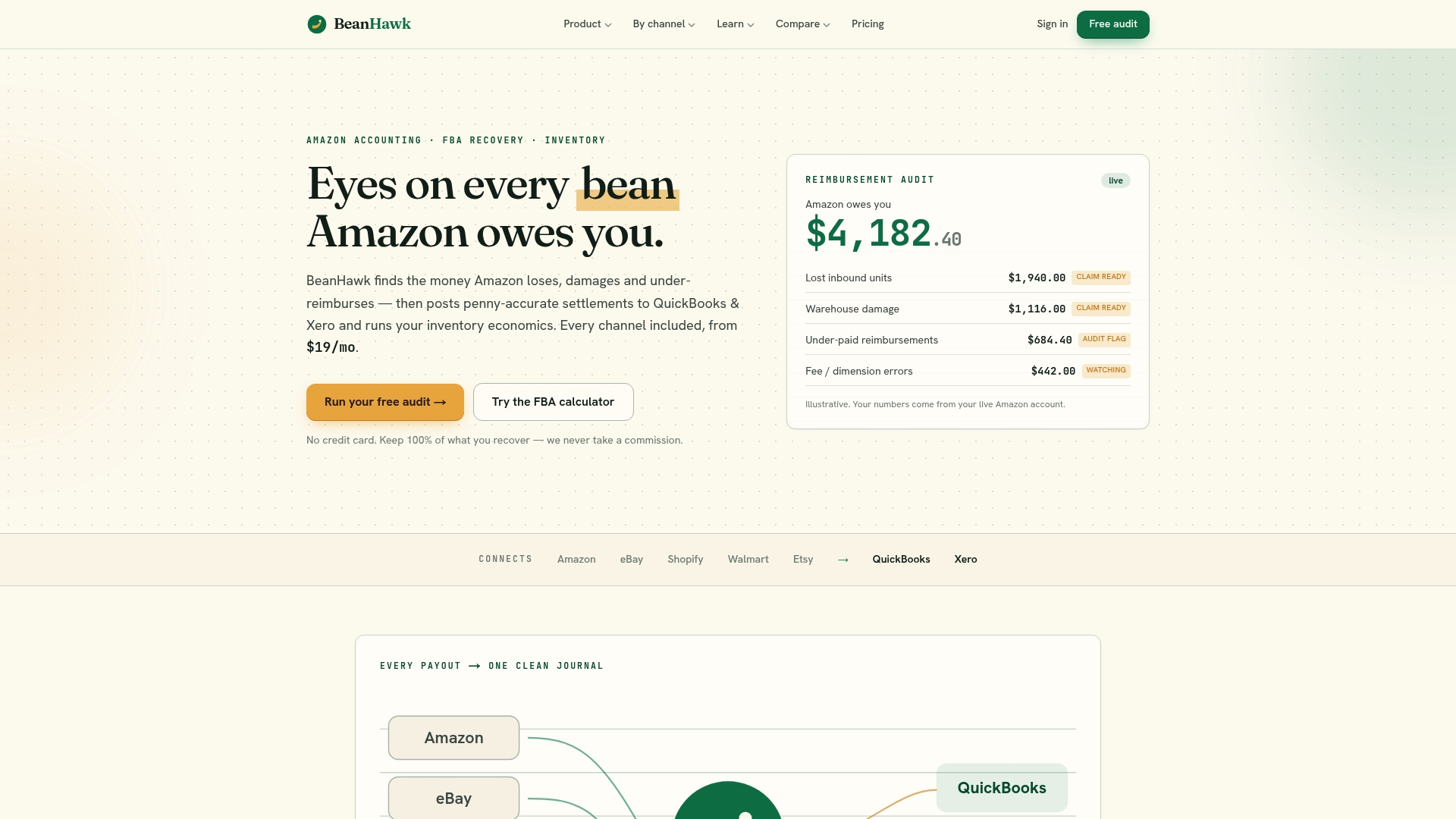
That matters most in the first 30 days after you switch, when mapping errors and missed claims are easiest to catch and fix. Start with the free limited audit to see what BeanHawk finds in your existing FBA account, then decide whether automated recovery plus ledger reconciliation is worth adding to your stack. If you’re still getting familiar with how FBA settlements and reimbursements actually work, BeanHawk’s guide on what Amazon FBA involves is a useful place to start before you run your first audit.
Sources
- Synder - Effortless sales reconciliation with QuickBooks and Xero | Shopify App Store
- A2X vs Link My Books: Compare accuracy, features, and …
- Best Ecommerce Accounting Software (2026): 8 Tools I’d Actually Recommend | Dupple
FAQ
How Much Does LinkMyBooks Cost Per Month?
LinkMyBooks prices by monthly order volume on a tiered subscription model, similar to most connectors on this list, including Synder and Taxomate. Exact tier pricing shifts often enough that checking each vendor’s current pricing page before comparing is the safer approach.
What Software Do Most Bookkeepers Use?
Bookkeepers working with ecommerce clients most often build a stack around QuickBooks or Xero as the ledger, paired with a connector like A2X, Synder, or BeanHawk for settlement posting, and sometimes Dext for receipt capture. The layered-stack approach tends to produce fewer reconciliation errors than forcing one tool to handle everything.
What Is the Best Software to Replace QuickBooks?
Xero is the most common direct alternative to QuickBooks for ecommerce sellers, and every connector covered here, including BeanHawk, supports both platforms. Switching ledgers is a bigger decision than switching connectors, since it affects your entire accounting history, not just settlement posting.
Why Don’t Accountants Like QuickBooks?
Accountants’ complaints about QuickBooks usually center on weak native handling of marketplace settlements and COGS at the SKU level, not the ledger itself. That gap is exactly why connectors like A2X and BeanHawk exist: they translate messy Amazon and multi-channel settlement data into clean journal entries QuickBooks can actually use.
Is BeanHawk a Good LinkMyBooks Alternative for Amazon Sellers?
BeanHawk fits Amazon sellers who want reimbursement recovery and ledger posting handled together rather than as two separate tools. Sellers who need broader multi-gateway coverage instead may find Synder or Taxomate a closer match to their channel mix.