
Amazon Returns Reconciliation: Catch Refund Gaps Weekly With 5 Reports

Pull the Flat File V2 Settlement Report, the Payments/Transaction view, FBA Customer Returns, Reimbursements, and the Inventory Ledger for the same date range, then match rows by order-id, FNSKU, and LPN. Use amount-type, amount-description, and amount to spot refund adjustments, and trace the matching unit through FNSKU or LPN fields. When a refund row has no matching return or reimbursement, you have found money Amazon owes you, and automated monitoring (covered later) can catch these gaps continuously instead of weekly.
TL;DR:
- Use Flat File V2 as the anchor, compare Transactions for posting time, Returns for receipt, Reimbursements for payouts, and the Inventory Ledger for unit movement.
- Wait a week or two before escalating: refunds can post at first scan, while return records lag and some reimbursement windows extend beyond 45 days.
- Returnless refunds will never produce a return record, while partial refunds and small currency differences can be legitimate rather than evidence of missing reimbursement.
- Trace missing units by LPN in Returns and the Inventory Ledger, then attach settlement, transaction, and return or ledger evidence before filing a claim.
- Run a weekly workbook with one owner for a month, group exceptions by cause, then automate scheduled report pulls first to reduce skipped exports.
Table of Contents
- Which reports to pull and what each report shows
- Step-by-step reconciliation workflow you can run weekly
- Common discrepancies and the evidence that resolves them
- From workbooks to continuous reconciliation
- Why consistent reconciliation reduces leakage
- BeanHawk: an automation option to recover missed reimbursements
- FAQ
- Sources
Which reports to pull and what each report shows
Five reports cover nearly every return and refund scenario, and each one answers a different question.
- Flat File V2 Settlement Report: pull amount-type, amount-description, amount, and settlement-id to isolate refund and adjustment lines inside your settlement data.
- Payments/Transaction view: shows individual refund lines with posted-date-time, useful for confirming when a refund actually hit your account.
- FBA Customer Returns: lists order-id, FNSKU, disposition, and LPN, which tells you whether a returned unit physically arrived at a fulfillment center and in what condition, since Seller Central’s own guidance notes the order details page typically lacks return tracking.
- Reimbursements report: the place to check for lost, damaged, or returnless refund reimbursements already paid out.
- Inventory Ledger: tracks unit-level movements and stowage, which matters when a returned item shows up in inventory but never generates a reimbursement.
Treat the Flat File V2 report as your anchor. Its condensed column structure makes it far easier to filter refund and adjustment rows than parsing raw transaction data row by row. Once you have refund rows isolated there, cross-reference each one against FBA Customer Returns to confirm the unit came back, then check Reimbursements to see if Amazon already paid you for it. If a refund exists with no return and no reimbursement, that row goes into your exception list.
Step-by-step reconciliation workflow you can run weekly
A workbook-based process works well for most sellers, and it scales down to a few hours a week once the structure is set.
- Download the five reports for a consistent date range and load each into its own named tab: Settlement, Transactions, Returns, Reimbursements, and Ledger.
- Standardize column headers across tabs so order-id, FNSKU, and LPN sit in the same columns on every sheet, which makes lookups far less error-prone.
- In the Settlement tab, filter amount-type for refund-related entries, then use XLOOKUP or SUMIFS to pull the matching order-id into the Transactions and Returns tabs.
- For each refund row, check whether a corresponding row exists in FBA Customer Returns using order-id and FNSKU, and whether an LPN confirms physical receipt.
- Check the Reimbursements tab for any payout tied to the same order-id or FNSKU.
- Classify every refund row as returned and reimbursed, returned and not reimbursed, or no return recorded, and mark an ‘open case’ flag for anything in the latter two categories.
- Before filing a case, collect the settlement row, the refund transaction, the return report row (or its absence), and any reimbursement evidence.
Pro Tip: Keep a single “case evidence” column in your workbook with a short text note on exactly what’s missing, so you’re not re-digging through five tabs when Seller Support asks for clarification.
Timing matters here. Amazon typically refunds buyers at first scan of a returned item, not when the item is fully processed back into inventory, which can create a lag between the refund hitting your settlement and a return showing up in your returns report. Some reimbursement eligibility windows extend past 45 days, and recent Seller Central updates have expanded automated reimbursements for certain goodwill and returnless refunds, so a row that looks like a discrepancy today may resolve itself automatically within a few weeks. Build a short waiting period into your exception flag, typically a week or two, before escalating to a case.
A manual reconciliation approach discussed in Amazon’s seller forums follows the same pattern: separate tabs for each report, VLOOKUP or SUMIFS to find mismatches, and a weekly cadence with exceptions grouped by root cause rather than reviewed one at a time.
Common discrepancies and the evidence that resolves them
Most mismatches trace back to a handful of recurring causes, and each one has a specific fix.
- Returnless refunds: the buyer keeps the item, so no return record will ever appear, and you should check the Reimbursements report instead of waiting on FBA Customer Returns.
- Delayed receipt into the fulfillment center: the refund posts before the physical unit scans in, creating a temporary gap that often closes within days.
- Mismatched SKUs or merchant-order-item-ids: a listing change or variation swap breaks the join between reports, so confirm FNSKU rather than SKU alone.
- Partial refunds: the settlement amount won’t match the full order value, which is expected and not a discrepancy on its own.
- Currency or rounding differences: small cent-level gaps usually come from fee proration, not a missing reimbursement.
When a unit genuinely disappears, search FBA Customer Returns and the Inventory Ledger by LPN rather than order-id, since the LPN barcode is the most reliable way to trace a specific physical unit, a method Seller Central’s own documentation points to directly. Before opening a case, assemble the settlement row, the refund transaction detail, the relevant return or ledger row (or proof it doesn’t exist), and a short note on what reimbursement you expect. File through the IDR portal for lost or damaged inventory, or through SAFE-T claims for customer-service-driven refunds, and expect Seller Support to ask for the same evidence set you already compiled.
From workbooks to continuous reconciliation
A weekly workbook catches most discrepancies, but the gap between when a refund posts and when you notice it still costs money. Three things are worth automating first: scheduled report pulls so you’re not manually exporting five files every week, deterministic matching rules so exception flags happen without a human checking every row, and automated posting of summarized settlement entries into accounting software like QuickBooks or Xero.

Continuous monitoring shortens the detection window from a week to near real time, which matters most for returnless refunds and lost-unit cases where Amazon’s own reimbursement windows are time-limited. We built our FBA reconciliation approach around exactly this shift: continuous monitoring of inbound shipments and ledger events, paired with a free FBA reimbursement audit that shows sellers what’s already slipping through before they commit to anything.
Pro Tip: Start with the weekly workbook method for a month so you understand your own discrepancy patterns, then automate the report pulls first, since that’s the step most likely to get skipped when you’re busy.
Why consistent reconciliation reduces leakage
The sellers who lose the most money aren’t the ones with complicated returns, they’re the ones who mix up order-id and merchant-order-item-id, or forget that LPNs change between return events. A weekly cadence with one clear owner, whether that’s the seller or their accountant, catches these before they age past a reimbursement window. The free audit is a reasonable first diagnostic step if you want to see what’s already been missed without committing to a process overhaul.
, Tim
BeanHawk: an automation option to recover missed reimbursements
We built our product around the exact gap this workflow exposes: the time between a missed reimbursement happening and someone noticing it in a spreadsheet. Our system continuously monitors inbound shipments and FBA ledger events, so a lost or under-reimbursed unit gets flagged automatically instead of waiting for next week’s export.
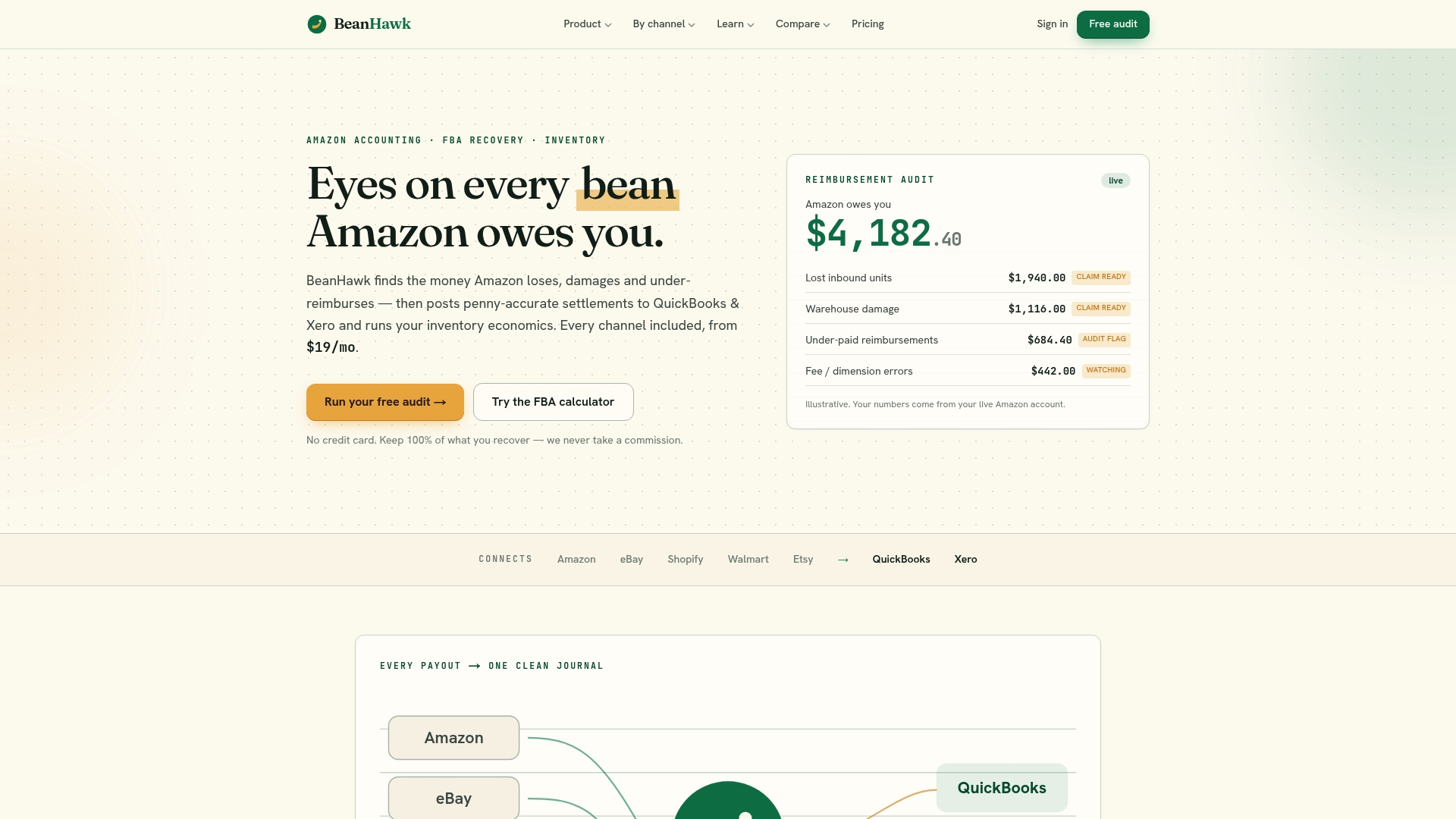
- We offer automated, summarized settlement entries directly to accounting software, so your books match what Amazon actually paid without manual journal entries.
- We offer a free FBA reimbursement audit that surfaces gaps across your existing returns and reimbursement history before you commit to anything.
- Our plans run from Free up through Starter at $19 per month, Growth at $49 per month, and Scale at $99 per month, scaled to order volume.
This setup fits sellers and accountants managing reconciliation across multiple channels who want one centralized view instead of five separate report exports. If you’re ready to see what a continuous monitoring approach catches, start with the free audit and compare it against your own workbook findings.
FAQ
How do I reconcile Amazon orders against refunds?
Pull the Flat File V2 Settlement Report alongside your Transactions, FBA Customer Returns, and Reimbursements reports for the same date range, then match rows by order-id, FNSKU, and LPN. Flag any refund that has no matching return record or reimbursement as an open case for further investigation.
Will Amazon penalize me for too many returns?
A high return rate can affect your account health metrics, which Amazon and third-party monitoring tools track as part of overall seller performance, as explained in this account health overview. The return rate itself isn’t a direct financial penalty, but it can affect buyer trust signals and category eligibility over time.
Is Amazon changing its return policy in 2026?
Amazon has been rolling out updates that reduce returnless refunds and automate more reimbursements for goodwill and SAFE-T claims, changes described in Amazon’s own announcement. These shifts mean fewer manual cases are needed for some refund types, though sellers should still verify reimbursements rather than assume automation covers every scenario.
Is Amazon having trouble with returns?
Amazon has expanded return handling options, including returnless resolutions, Grade and Resell, and donation channels, which change whether a returned item ever physically comes back to a fulfillment center, as outlined in Amazon’s update on return options. These options are aimed at reducing processing costs and return fraud rather than signaling a problem with the returns system itself.
What’s the difference between a Settlement report and a Transaction report?
The Settlement report summarizes disbursed funds over a payment period, while the Transaction report lists individual state changes like refunds as they happen, a distinction laid out in Amazon Pay’s reporting documentation. Use the Transaction view to pinpoint exactly when a refund posted, and the Settlement report to confirm it against your overall payout.
Sources
- Flat File V2 Settlement Report , developer docs
- Tracking FBA refunded returns , Seller Central help
- Seller forum discussion: reconciling refunds against returns
- Upgrades to customer service by Amazon help sellers save time and reduce refunds