
Protect Margins with a COGS First Chart for Amazon Sellers

The best Amazon expense categorization uses a COGS-first chart of accounts that keeps each settlement component separate: sales, fees, shipping income, reimbursements, and inventory costs each get their own line, never lumped into a single deposit figure. A clearing account sits between Amazon and the bank so nothing posts until it is reconciled. This approach follows the structure QuickBooks’ own connector is built around, and it is the same logic BeanHawk applies when it automates settlement posting. The sections below walk through the mapping, the reconciliation steps, and the common mistakes that throw off margin reporting.
TL;DR:
- Using a detailed chart of accounts with separate lines for sales, fees, reimbursements, and inventory costs prevents revenue inflation and improves margin accuracy.
- All settlement components should be mapped from Amazon transaction reports rather than the net payout, with reconciliation staged in Undeposited Funds before bank deposit.
- Regular month-end and weekly reviews, including matching deposits to reports and checking unclassified lines, reduce errors and catch discrepancies early.
- Amazon’s 2025 reimbursement policy requires SKU-level cost records because reimbursements are based on manufacturing costs, excluding shipping and customs.
- Automated tools like BeanHawk can streamline settlement posting and continuous monitoring, saving hours of manual reconciliation and ensuring transaction accuracy.
Table of Contents
- Recommended chart of accounts for Amazon and multi-channel sellers
- How to split Amazon settlements into accounting entries
- Reconciliation controls that tie settlements to the bank
- Accounting for reimbursements and lost or damaged inventory
- Connector and posting best practices for QuickBooks and Xero
- Why continuous monitoring improves reimbursement accuracy
- Common bookkeeping traps and quick weekly checks
- Get your books reconciled without the manual cleanup
- Where these recommendations come from
- Sources
- FAQ
Recommended chart of accounts for Amazon and multi-channel sellers
A chart of accounts built for Amazon needs more granularity than a typical retail setup, because a single payout can contain a dozen different economic events. Each of the following deserves its own line rather than a shared bucket:
- Sales records gross Amazon marketplace revenue before any fees are deducted.
- Shipping income captures what customers paid for shipping, kept separate from sales.
- Discounts and promotions track coupon and deal costs that reduce revenue.
- Customer refunds and returns records money given back to buyers, distinct from fee activity.
- Selling and referral fees holds Amazon’s percentage-based commission on each sale.
- FBA fulfillment and transaction fees covers pick, pack, and ship charges.
- Storage and warehousing fees separates monthly and long-term storage costs.
- Subscription fees tracks the recurring seller plan charge.
- Advertising expense isolates Sponsored Products and other ad spend.
- Taxes payable holds sales tax collected on behalf of states.
- Reimbursements and adjustments sits apart from sales entirely, covering lost or damaged inventory recoveries and fee refunds.
- Cost of goods sold tracks SKU-level product cost as items sell.
- A clearing account, labeled Undeposited Funds or Payments to deposit, holds everything until it matches the bank.
Inbound shipping, prep, and other landed costs typically get capitalized into inventory first, then flow into COGS only when the unit sells. QuickBooks’ connector guidance lists this same breakdown, sales, shipping, discounts, reimbursements, selling fees, fulfillment and warehousing, subscription, and advertising, as the standard payout components worth mapping separately. Getting reimbursements into their own account matters because mixing them into sales inflates revenue and distorts the margin picture a seller relies on to price products correctly.
How to split Amazon settlements into accounting entries

Amazon’s payout is a net number: one deposit that bundles sales, fees, refunds, and reimbursements into a single dollar figure. The transaction report, not the payout summary, is where the individual line items live, and that report is the only reliable source for allocating amounts to the right accounts.
A workable mapping convention looks like this:
- Sum every sales line from the transaction report and post the total to the Sales account.
- Post shipping charges collected from customers to Shipping income.
- Route discounts, promotions, and customer refunds to their own Discounts/Refunds account.
- Post negative fee lines (referral fees, FBA fees, storage) to their matching expense accounts.
- Route positive fee lines, meaning fee refunds or reimbursements, to the Reimbursements/adjustments account rather than treating them as new sales.
Say a weekly payout totals $4,200. The transaction report might show $5,100 in gross sales, $1,400 in referral and fulfillment fees, $150 in customer refunds, and $650 in reimbursements for a damaged inbound shipment. Posting the full $4,200 straight to revenue would hide all of that detail. Instead, each line lands in its own account, the batch stages in Undeposited Funds, and only then does a Deposit transaction move the net $4,200 to the bank. QuickBooks’ documentation describes this staging pattern directly: sales receipts and expense lines accumulate first, adjustment lines sit at the bottom, and the deposit reconciles to what actually hits the account. Skipping that step and recording every positive settlement line as income is the single most common error in Amazon bookkeeping.
Reconciliation controls that tie settlements to the bank
A clearing account is the control that prevents Amazon’s net payouts from becoming a black box. Every imported sale, fee, and adjustment should stage in Undeposited Funds or Payments to deposit, get reviewed line by line, and only then get bundled into a Deposit that matches what lands in the bank account.
A simple month-end checklist catches most errors before they compound:
- Reconcile the transaction report total against the settlement summary PDF for the same period.
- Confirm every settlement line has an assigned account rather than sitting unclassified.
- Match the final deposit amount to the actual bank transaction.
- Flag and investigate any variance above a set dollar threshold.
Ongoing monitoring matters just as much as the month-end review, especially when managing e-commerce marketplace integrations that require detailed settlement-to-bank reconciliation. Checking inbound shipment status, reconciling inventory counts, and scanning the ledger for unexplained adjustments on a regular basis surfaces discrepancies while they’re still fixable.
Pro Tip: Set up alerts for inbound shipment exceptions and unusually large adjustments so you catch discrepancies the week they happen instead of during a quarterly cleanup.
Accounting for reimbursements and lost or damaged inventory
Amazon changed its FBA reimbursement policy effective March 10, 2025, moving to a manufacturing-cost basis for pre-customer-order lost or damaged inventory. When a seller hasn’t supplied their own manufacturing cost, Amazon applies an estimate instead, and that estimate excludes shipping, handling, and customs duties. This makes SKU-level cost records essential, not optional, because the reimbursement a seller receives depends directly on the cost basis Amazon has on file.
Three mapping approaches work, depending on inventory method and documented policy:
- Reduce the inventory asset when the item hasn’t yet been expensed to COGS.
- Offset COGS when the item’s cost already flowed through cost of goods sold.
- Record as other income or adjustment when neither inventory nor COGS was charged for the loss.
Confirm the choice with a tax advisor, since the IRS ties inventory and expense classification to the taxpayer’s accounting method, and there’s no single correct label for every situation. When Amazon pays an estimate first and later accepts a seller-supplied manufacturing cost, record the initial estimate, then post an adjusting entry once the revised amount is confirmed. Keep settlement reports, Inventory Defect and Reimbursement portal snapshots, and SKU cost backup on file to support every entry.
Connector and posting best practices for QuickBooks and Xero
A connector that dumps a single net deposit into the bank register defeats the purpose of integration. The review-and-confirm step matters most: imported sales, fees, and adjustments should stage to Undeposited Funds or Payments to deposit, and a human should confirm the batch before a Deposit transaction gets created.
Before trusting any connector’s output, check the following:
- Confirm mapping settings for sales, fees, shipping, advertising, taxes, and reimbursements point to the correct accounts.
- Verify item-level import works where SKU-level COGS tracking depends on it.
- Re-run a reconciliation on a recent payout after any connector update or migration, since mapping rules can shift silently.
- Keep CSV transaction reports and settlement PDFs linked to each deposit entry so the chain of evidence holds up under audit.
A quick FBA fee and profit calculator can help confirm whether a connector’s fee mapping lines up with what Amazon is actually charging before trusting it at scale. For a deeper walkthrough of setup and mapping checks, a QuickBooks Amazon integration guide covers the connector configuration step by step.
Why continuous monitoring improves reimbursement accuracy
Manual monthly audits miss a lot. Continuous monitoring of inbound shipments and FBA ledger events helps catch under-reimbursed or missing inventory closer to the moment it happens rather than weeks later. Automated posting to QuickBooks and Xero can keep the settlement-to-bank tie-out intact without hidden commissions on recovered funds. Automation earns its keep when adjustments recur unexplained, when settlements span multiple sales channels, or when internal bookkeeping bandwidth is thin.

Common bookkeeping traps and quick weekly checks
The traps repeat across most seller books: recording the full payout as revenue, skipping reconciliation on fee refunds, and running without SKU-level cost data to back up reimbursement claims. Three weekly checks prevent most of it: confirm the week’s deposit matches the transaction report total, scan for any positive line that isn’t a reimbursement, and spot-check that COGS is tracking against actual unit costs. For deeper diagnostics on what Amazon owes against what it’s paid, BeanHawk’s FBA reimbursement glossary is a useful starting reference.
, Tim
Get your books reconciled without the manual cleanup
Catching every missed reimbursement by hand takes hours most sellers don’t have, and a single unclassified fee refund can throw off a month’s margin report. A free FBA reimbursement audit can check inbound shipments and ledger events for lost, damaged, or under-reimbursed inventory before committing to any service.
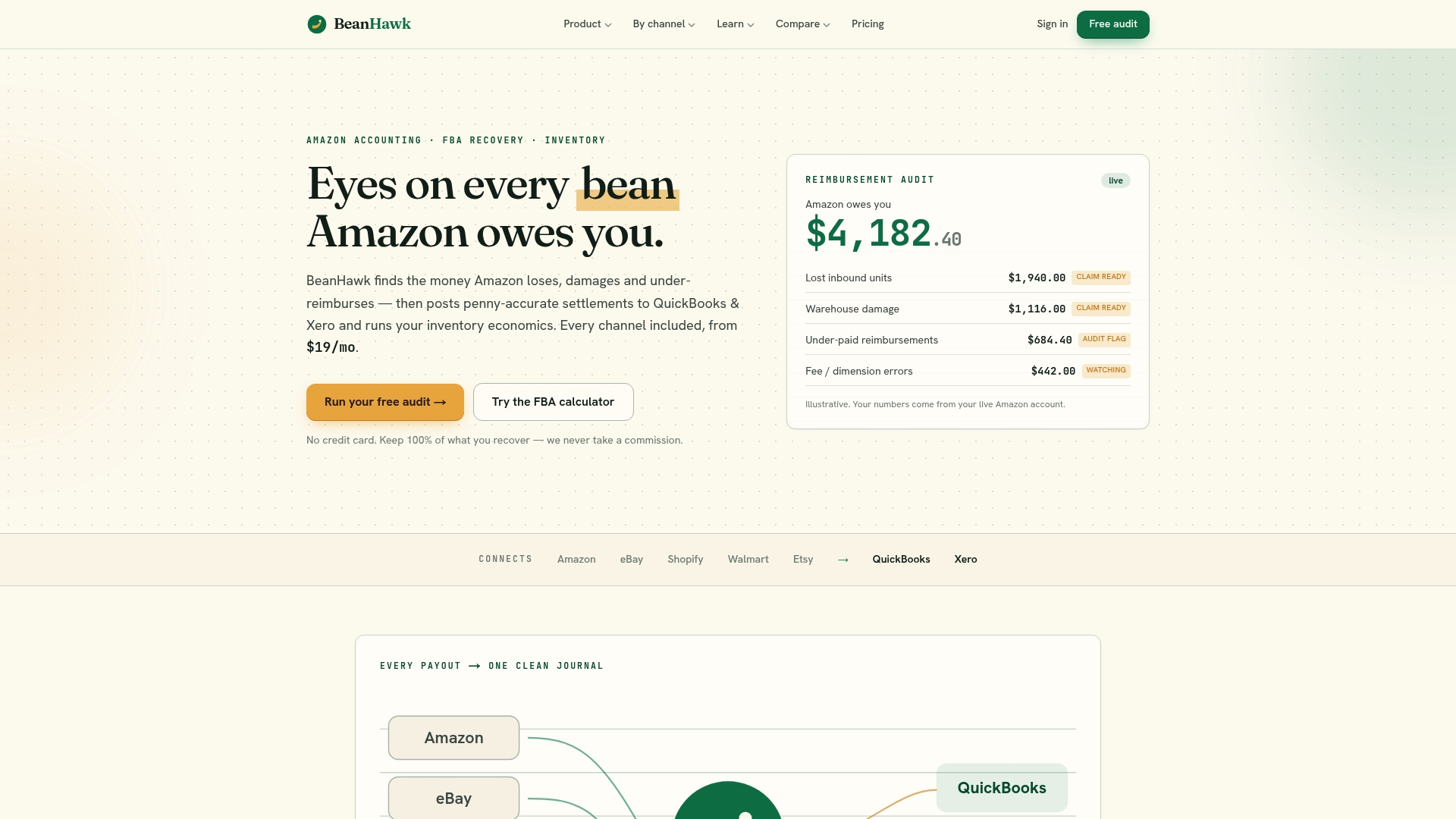
- The free audit identifies missed or under-reimbursed claims at no cost.
- Automated posting sends penny-accurate, reconciled settlements straight to QuickBooks or Xero.
- Paid plans start at $19 per month on the Starter tier, scaling up through Growth and Scale as order volume grows.
Start with the free FBA reimbursement audit to see what Amazon currently owes you, then check the pricing page for the plan that fits your order volume.
Where these recommendations come from
The mapping conventions here follow QuickBooks’ Amazon connector documentation, Amazon’s own transaction and reimbursement policy guidance, and IRS Publication 334 on inventory and expense classification.
- QuickBooks connector docs explain how settlement lines stage before deposit posting.
- Amazon’s seller forums detail how transaction reports distinguish charges from refunds.
- IRS Publication 334 ties expense classification to your chosen accounting method.
- BeanHawk’s inventory reconciliation guidance and settlement reconciliation walkthrough apply these rules in practice.
Sources
- Connect Amazon Seller Central to QuickBooks
- Publication 334 (2025), Tax Guide for Small Business | Internal Revenue Service
- Update to the FBA inventory reimbursement policy
FAQ
What is the best way to categorize Amazon seller expenses?
The best approach separates every settlement component, sales, fees, shipping, reimbursements, and COGS, into its own account rather than posting a single net deposit as revenue. A clearing account like Undeposited Funds should hold the detail until it’s reconciled against the bank, following the structure in QuickBooks’ connector documentation.
Should Amazon reimbursements be recorded as sales income?
No, reimbursements and fee refunds should post to a separate adjustments or other income account, never to sales. Amazon’s transaction report sign convention marks refunds as positive values distinct from sales lines, which makes separate mapping straightforward.
How does Amazon’s reimbursement policy affect bookkeeping?
Amazon’s March 2025 policy change reimburses pre-customer-order lost or damaged inventory based on manufacturing cost, using an estimate unless the seller supplies their own figure. This makes accurate SKU-level cost records necessary for both correct reimbursement amounts and defensible inventory accounting.
Does the IRS require a specific way to categorize FBA fees?
No single IRS rule dictates exact account names for FBA charges. IRS Publication 334 ties expense and inventory classification to the taxpayer’s chosen accounting method, so the mapping just needs to stay consistent and be reviewed with a tax professional.
Can BeanHawk automate Amazon expense categorization?
BeanHawk monitors inbound shipments and FBA ledger events continuously and automates settlement posting to QuickBooks and Xero with reconciled, itemized entries. A free FBA reimbursement audit shows what’s currently missing from your books before you commit to a paid plan.