
Payout First Multichannel Accounting Setup for Ecommerce Sellers

The reconciliation gap that breaks most ecommerce books closes with one configuration: a payout-level connector that posts settlement summaries into a channel-aware chart of accounts, matched to bank deposits weekly. This setup stops gross-versus-net mismatches before they compound, automates fee and refund allocation, and keeps inventory economics tied to what actually happened, not what the order report says happened.
TL;DR:
- Payout-level reconciliation linking bank deposits to settlement summaries prevents gross-versus-net mismatches and reduces manual adjustments.
- Using separate accounts for gross sales, refunds, fees, and COGS ensures clear visibility into channel profitability and accurate tax reporting.
- Testing connectors with a historical payout before automation avoids misclassification errors and streamlines bookkeeping accuracy over time.
- Centralizing inventory tracking across channels with a single source of truth reduces overselling and margin distortions caused by stock discrepancies.
- Focusing on manual mapping and weekly payout-to-deposit matching provides quick fixes and reliability before scaling automation efforts.
Table of Contents
- What multi-channel accounting means and why it differs from single-channel bookkeeping
- The real problems that break multi-channel bookkeeping
- Step-by-step setup checklist: prioritized actions to implement now
- Chart of accounts and mapping rules that avoid the common mistakes
- Connectors and integrations: what features actually solve reconciliation
- Inventory and COGS across channels
- Reconciliation cadence, month-end close, and tax reporting notes
- How to evaluate tools and staffing for a growing channel mix
- A practitioner’s take on where to focus first
- Where BeanHawk fits into a payout-first setup
- Sources
- FAQ
What multi-channel accounting means and why it differs from single-channel bookkeeping
Multi-channel accounting is the practice of consolidating sales, fees, refunds, settlements, and inventory movements from several sales channels, Amazon, Shopify, Walmart, retail wholesale, into one ledger that reflects true financial position. A single-channel bookkeeping setup only has to reconcile one payment processor and one order source. Multi-channel setups have to handle several of each, often on different payout schedules and with different fee structures.
The distinction that trips up most sellers is gross order data versus settlement postings. An order report shows what a customer paid. A settlement or payout report shows what actually landed in the bank after the marketplace deducted commissions, fulfillment fees, advertising costs, and refunds. Form 1099-K reflects the gross figure too: Third Party Settlement Organizations file it once gross payments exceed the IRS reporting thresholds and transaction counts, and that gross number is a starting point for tax reporting, not the net revenue figure that belongs on your books.
You know you need this setup when payouts never match your bank deposits by the same amount twice, when a bookkeeper is manually re-keying marketplace reports every month, or when you sell on more than one platform and cannot say, without digging, what your actual margin is per channel.
The real problems that break multi-channel bookkeeping
Most multi-channel books do not fail from one big error. They fail from a handful of recurring gaps that compound month over month.
- Data fragmentation: orders, fees, and payouts live in separate marketplace dashboards, so no single report shows the full financial picture.
- Gross import without mapping: pulling in order totals without separating fees and refunds inflates revenue and hides the real cost of selling on each channel.
- Inventory tracking errors: stock split across a 3PL, an FBA warehouse, and a retail location often gets counted differently in each system, distorting cost of goods sold.
- Timing mismatches: an order placed in one period may settle, adjust, or get refunded in another, so the bank deposit rarely lines up with the order date.
- Sales tax and 1099-K confusion: treating the 1099-K gross figure as taxable revenue, or missing that nexus rules apply separately on each channel, both lead to overstated tax liability or missed filings.
Each of these is fixable with process, not more software spend. The fix starts with treating the payout, not the order, as the unit of reconciliation. Marketplaces deposit net amounts after fees and refunds are already deducted, so matching the bank deposit to the order total will almost never balance. Matching it to the settlement report, broken into gross sales, fees, and refunds, will.
Step-by-step setup checklist: prioritized actions to implement now
Building this correctly the first time avoids months of cleanup later. Work through these in order rather than jumping to automation before the mapping is verified.
- Pull source documents. Export the last 60 to 90 days of settlement or payout reports from each channel, alongside matching bank statements.
- Design the chart of accounts. Create separate accounts for gross sales, returns and refunds, marketplace fees, payment processing fees, shipping income and expense, inventory asset, and cost of goods sold.
- Install and test connectors. Set up channel connectors or middleware that can post settlement summaries rather than raw order feeds, following guidance like QuickBooks’ migration steps for e-commerce connectors.
- Map one historical payout by hand. Take a single settlement, break it into gross sales, fees, and refunds, and confirm the net figure matches the bank deposit exactly before trusting any automated mapping rule.
- Turn on automation with exception alerts. Once the mapping rules are verified, automate imports, schedule weekly matching, and flag any deposit that does not tie to a settlement report.
Pro Tip: Run your connector migration on a low-transaction day and pick a start date that does not overlap data you already imported. It cuts the duplicate-entry cleanup down to almost nothing.
The order matters because automation amplifies whatever mapping logic you feed it. A connector that misclassifies a refund as a fee will misclassify every refund going forward until someone catches it in a reconciliation. Testing one payout manually first is slower on day one and faster over the following twelve months. This is also the point where sellers on more than one platform should decide whether to run channel-specific sub-accounts under each fee category, useful when comparing profitability between Amazon and Shopify, or a single shared fee account, which is simpler but hides channel-level detail.
Chart of accounts and mapping rules that avoid the common mistakes
The account structure determines whether reconciliation is a five-minute weekly task or a monthly fire drill. A workable multi-channel chart of accounts includes:
- Gross sales by channel, so revenue is visible before any deductions.
- Returns and refunds, kept separate from sales so the discounts do not silently reduce top-line revenue.
- Marketplace and platform fees, split from payment processing fees since they behave differently and often need separate vendor tracking.
- Shipping income and shipping expense, tracked apart from each other rather than netted.
- Inventory asset and cost of goods sold, mapped to the same valuation method across every channel that sells the same SKU.
Order-level imports post every transaction individually and generate a large volume of ledger entries, useful for line-item audits but noisy for daily bookkeeping. Settlement summary journals post one entry per payout period, with fees and refunds broken out as separate lines, which is the pattern Shopify’s accounting guidance recommends for keeping payouts reconcilable against bank deposits.
A typical payout journal entry debits the bank account for the net deposit, debits marketplace fees and refunds as separate expense or contra-revenue lines, and credits gross sales for the full order total, so the entry balances and each component stays visible. Remember that the 1099-K gross figure needs the same fee and refund adjustments applied before it becomes net taxable revenue, a step BeanHawk’s guide to generating 1099 forms walks through in more detail.

Connectors and integrations: what features actually solve reconciliation
Payout-level reconciliation means matching the exact deposit that hit your bank account to the settlement report that explains its components, rather than matching individual orders to a bank total that will never agree with them. This single feature, more than any dashboard or automation claim, determines whether a connector actually solves your reconciliation problem.
When testing a connector, check for:
- Deposit-level import, so each bank deposit maps to one settlement report.
- Adjustments mapping, meaning fees, refunds, chargebacks, and reserves each post to their own account.
- SKU or product matching, so revenue and COGS tie back to the right item across channels.
- Multi-warehouse or multi-location support, if inventory sits in more than one place.
- Audit logs, so every posted entry can be traced back to its source report.
Pro Tip: Before committing to any connector, import one historical payout and compare the resulting journal entry line by line against the marketplace’s own settlement report. That single test exposes more limitations than a month of vendor demos.
QuickBooks’ newer e-commerce connectors support this kind of deposit-level reconciliation and product tracking for Shopify and Amazon integrations, which makes them a reasonable baseline to test against. When a connector cannot break out adjustments cleanly, a middleware layer that summarizes settlements before they hit the ledger is a workable fallback, keeping detailed order data in a separate reporting system while the general ledger only sees clean summary journals.
Inventory and COGS across channels
Pick one source of truth for inventory quantities, whether that is a warehouse management system, your primary ecommerce platform, or an inventory module inside your accounting software, and map every other channel back to it rather than letting each platform maintain its own count. Shopify’s inventory guidance recommends this single-source approach specifically to prevent overselling and stock discrepancies once a business sells in more than one place.
- Decide when COGS posts: at shipment, at fulfillment confirmation, or through periodic costing at month end, and apply the same rule to every channel selling the same SKU.
- Account for landed cost, including freight, duty, and 3PL receiving fees, so unit cost reflects what the product actually cost to get sellable.
- Reconcile physical counts regularly: cycle counts catch shrinkage and damage before they distort margins across an entire quarter.
- Post variance journals when a cycle count disagrees with book inventory, and route the adjustment through COGS rather than burying it in a miscellaneous expense account.
Getting this wrong shows up as a margin that looks fine on the income statement but does not match the cash actually available, usually because inventory shrinkage or landed costs never made it into COGS at all.
Reconciliation cadence, month-end close, and tax reporting notes
A workable cadence has three layers: near-daily bank and payout matching, weekly inventory and settlement reconciliation, and a monthly close that ties everything together.
The monthly close checklist should include:
- Payout-to-deposit reconciliation for every channel, with no unexplained variance carried forward.
- Inventory adjustments posted from the latest cycle count or physical inventory.
- Sales tax reconciliation against amounts actually remitted, by state where nexus applies.
- Accounts payable and receivable confirmations, following the same verification logic AccountingTools describes for AP reconciliation, matching supporting documents against ledger balances before finalizing statements.
- Profit and loss review by channel, not just company-wide, to catch a channel quietly losing money.
Automating accounts payable and settlement posting shifts bookkeeping time toward margin analysis instead of manual matching, according to Xero’s guidance on accounts payable automation, which points to channel profitability review as the real payoff once the mechanical matching is off a person’s plate.
Treat the 1099-K as a gross-payment record, never as taxable income. Reconcile fees, refunds, and adjustments against it first, and keep the settlement reports that support that reconciliation on file for as long as your tax authority requires.
How to evaluate tools and staffing for a growing channel mix
Judge software on reconciliation depth, inventory sync accuracy, and audit trail quality, not on marketing claims about automation or AI. A connector that only imports gross orders without breaking out fees and refunds will create more cleanup work than it saves.
- DIY bookkeeping works while you are on one or two channels with low transaction volume and can still reconcile payouts by hand in under an hour a week.
- A part-time bookkeeper becomes worthwhile once monthly transaction volume makes manual matching take longer than a few hours, or once you add a third channel.
- Outsourced accounting makes sense when sales tax nexus spans multiple states or when inventory sits across several warehouses or 3PLs and needs regular reconciliation.
- Budget realistically: connector or middleware subscriptions plus bookkeeping time typically scale with order volume rather than revenue, so price them against transaction count, not just sales.
- Plan for 30 to 90 days to fully roll out a new setup, covering account structure design, connector testing, one full month of parallel reconciliation, and a final cutover once the mapping is verified.
A useful discipline borrowed from customer profitability analysis frameworks is to evaluate each channel the same way you would evaluate a customer segment: revenue minus fees minus fulfillment cost minus returns, then rank channels by what is actually left. Red flags in any tool: no exportable audit log, gross-only order imports, or no way to test against a historical payout before committing.
A practitioner’s take on where to focus first
If you fix nothing else this week, map one payout by hand, correct your fee and refund accounts based on what that mapping reveals, and set a recurring weekly time block for payout-to-deposit matching. Those three moves fix more books than any software purchase.
Automation earns its cost once you are reconciling more than a handful of payouts a week across multiple channels. Below that volume, manual control is often faster and catches errors automation would blindly repeat. Sellers with unstable books sometimes stabilize faster by temporarily pausing expansion to a new channel until the existing ones reconcile cleanly, rather than adding complexity on top of a broken process.
, Tim
Where BeanHawk fits into a payout-first setup
Amazon sellers running this kind of payout-first setup often hit the same wall: FBA ledgers routinely under-reimburse for lost, damaged, or overcharged inventory events, and catching it requires ongoing monitoring most sellers do not have time for.
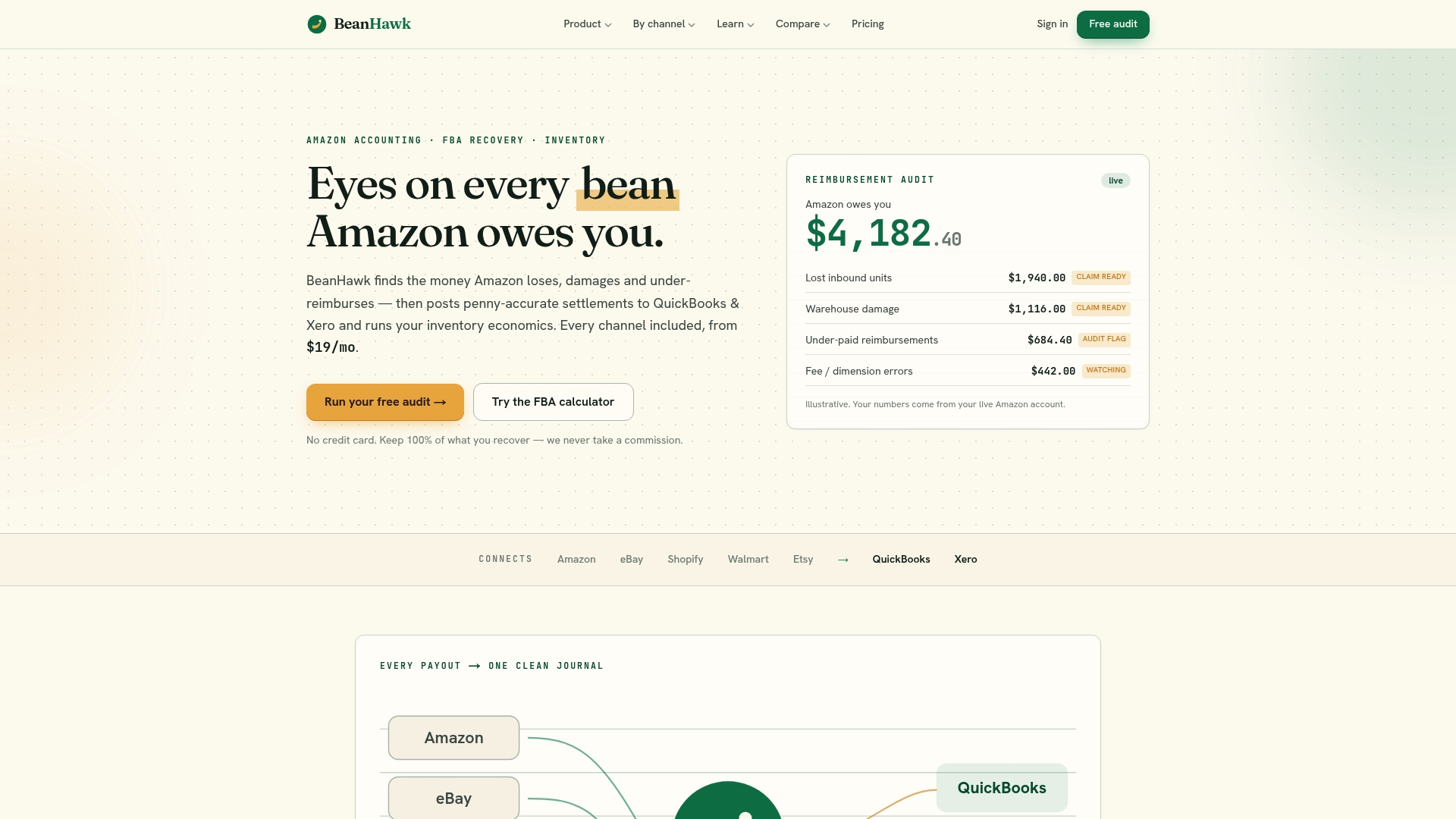
BeanHawk automates that monitoring and the accounting side of it together:
- Continuous FBA ledger monitoring to catch lost, damaged, or under-reimbursed inventory events.
- Automated settlement posting to QuickBooks and Xero, mapped to gross sales, fees, and refunds the way this article recommends.
- Centralized multi-channel posting, so reconciliation happens in one place instead of one spreadsheet per channel.
BeanHawk takes no commission on funds it recovers and charges flat monthly pricing instead. Sellers who suspect they are under-reimbursed can start with the free FBA reimbursement audit to see what may already be owed to them before deciding whether the full setup makes sense.
Sources
- What to do with Form 1099-K | Internal Revenue Service
- Migrate to the new QuickBooks Online e-commerce connectors
- Ecommerce accounting: A beginner’s guide | Shopify
- How to reconcile accounts payable | AccountingTools
FAQ
What is the best accounting software for multi-company accounting?
There is no single best option: the right choice depends on whether your priority is payout-level reconciliation, multi-currency support, or inventory sync across warehouses. QuickBooks and Xero both support connector integrations built for this, and the right pick usually comes down to which connector your specific sales channels support cleanly.
What is a multi-channel sales strategy?
A multi-channel sales strategy means selling the same products through more than one platform, marketplace, or storefront, such as Amazon, Shopify, and wholesale, at the same time. It increases revenue potential but also multiplies the bookkeeping complexity described throughout this guide, since each channel has its own fee structure and payout schedule.
What is the best multi-channel ecommerce platform?
The best platform depends on your product type, order volume, and whether you need built-in multi-location inventory support. Rather than one universal answer, evaluate platforms on how cleanly their sales and payout data exports into your accounting system, since that determines how much manual reconciliation you will do every month.
What are the four types of accounting systems?
Definitions vary, but a common breakdown separates accounting systems into manual bookkeeping, single-entry systems, double-entry systems, and computerized or cloud-based accounting software. Most multi-channel ecommerce sellers operate in the last category, using cloud software like QuickBooks or Xero connected to channel-specific integrations.
How often should I reconcile a multi-channel ecommerce business?
Match bank deposits to payouts on a near-daily or weekly basis, and treat month-end close as the point where inventory adjustments, sales tax, and channel-level profit and loss all get reviewed together. Waiting longer than a month to reconcile tends to let small mapping errors compound into larger discrepancies.