
Multichannel Sellers: Reconcile Bank Payouts Through Clearing Accounts

Reconcile each processor payout by posting full payout detail to a processor clearing account, matching the payout ID and net amount to the bank deposit, and resolving exceptions in a fixed priority order. This treats the processor report as a subledger rather than a bank memo you squint at, and it lines up with how the IRS and QuickBooks both describe gross-versus-net reporting. Tools exist that can automate the posting step for multi-channel sellers, such as Stripe Analytics for Engineers: Same Day Revenue with Cromojo.
TL;DR:
- Use a separate clearing account for each processor, post gross sales first, and record fees, refunds, chargebacks, and reserves in their own accounts.
- Match payout IDs, settlement dates, and destination accounts before investigating; then check batching, netted deductions, currency differences, failures, and duplicate or missing entries.
- Allow two to three business days for settlement, since month end payouts may reach the bank in the next reporting period without indicating an error.
- Automate matching when manual work becomes unreliable, but require tools to map each transaction to the chart of accounts and preserve transaction identifiers.
- Form 1099-K reports gross transactions, while bank deposits reflect deductions such as fees and refunds, so the two totals should not be expected to match.
Table of Contents
- What to check first when totals don’t match
- A repeatable step-by-step reconciliation process
- Why clearing accounts are the control that makes this work
- How automation and processor APIs cut reconciliation time
- A month-end routine that keeps the books clean
- Common payout discrepancies and how to fix each one
- What finance teams consistently get wrong about this process
- Automated settlement posting with BeanHawk
- FAQ
- Sources
What to check first when totals don’t match
When a payout and a bank deposit refuse to line up, resist the urge to start adjusting journal entries. Work through a short, ordered checklist instead, because most mismatches trace back to one of five predictable causes.
- Confirm the payout ID, the settlement or arrival date, and the destination bank account actually match what you’re comparing.
- Check for processor batching or split deposits, where one payout lands as two or more bank entries or several payouts combine into one.
- Look for fees, refunds, chargebacks, or reserves that were netted out of the payout before it ever hit the bank.
- Rule out currency conversion, partial payout failures, or duplicate and missing entries in either record.
- Pull the processor’s balance-transaction detail when the summary report doesn’t explain the gap.
Settlement lag causes a disproportionate share of these mismatches. A payout initiated on the last day of the month can arrive in the bank two or three business days later, which pushes it into the following reporting period and makes last month’s clearing account look unbalanced for no real reason.
Processor documentation backs up why this matters: Stripe’s payout object carries fields like id, amount, arrival_date, balance_transaction, destination, and status, which exist specifically so you can trace a payout without relying on a vague bank description.
Pro Tip: Sort unmatched items by dollar size before you start investigating.
A repeatable step-by-step reconciliation process
A clearing account turns reconciliation from a monthly scramble into a routine you can hand to anyone on the team. Here’s the sequence that keeps it consistent across channels.
- Export the processor’s payout report and the bank statement for the same date range, pulling full detail rather than a summary total.
- Post gross receipts to a dedicated processor clearing account, and record fees, refunds, and chargebacks to their own accounts instead of folding them into revenue.
- Match each payout ID and its balance-transaction lines against the clearing-account entries you just posted.
- Record the bank deposit against the clearing account, which should bring that account’s balance back to zero once everything lines up.
- Document any exceptions in writing and retain the payout report and bank statement as supporting workpapers.
The clearing account is doing real work here: it isolates settlement timing from revenue recognition, so your income statement reflects sales activity while your balance sheet reflects what’s actually sitting in transit. QuickBooks structures its own grouped-deposit feature around the same idea: when a recorded deposit doesn’t match the bank statement, QuickBooks recommends editing the grouping until the two totals agree, rather than forcing a mismatched entry through.
A clearing account balance that sits open for more than the processor’s normal settlement window, typically 2 to 3 business days, signals an exception worth investigating rather than a booking error you can ignore. That window comes directly from how processors batch and release funds, and tracking it gives you an early warning before small timing gaps become a backlog of unexplained variance.
For Amazon sellers specifically, this process gets another layer: payouts combine marketplace sales, FBA fees, storage charges, and occasional reimbursements into a single settlement, which is one reason a dedicated walkthrough for reconciling Amazon payouts in QuickBooks is worth keeping on hand as a reference.
Why clearing accounts are the control that makes this work
A clearing account works because it isolates one thing: money that’s left the customer but hasn’t landed in your operating bank account yet. Mixing that transit period into your revenue accounts is how reconciliation turns into guesswork.
- Use one clearing account per processor or sales channel, so each subledger stays clean and traceable.
- Post gross sales first, then route fees, refunds, chargebacks, and reserves to their own separate accounts rather than netting them against revenue.
- When deposits arrive grouped differently than they were recorded, QuickBooks’ deposit workflow lets you combine receipts through Undeposited Funds until the total matches the bank statement.
- A clearing-account balance that drifts well beyond your normal settlement lag is the signal to stop and investigate, not a balance to carry forward quietly.
A clearing account, used this way, becomes your early-warning system for the whole reconciliation process rather than a parking spot for numbers you haven’t dealt with yet.
Pro Tip: Name each clearing account after its channel (“Stripe Clearing,” “Amazon Clearing”) instead of using one generic account. It takes five minutes to set up and saves hours when you’re tracing a specific discrepancy months later.
How automation and processor APIs cut reconciliation time
Processor reports and APIs exist to be read as a subledger, not a bank statement substitute. Stripe’s balance-transaction documentation lists distinct types for fees, refunds, payouts, reserves, and reversals, which is exactly the breakdown your accounting ledger needs to mirror.
- Preserve balance-transaction IDs, failure codes, and statement descriptors in your exports so you have an audit trail if something reverses later.
- Automate once volume or channel count makes manual matching unreliable, which for most multi-channel sellers happens well before it feels obvious.
- Require that any automation map cleanly to your chart of accounts; a tool that just drops a lump sum into revenue defeats the purpose of a clearing account.
- Treat multi-channel settlement as its own problem: a transaction lifecycle across channels needs consistent mapping or each channel ends up reconciled differently.
Platforms exist that post settlements to QuickBooks and Xero with this structure already built in, which keeps the clearing-account logic intact even when sales come from several channels at once.
A month-end routine that keeps the books clean
A month-end checklist turns reconciliation into a fixed routine instead of a fire drill you run when the books won’t close.
- Lock the accounting period and download both the processor payout reports and the bank statement.
- Confirm each processor maps to its own clearing account and that fees, refunds, and chargebacks are posted separately from gross sales.
- Match payout IDs to bank deposits, building in a few business days of settlement lag rather than expecting same-day matches.
- Record how each exception was resolved, and retain the reconciliation file as a workpaper.
| Step | What it confirms |
|---|---|
| Lock period and pull reports | Processor and bank data cover the same date range |
| Map processors to clearing accounts | Each channel’s subledger stays separate |
| Match payout IDs to deposits | Settlement lag is accounted for, not mistaken for an error |
| Document exceptions | Audit trail exists for anything unresolved at close |
Retaining these files matters more than it seems: gross processor totals reported on a Form 1099-K won’t match your net bank deposits, and having the clearing-account detail on hand is what lets you explain the difference if anyone asks.
Common payout discrepancies and how to fix each one
Most mismatches fall into a handful of repeatable patterns, and each one has a specific fix rather than a generic “re-run the reconciliation” response.
- Split deposits or batching: when one payout arrives as multiple bank entries, or several payouts combine into one, split or combine your accounting entries to mirror what the bank actually shows.
- Fees netted from receipts: unbundle the deposit back into gross sales and a separate fee expense, rather than recording the net figure as revenue.
- Refunds, chargebacks, and trailing reversals: trace these through the payout or balance-transaction ID rather than assuming they belong to the current period’s sales.
- Reserves, holds, and payout failures: these show up as a reduced payout amount or a delayed release; reflect the held amount in the clearing account until it’s actually released. When a payout reverses, the processor typically generates a reversal entry that you can trace back through its own balance-transaction ID.
- Currency conversion differences: post the realized gain or loss separately instead of absorbing it into the payout amount, since processor conversion rates rarely match your book rate exactly.
If the bank deposit doesn’t equal the payout report, investigate in order: wrong settlement date or account, processor batching, netted fees, refunds or chargebacks, reserves, currency conversion, payout failure, then duplicate or missing entries.
That order isn’t arbitrary. It moves from the cheapest checks to the most time-consuming ones, so you’re not pulling balance-transaction detail before you’ve ruled out a simple date mismatch. If you ever need to correct a deposit that was reconciled incorrectly, unreconciling in QuickBooks Online is a cleaner fix than forcing a plug entry.
What finance teams consistently get wrong about this process

Most reconciliation problems aren’t accounting problems. They’re discipline problems, specifically the discipline to post gross and net separately instead of taking the shortcut of recording whatever number landed in the bank.
Track outstanding clearing-account days as a real metric, not a vague sense of “it usually clears fast.” A clearing account that routinely sits open two days longer than it used to is telling you something changed on the processor side before anyone else notices. Automation handles the matching at volume, but someone still needs to look at the exceptions it can’t explain. The teams that stay out of trouble are the ones who treat that review as a fixed task, not a response to a problem that’s already overdue.
, Tim
Automated settlement posting with BeanHawk
If you’re running payouts across Amazon and a handful of other channels, the clearing-account discipline above gets harder to maintain by hand every month. Some specialized solutions post settlements directly to QuickBooks and Xero with gross sales, fees, refunds, and reserves already separated, so the clearing account closes to zero without a manual rebuild each cycle.
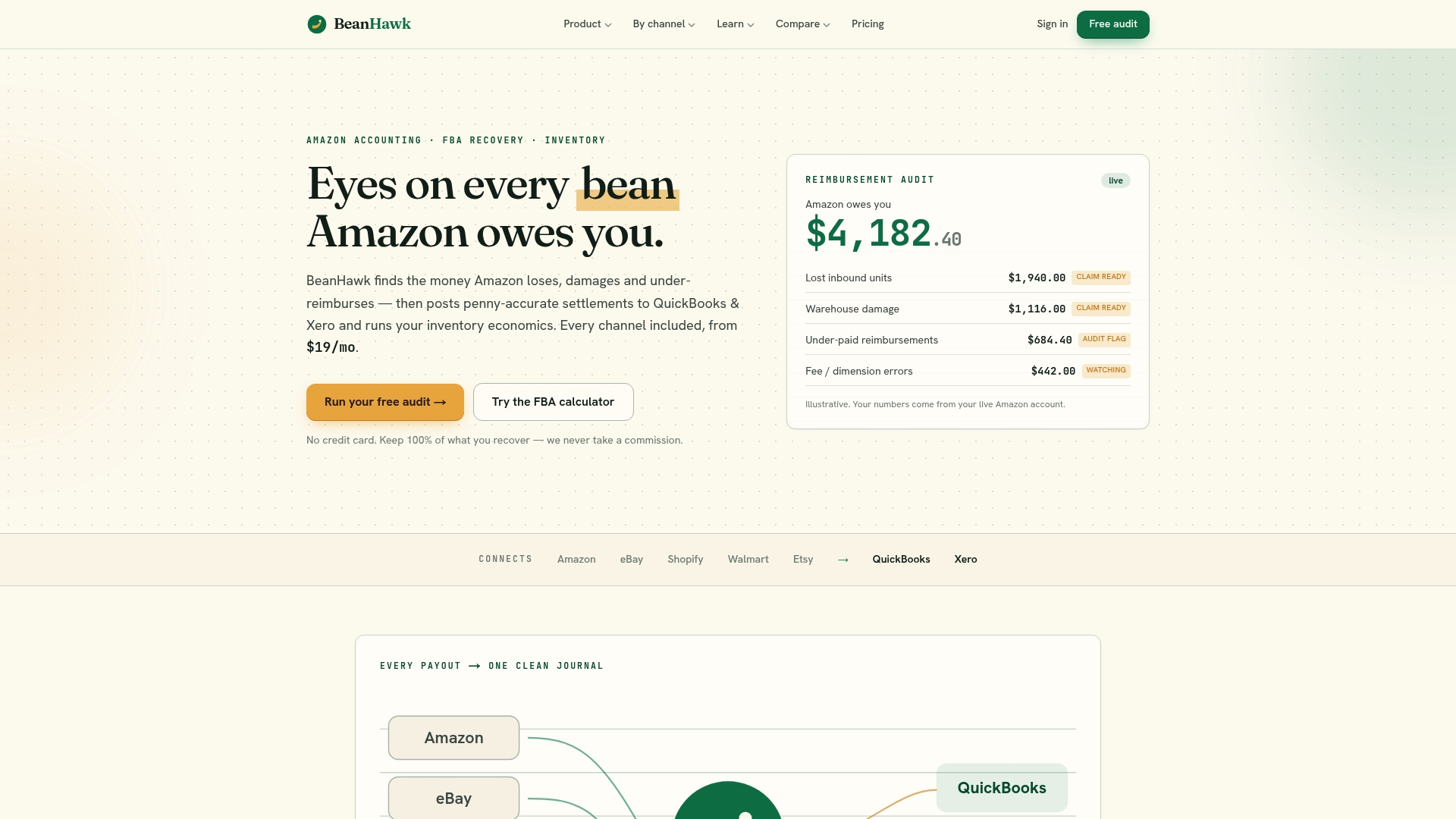
Our approach centers on settlement-first posting rather than order-by-order entry, which keeps the ledger aligned with how processors actually batch funds, and we monitor FBA shipment and ledger events continuously to catch reimbursements that would otherwise slip through. There’s no commission on recovered funds, just flat pricing by order volume, starting with a free FBA reimbursement audit if you want to see what’s currently unmatched before committing to anything.
FAQ
What is the purpose of a bank reconciliation statement?
A bank reconciliation statement confirms that your internal accounting records match what the bank actually shows, accounting for timing differences like outstanding deposits or uncleared items. It’s the control that catches errors, fraud, or missing transactions before they compound into bigger reporting problems.
What does a monthly bank account reconciliation involve?
A monthly reconciliation compares your recorded transactions against the bank statement for that period, matching deposits and withdrawals and identifying anything unexplained. For businesses with processor payouts, it also means tying payout IDs to bank deposits through a clearing account rather than comparing lump sums directly.
Is bank reconciliation hard to do?
Basic reconciliation is straightforward once you have a consistent process, but it gets harder with multiple sales channels, netted fees, and settlement lag. Using a dedicated clearing account per processor and following a fixed checklist for exceptions, as outlined above, keeps the difficulty manageable even at volume.
What happens if a bank reconciliation doesn’t balance?
An unbalanced reconciliation usually points to one of a few causes: a wrong date or account, batched or split deposits, netted fees, unrecorded refunds or chargebacks, or a currency conversion difference. Work through them in that order using the payout detail and balance-transaction records rather than adjusting the bank balance to force a match.
Why doesn’t my 1099-K match my bank deposits?
Form 1099-K reports gross payment-card or third-party-network transactions, and the IRS confirms it isn’t reduced for fees, refunds, or other adjustments. Your bank deposit reflects the net amount after those deductions, which is why the two figures are expected to differ.
Sources
- IRS: Understanding your Form 1099-K
- QuickBooks: Fix QuickBooks Payments deposits to match bank
- Stripe API: retrieve payout object