
6 Step Transaction Lifecycle: Multi Channel Reconciliation for CFOs

Multi channel reconciliation is the process of matching sales, fees, and payouts from every channel against bank deposits and the general ledger. The right approach treats it as a transaction lifecycle, not a single match, and automates the high volume comparisons first. Regulators including the FDIC treat this as a core internal control, and vendors now post settlements directly into QuickBooks and Xero to close that loop automatically.
TL;DR:
- Proper multi channel reconciliation must track transaction lifecycle stages, including order creation, payouts, refunds, and bank deposits, with automated exception handling.
- Timing gaps and batch payouts across channels pose risks to liquidity and delay financial closing, requiring tolerance and batch matching rules.
- Consistent data mapping and structured workflows are critical, especially for high-volume channels like marketplaces, to minimize discrepancies and manual cleanup.
- Implementing controls such as exception queues, role-based approvals, and audit trails ensures reconciliation is a true internal control aligned with regulator expectations.
- Starting automation with the largest leakage or hardest-to-reconcile channel delivers the fastest ROI and reduces unrecovered funds.
Table of Contents
- What counts as multi channel reconciliation
- Why poor reconciliation creates real financial risk
- Which channels to track and the data fields that make matching possible
- The reconciliation process as a transaction lifecycle
- Order-level, payout-level, and multi-step reconciliation methods
- Software features and controls worth requiring
- A rollout checklist from spreadsheets to automation
- How BeanHawk handles reconciliation for marketplace sellers
- What finance leaders should prioritize first
- Automating recovery and reconciliation with BeanHawk
- FAQ
- Sources
What counts as multi channel reconciliation
Multi channel reconciliation matches gross sales, discounts, taxes, fees, refunds, and net settlement amounts from each sales channel against the deposit that actually lands in the bank, then confirms the general ledger reflects the same numbers. It differs from single-channel bank reconciliation in a few concrete ways.
A single bank account reconciliation compares one ledger to one statement, usually with a predictable format and timing. Multi channel work means handling several file formats, aggregated or batched payouts that bundle dozens of transactions into one deposit, and liabilities like reserves or disputes that sit outside the normal cash flow. Timing gaps between an order date and its eventual payout add another layer: a sale recorded in week one might not hit the bank until week three.
Supervisory guidance from the FDIC on merchant processing frames this kind of reconciliation as part of an institution’s control environment, not an optional bookkeeping task. That framing matters for any finance team building a process, because it means:
- Reconciliation needs documented procedures, not ad hoc spreadsheet checks.
- Exceptions need a resolution trail, not a quiet write-off.
- The process should map to specific risks: transaction risk, liquidity risk, and timing risk.
Why poor reconciliation creates real financial risk
Weak multi channel reconciliation hides problems until they are expensive to fix. Unmatched fees, late-surfacing exceptions, and reserve shortfalls accumulate quietly because no single channel report shows the full picture.
Liquidity exposure is the part most teams underestimate. The OCC’s merchant processing handbook explains how acquirer and aggregator payout schedules create timing gaps between a sale and the cash actually landing in the bank, which can strain working capital for sellers who assume revenue equals available cash.
The operational drag is just as real:
- Manual matching across five or six channel formats consumes days each month that could go toward analysis instead.
- Missed fee or reimbursement discrepancies become permanent losses once the recovery window closes.
- Close delays cascade, since finance cannot finalize books until every channel is tied out.
A single reconciliation that proves cash movement can still misstate revenue timing. The SEC and EY’s guidance on revenue recognition makes clear that matching cash is not the same as confirming revenue is recorded in the right period, which means reconciliation and revenue review have to run as separate, paired checks.
Which channels to track and the data fields that make matching possible
Every sales channel and payment system that touches customer money needs a reconciliation feed such as marketplaces, payment gateways, point-of-sale systems, digital wallets, bank transfers, and the processors sitting between them. Each one reports data differently, which is exactly why a shared data model matters more than any single channel’s report format, as explained in detail for ecommerce and marketplaces in Cray’s partner content.
A workable minimum data model, consistent with the kind of structure referenced in SEC settlement disclosures, includes these fields for every transaction:
- Source channel and tender type, so a credit card sale is never confused with a wallet payment.
- Transaction or order ID, gross amount, discounts, tax, and shipping.
- Fees, refunds, disputes, and reserve amounts held back by the processor.
- Net settlement amount, payout ID, payout date, and the bank deposit date it ultimately lands under.
- GL reference and a match status flag for every line.
The hard part is rarely the fields themselves. It is mapping inconsistent field names across channels (one platform’s “settlement fee” is another’s “referral fee”) and handling payouts that batch dozens of orders into a single deposit with no visible line-item detail unless the source report is pulled separately.
The reconciliation process as a transaction lifecycle
Treat reconciliation as a chain of stages rather than one big match, because each stage produces its own data artifact that the next stage depends on.
- Order or authorization: the customer transaction is created and a gross amount, tax, and shipping are recorded.
- Capture and fees: the channel deducts referral, payment, or fulfillment fees, producing a net amount.
- Refunds and disputes: any reversal or chargeback adjusts the net figure and needs its own record.
- Settlement: the channel or processor aggregates transactions into a payout batch.
- Bank deposit: the payout lands in the bank account, often days after settlement.
- GL posting: the finance system records the net activity against the correct accounts.
This is a three-way bridge: operational activity (orders and fees) connects to settlement records (payout batches) which connects to bank cash (deposits). Say a seller’s marketplace shows $10,000 in gross sales, $1,200 in fees, and $300 in refunds for a batch: the expected settlement is $8,500, and that figure, not the $10,000 gross number, is what should match the bank deposit.
Matching logic typically combines a few approaches: exact ID-based matching where transaction IDs are available, tolerance-based matching for small rounding or currency differences, batched matching for bundled payouts, and time-window rules that allow a few days of lag between settlement and deposit. Exceptions that fail all three should route to a queue with an owner and a deadline, not sit unresolved.
Pro Tip: Build the exception queue before the automation rules; a rule set with nowhere to send its failures just hides problems instead of surfacing them.

Order-level, payout-level, and multi-step reconciliation methods
The right method depends on volume, how much ID data is available, and how channels batch their payouts.
- Order-level matching works when every transaction carries a unique, traceable ID straight through to settlement. It is the most precise method but breaks down fast once a channel aggregates data before it reaches the finance system.
- Payout or batch matching compares a single settlement total against the bank deposit, which suits high-volume channels that bundle hundreds of transactions into one payout. It needs tolerance rules to absorb minor currency or rounding differences.
- Multi-step or three-way reconciliation chains order-level, settlement-level, and bank-level checks together, which is usually necessary for marketplace and processor flows where fees, reserves, and refunds are calculated at different stages.
Teams with low transaction volume and clean IDs can often stay at order-level. High-volume sellers across several marketplaces almost always need the multi-step approach, since no single match catches every discrepancy on its own.
Software features and controls worth requiring
A reconciliation tool is only as good as its ability to parse messy channel data and route exceptions to a human when automation cannot resolve them. Look for:
- Prebuilt connectors to the specific marketplaces, gateways, and payment processors in use.
- A fee and refund parser that understands each channel’s own terminology instead of treating every deduction the same way.
- A rules engine supporting tolerance, batch, and time-window matching, not just exact-ID comparisons.
- Exception management with assigned owners, aging alerts, and a clear resolution trail.
- Automated GL posting with multi-currency support and reserve or hold tracking.
Operational controls matter as much as features. An audit trail, role-based approval for adjustments, and a defined reconciliation service level agreement turn the tool into an actual control rather than a faster spreadsheet. Recent SEC guidance on settlement operating models recommends preserving immutable, correlated event logs across the chain so examiners or auditors can trace a single transaction from order to deposit without gaps.
Tracking match rate, exception aging, recovered leakage, and days to close gives finance leaders a concrete read on whether automation is working, according to the SEC’s settlement operating-model guidance, which ties auditable event tracking directly to process reliability.
A rollout checklist from spreadsheets to automation
Moving off manual reconciliation works best as a staged rollout rather than a single cutover.
- Build the canonical data model first and map every channel’s field names to it before connecting any automation.
- Prioritize connectors for the highest-volume or highest-discrepancy channel, since that is where leakage is largest.
- Run the new automated process in parallel with the existing manual one for at least one full close cycle.
- Set exception SLAs and assign named owners so unresolved items do not linger past the close date.
- Document the audit trail and sign-off process so every adjustment has a reviewer and a timestamp.
- Expand to the next channel only after the pilot channel’s match rate stabilizes.
For sellers managing Amazon settlements specifically, this staged approach pairs naturally with settlement-first reconciliation practices that separate cash matching from revenue timing review.
Pro Tip: Measure match-rate uplift on the pilot channel before touching a second one; a process that looks automated but still needs manual cleanup will just multiply the cleanup work as you scale it.
How BeanHawk handles reconciliation for marketplace sellers
BeanHawk continuously monitors inbound shipments and FBA ledger events, which catches lost, damaged, or under-reimbursed inventory that typically gets buried in manual review. It then posts settlements to QuickBooks and Xero automatically, replacing the manual journal entry work most sellers do channel by channel.
This approach fits Amazon sellers and the accountants reconciling their marketplace settlements, particularly ones juggling high order volume across several fulfillment and payment flows. The practical outcome is fewer manual postings, settlement records that match the bank to the penny, and recovery of funds that would otherwise go unclaimed once Amazon’s reimbursement window closes.
What finance leaders should prioritize first
Start with the channel losing the most money to unmatched fees or missed reimbursements, not the easiest one to automate. That is where the first automation pass proves its value fastest.
Canonicalize data before writing matching rules; a rules engine built on inconsistent field names will produce false exceptions no matter how good the logic is. Once that is solid, measure recovered leakage and time to close as the two numbers that tell you whether the system is actually working.
, Tim
Automating recovery and reconciliation with BeanHawk
Some tools turn the reconciliation work described above into something that runs without a spreadsheet: they monitor FBA ledger events for lost or damaged inventory, file the recovery claims, and post the resulting settlements straight into QuickBooks or Xero without taking a commission on recovered funds.
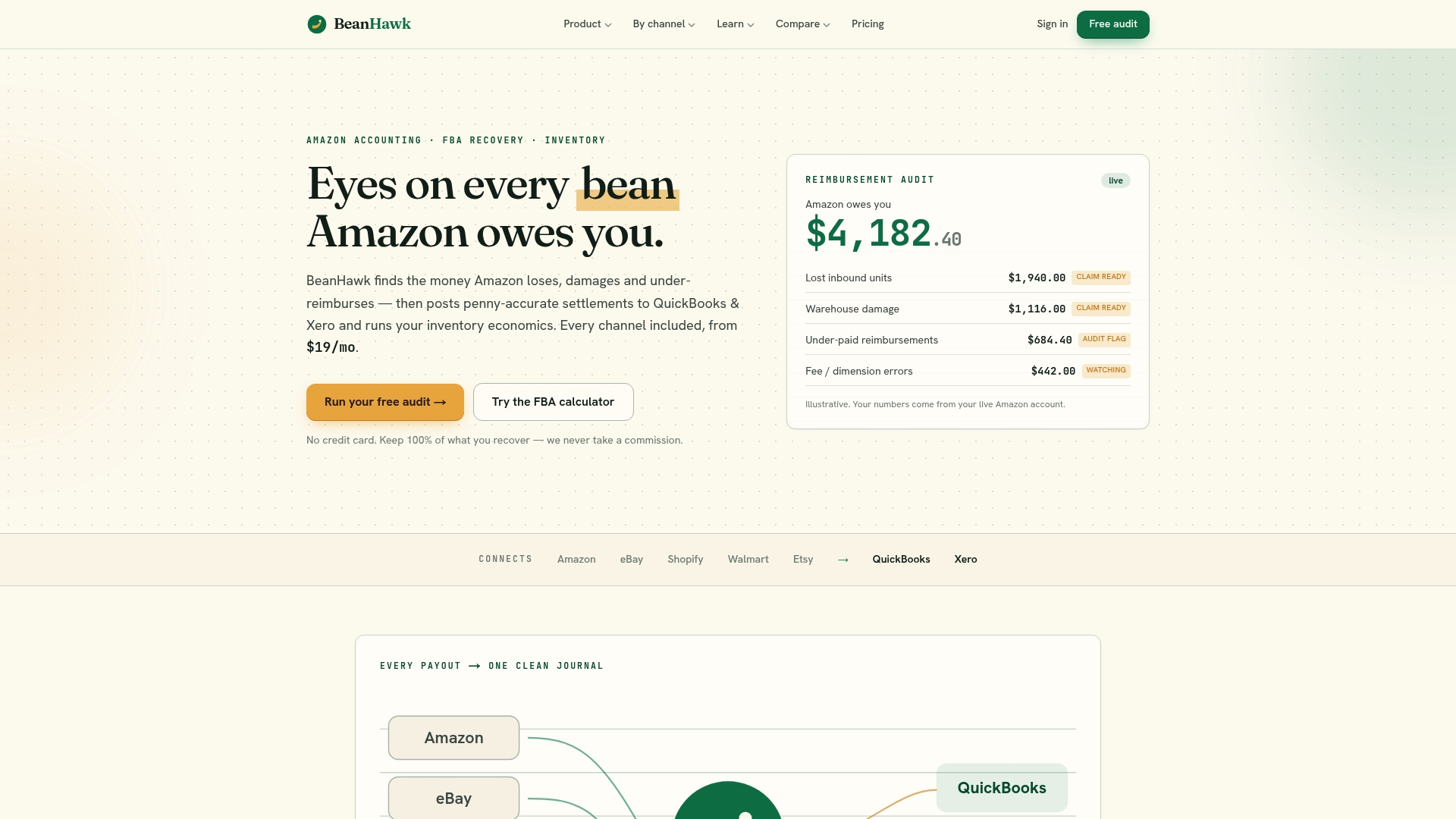
This fits sellers and accountants who are reconciling Amazon settlements manually today and want the fee parsing, exception handling, and GL posting to happen automatically instead. The free FBA reimbursement audit is the fastest way to see how much is currently going unclaimed, and the pricing page lists the Free, Starter, Growth, and Scale plans for teams ready to move past manual tracking.
FAQ
What are the three main types of bank reconciliation?
The three common types are balance-level reconciliation (comparing the bank statement balance to the ledger), transaction-level reconciliation (matching individual entries), and reconciliation of outstanding items like uncleared checks or pending deposits. In multi channel settings, these extend into order-level, payout-level, and three-way bridging to cover settlement and fee data.
What is the five-step reconciliation process?
A typical process runs: gather source records from every channel, match transactions against bank deposits, identify discrepancies, investigate and resolve exceptions, and post the confirmed adjustments to the general ledger. Multi channel reconciliation adds a settlement layer between the transaction and the bank step, since payouts are usually batched.
What is the best reconciliation software for banks?
The right choice depends on transaction volume, the number of channels involved, and whether automated GL posting is needed, so there is no single best answer for every team. Tools that directly recover and post marketplace settlements, such as BeanHawk for Amazon sellers, serve a different need than general-purpose bank reconciliation platforms built for single accounts.
What does transaction reconciliation mean?
Transaction reconciliation means confirming that a specific transaction’s recorded amount, after fees and refunds, matches the actual settlement and bank deposit tied to it. It is the smallest unit of the larger multi channel reconciliation process, which aggregates thousands of these matches across channels.
Sources
- SEC filing (example) , reconciliation and settlement disclosure
- FDIC: Merchant processing supervisory guidance (chapter excerpt)
- EY technical guidance on revenue recognition and marketplaces (ASC 606 considerations)
- OCC: Merchant processing comptroller’s handbook