
Up to 5 Business Days: Fix Amazon Disbursement Delays With Trace ID

Most Amazon disbursement delays trace back to one of four things: an account reserve, a bank or identity verification hold, a deferred DD+7 transaction, or a rejected bank transfer. Amazon’s own timing rules give you a window to judge whether you’re looking at normal processing or a real problem: up to five business days for a bank to post an initiated transfer, a 3-day hold after any bank-account change, and a standard 7-day delivery reserve on newer transactions. Check Statement View and the Disbursements tab first, grab your trace ID, and only then decide whether to wait or escalate.
TL;DR:
- Most delays are caused by account reserves, verification holds, or funds still within the seven-day deferred period, which are normal friction points.
- Bank posting times can take up to five business days after Amazon initiates the transfer, and recent bank updates add an additional three-day hold.
- Checking Statement View and the disbursement trace ID helps confirm if the transfer was scheduled, rejected, or still pending before contacting support.
- Sudden disbursement delays during peak events or high-volume periods may result from platform overload or temporary payment-posting lags.
- Proactively monitoring your ledger and verifying bank details regularly helps prevent surprises, with optional free audits available to identify missing funds or reimbursements.
Table of Contents
- What Causes Amazon Disbursement Delays and Payout Timing
- Common Causes of Delayed or Failed Amazon Payments
- How Long Amazon Disbursements Really Take
- How to Trace a Delayed Disbursement Step by Step
- How to Resolve a Delayed or Failed Disbursement
- How to Prevent Future Amazon Payout Problems
- The Beanhawk View: Why Monitoring Beats Waiting
- Get a Free Audit Before You Chase Another Payout
- Sources
- FAQ
What Causes Amazon Disbursement Delays and Payout Timing
Amazon doesn’t pay you the moment a customer buys something. It batches your sales, refunds, fees, and reimbursements into a settlement, then schedules a disbursement against your account’s payout cycle. You can see all of this in Seller Central’s Payments Dashboard, under Statement View, which lists your next scheduled disbursement date and the estimated amount Amazon expects to send.
Here’s where a lot of sellers get confused: there’s a difference between Amazon initiating a transfer and your bank posting it. Amazon can push the money out on schedule, but banks can take up to five business days to actually credit your account. That gap alone accounts for a huge share of “why hasn’t my money arrived yet” panic.
Then there’s the deferred transaction system, often labeled DD+7. Amazon holds back funds tied to certain orders for seven days past the delivery date, giving the return window time to close before it releases cash tied to that specific sale. It’s a built-in buffer, not a punishment, and it means your disbursement total can look smaller than expected simply because some revenue hasn’t cleared its holding period yet.
Bank-update holds work the same logic in reverse: change your account details, and Amazon pauses disbursements for about three days starting from the change date, purely as a fraud check. Verification-triggered pauses follow the same pattern. None of these are glitches. They’re designed friction points, and once you know they exist, most “delays” stop feeling mysterious.

Common Causes of Delayed or Failed Amazon Payments
Beyond routine timing gaps, a handful of specific triggers account for nearly every real disbursement problem sellers report.
- Account-level reserves. Amazon can place a reserve on your account at its own discretion, holding back a portion of your balance to cover potential refunds or claims. New sellers, sellers with rising return rates, and accounts flagged for risk see this most often.
- Identity or bank verification requests. Amazon periodically asks sellers to reverify their identity or business documents. Miss the document window, and disbursements freeze until you comply.
- Bank-change holds. Any update to routing or account numbers triggers the mandatory 3 day hold mentioned above.
- Deferred transactions. DD+7 funds simply aren’t available yet, even though they show up in your reports.
- Negative balances, refunds, and chargebacks. If refunds and chargeback liabilities outpace new sales, your payout can shrink to zero or turn negative.
- ACH rejects. Wrong routing numbers, closed accounts, or bank-side fraud filters bounce transfers back to Amazon.
- Automated risk reviews. Sudden sales spikes, like around Prime Day, sometimes trigger extra scrutiny that briefly slows payouts.
How Long Amazon Disbursements Really Take
A disbursement is usually routine, not delayed, if it fits inside these windows. Anything longer is worth investigating.
| Situation | Typical timing |
|---|---|
| Standard bank posting after Amazon initiates transfer | Up to 5 business days |
| Hold after changing bank details | 3 days from the change date |
| Deferred (DD+7) transaction | 7 days after delivery, then included in the next cycle |
| Reserve adjustment | Varies; releases as risk factors resolve |
| Site incident or peak-event backlog | A few extra days beyond normal posting |
Rolling reserves release incrementally as the orders behind them age out of the return window, so a reserve rarely lifts all at once. If you’re mid Prime Day or another high-volume event, build in a buffer. Payment-posting lags have been documented during periods of unusually high platform load, and those incidents sit outside anything your individual account did wrong.
How to Trace a Delayed Disbursement Step by Step
Before you contact anyone, gather your own evidence. Support moves faster when you hand them specifics instead of “my money isn’t here.”
- Open Statement View under the Disbursements tab. Confirm the scheduled date and estimated payout amount Amazon has on file.
- Locate the Disbursement trace ID tied to the transfer in question. This number is what your bank uses to search its own systems, and it’s the single most useful piece of evidence you can produce.
- Check Performance Notifications for any payment, verification, or account-health messages you may have missed.
- Call your bank and request an ACH trace using that trace ID. A bank can usually confirm within a day or two whether a transfer landed, bounced, or never arrived.
- Save screenshots of the scheduled date, estimated amount, trace ID, and any bank confirmation before you open a support case.
Pro Tip: Call your bank before you contact Amazon Seller Support. A bank confirmation that a transfer never arrived (or was rejected) turns a vague complaint into a specific claim Amazon can act on immediately.
How to Resolve a Delayed or Failed Disbursement
Once you’ve confirmed something is actually wrong, work through this sequence rather than jumping straight to a support ticket.
- Verify your bank details in Seller Central against your actual account, and check whether you changed anything recently that could have triggered a hold.
- Ask your bank directly about ACH rejects. Closed accounts, mismatched names, or fraud filters often bounce a transfer silently.
- Respond immediately to any verification request. Follow Amazon’s document guidance exactly. Partial submissions restart the review clock.
- Open a Seller Support case with specifics: the disbursement trace ID, scheduled date, estimated amount, and your bank’s confirmation (or denial) that funds arrived.
- Escalate if you hear nothing back after a few business days, especially once your bank has confirmed the funds never posted on their end.
- Lead with the trace ID and bank statement every time you talk to support. It stops the back and forth where Amazon blames your bank and your bank blames Amazon.
How to Prevent Future Amazon Payout Problems
A little routine maintenance beats a lot of reactive troubleshooting.
- Keep verification documents current and ready to upload the moment Amazon asks.
- Check Statement View regularly, not just when a payout looks off, so you catch a new reserve or adjustment early.
- Look into Express Payout if your account qualifies. Eligible sellers can receive disbursements within 24 hours of enrolling, instead of waiting on the standard cycle.
- Manage returns and disputes proactively. Fewer chargebacks means fewer reasons for Amazon to raise a reserve in the first place.
- Build known holds (bank changes, DD+7, peak-season reviews) into your cash-flow planning instead of treating them as surprises.
Pro Tip: Reconcile your Amazon settlements against your own books at least monthly. A reserve change or unexplained deduction is far easier to catch, and dispute, within days of it happening than three months later.
The Beanhawk View: Why Monitoring Beats Waiting
Most sellers only notice a disbursement problem after the money doesn’t show up, which is the most expensive time to find out. Continuous ledger monitoring flags an unexpected reserve change or reimbursement gap the day it happens, not weeks later. Posting summarized settlements straight into QuickBooks or Xero makes discrepancies visible against your actual books instead of buried inside an Amazon report. If your payouts have felt unpredictable for more than a cycle or two, a full reconciliation often surfaces deductions you never would have caught manually.
, Tim
Get a Free Audit Before You Chase Another Payout
Services exist for sellers who wonder where a disbursement went and whether it’s worth the hours it takes to dig through statements manually. Rather than cross-referencing every settlement line by hand, some tools continuously monitor inbound shipments and ledger events, flag amounts owed, and post summarized settlements into accounting software.
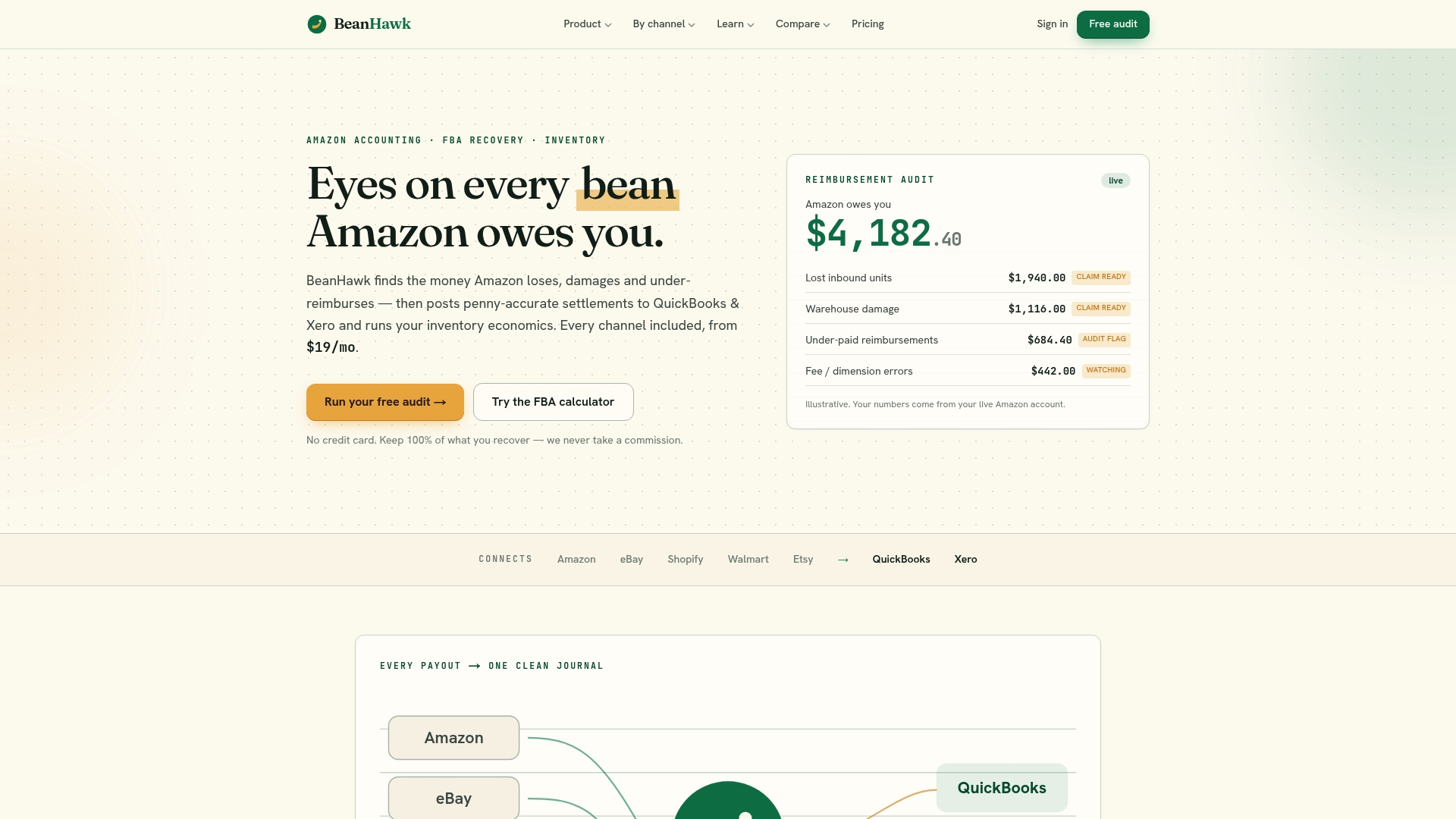
If a reserve, a chargeback, or a quiet ledger adjustment has been eating into your payouts, start with the free FBA reimbursement audit to see what’s actually missing. From there, plans run from the Free tier up through Starter, Growth, and Scale, scaled to your order volume, with no hidden fees layered on top. Run the audit this week and find out whether your last few “delays” were really disbursement timing or money Amazon simply never sent.
Sources
- How Amazon seller payments work
- Seller Central payments help , reserve information
- Amazon Pay , adding and managing a bank account (verification and holds)
- Verifying your identity , Amazon Pay
- Amazon payment-posting lag leads to disbursement delays
FAQ
How long does an Amazon disbursement take?
Once Amazon initiates a transfer, expect up to five business days for your bank to post the funds. If you’ve recently changed bank details, add the mandatory 3 day hold on top of that window before treating it as delayed.
Why are my Amazon payments delayed?
The most common reasons are an account reserve, a pending identity or bank verification request, a deferred DD+7 transaction still inside its holding period, or a rejected bank transfer. Check Statement View’s Disbursements tab first to see whether Amazon has already scheduled the payout on its end.
Is there an issue with Amazon right now?
Occasionally, yes. Independent reporting has documented platform-wide payment-posting lags that delayed disbursements for many sellers at once, separate from any individual account issue.
Why is Amazon taking so long to send my money?
It’s usually one of a few things: a reserve reducing your available balance, a verification hold, or funds still sitting inside the DD+7 deferred window tied to a recent delivery. If your bank confirms nothing was received and Statement View shows the transfer as sent, that trace ID is your fastest path to an answer from Seller Support.
Can Beanhawk help if my disbursement is short, not just late?
Yes. A delayed payout and an under-reimbursed one often look identical from Seller Central, and Beanhawk’s free reimbursement audit checks your ledger for missing FBA reimbursements that could explain why the amount, not just the timing, looks off.