
Amazon Fees Accounting for Sellers: Five Step Tax Ready Reconciliation

Recognize gross marketplace sales from your settlement detail, then post Amazon fees, refunds, and reimbursements as separate expense and adjustment lines so your net deposit matches the actual bank payout. Form 1099-K reports gross payments, not taxable profit, so you still have to reconcile it against your books before tax season. What follows is a checklist, a fee-by-fee breakdown, a step-by-step reconciliation process and guidance on tax handling and tooling.
TL;DR:
- The settlement reports must be mapped line-by-line to correctly identify fees, refunds, and adjustments for accurate reconciliation.
- Fees such as referral, fulfillment, storage, and advertising should be posted to specific expense accounts, not lumped together, to maintain clear margin analysis.
- Variances often stem from reserve holdbacks, refunds in different periods, or reimbursements not yet recorded, requiring detailed investigation and periodic adjustments.
- Form 1099-K reports gross payments and needs to be adjusted for refunds, fees, and taxes to accurately reflect taxable revenue.
- Automating data import and reconciliation processes with specialized tools and routines reduces manual errors and helps recover lost or under-reimbursed inventory.
Table of Contents
- Quick Checklist: Reports and Records to Gather Before Reconciling
- Breakdown of Amazon Fee Types and the Bookkeeping Entry for Each
- Step-by-Step Reconciliation Workflow for an Amazon Settlement Period
- Form 1099-K and Year-End Reconciliation: What to Watch For
- Allocating Fees to COGS and Calculating SKU-Level Margins
- Common Mistakes, Diagnostics, and Quick Fixes
- Practical Tooling and Integrations: What They Do and How to Use Them
- BeanHawk Perspective: How We Solve Reconciliation and Recovery
- Start With a Free Audit of What Amazon Owes You
- FAQ
- Sources
Quick Checklist: Reports and Records to Gather Before Reconciling
Before you touch a single journal entry, pull the raw data. Reconciliation falls apart when the source reports are incomplete or the wrong version of a report gets used.
Start in Seller Central and download these:
- Settlement report (Transaction View): the line-level detail behind every payout, including fees, refunds, and adjustments.
- Payments/Deposit report: shows the actual amount deposited and the payout date.
- Fee Preview: Amazon’s own estimator for referral, fulfillment, and storage fees before a sale posts.
- Inventory adjustment report: documents lost, damaged, or disposed units that affect both reimbursements and COGS.
- Returns report: tracks customer returns separately from financial refunds, since the two don’t always happen in the same period.
On the accounting side, you need an Undeposited Funds account or an equivalent clearing account, a chart of accounts that separates fee types instead of lumping them into one “Amazon fees” bucket, product-level inventory and COGS detail, and your bank statement for the actual deposit dates.
Timing is where most sellers get tripped up. A sale recorded on the date it happens almost never matches the date the payout hits your bank, because Amazon batches settlements over a period and then pays out days later. You also need to track Amazon’s reserve or holdback balances, since a portion of your payout is often withheld for days against potential refunds or chargebacks. That holdback is a receivable, not an expense, and it needs its own line on your books until Amazon releases it. Finally, keep inbound shipment costs (freight, prep, labeling) on hand separately, since they feed into landed COGS later in this guide.
Breakdown of Amazon Fee Types and the Bookkeeping Entry for Each
Amazon’s own FBA fee documentation breaks fees into categories: fulfillment, storage, long-term storage, removal, and return-related charges. Each one needs a distinct treatment in your books if you want margins that mean anything.
1. Referral and selling plan fees. These are Amazon’s cut for access to the marketplace, typically a percentage of the item price. The cleanest approach for accrual-based books is to record the full sale price as gross revenue, then post the referral fee as a selling expense in its own account. Some sellers prefer to net the fee directly against revenue, but that approach buries a cost that you want visible when you’re analyzing category-level profitability. Our glossary entry on the referral fee walks through this distinction in more detail.
2. FBA fulfillment fees. These cover picking, packing, and shipping for each unit sold. Most sellers post them to a dedicated “FBA Fulfillment Fees” expense account rather than COGS, because they’re transaction-based and tied to the sale, not the purchase of inventory. That said, if you’re building a true landed-cost model for margin analysis, there’s a case for allocating a portion into COGS. We cover that trade-off in the margin allocation section below.
3. Storage fees, monthly and long-term. Monthly storage fees accrue based on the cubic footage your inventory occupies in Amazon’s warehouses, and long-term storage fees kick in for inventory sitting past a certain age threshold. These should post to an operating expense account, and if your business carries meaningful inventory volume, consider accruing an estimate at month-end rather than waiting for the invoice to hit your settlement, since storage charges don’t always land in the same period as the inventory they relate to. Removal and disposal charges, which Amazon bills when you ask them to send back or destroy excess stock, get their own line too, since mixing them with standard storage fees makes it hard to spot inventory that’s not moving.
4. Advertising and promotions. Sponsored Products, Sponsored Brands, and similar ad spend should post as a marketing expense in the period the ad ran, not the period the resulting sale closed. Promotional discounts (Lightning Deals, coupons) reduce the gross sale price and should be reflected as a contra-revenue line so your margin analysis reflects what you actually collected, not list price.
5. Returns, refunds, chargebacks, and reimbursements. This is where most reconciliation errors start. A customer refund reduces revenue and should post against a sales returns account, matched to the original sale where possible. A chargeback is a forced refund triggered by a payment dispute and gets the same treatment, with a note if it involves a fee penalty. Reimbursements, on the other hand, which Amazon issues for lost or damaged inventory, are not revenue. They’re a correction entry that restores value you’d already written off, so they should post against the inventory loss or COGS account they’re correcting rather than to sales. Our post on Amazon returns and reimbursements covers the sixty-day return window and how it affects timing.
Numbered reference for posting logic:
- Gross sale price posts to revenue.
- Referral fee posts to a selling expense account.
- Fulfillment fee posts to a fulfillment expense account (or COGS, per your allocation method).
- Storage and removal charges post to operating expense.
- Ad spend posts to marketing expense in the period incurred.
- Refunds and chargebacks post against sales returns.
- Reimbursements post against the inventory loss or COGS entry they correct, never as new revenue.
Pro Tip: Use a sales receipt plus itemized expense lines for each settlement period rather than one giant consolidated journal entry. It takes longer up front but makes every variance traceable to a specific fee type when something doesn’t match.
Step-by-Step Reconciliation Workflow for an Amazon Settlement Period
A settlement period reconciliation is really five steps, done the same way every time.
Step 1: Pull the reports. Download the settlement report, the transaction view, and the payments report from Seller Central for the period, then pull your bank statement for the matching payout date. The payout date on your bank statement won’t match the sale dates inside the settlement, and that’s expected.
Step 2: Map every line. Go line by line through the settlement and assign each one to a category: sales, refunds, referral fees, fulfillment fees, storage fees, advertising, or tax collected. This is tedious the first few times and becomes mechanical once your chart of accounts is set up correctly. The QuickBooks Online Amazon connector automates much of this import, though it still needs a human check on anything unusual.
Step 3: Clear undeposited funds. Record each transaction (or a summarized batch, depending on your volume) to an Undeposited Funds account, then apply the actual bank deposit against that account. When the deposit clears cleanly against undeposited funds, you know your mapping was accurate. When it doesn’t, you have a variance to chase.
Step 4: Investigate variances. The usual suspects are reserve holdbacks that haven’t released yet, refunds that posted in a different period than the original sale, and reimbursements that Amazon issued but never made it into your books. Document each variance with a short note so the next person reconciling this account (including future you) doesn’t have to re-investigate from scratch.
Step 5: Close the period. Once the deposit matches and every variance has an explanation, close the period. For any amount still held back by Amazon, create a receivable entry rather than writing it off, and track it until the funds release.
Common variance causes to check first:
- Reserve or holdback balances not yet released by Amazon.
- Refunds processed in a later settlement period than the original sale.
- Reimbursements issued but never posted to the ledger.
- Currency or marketplace mismatches for sellers operating in more than one region.
Our guide on reconciling Amazon payouts in QuickBooks walks through this process inside the software itself, with screenshots of each step.
Form 1099-K and Year-End Reconciliation: What to Watch For
Form 1099-K reports gross payment volume, and Box 1a specifically shows the raw total Amazon processed on your behalf, with no deductions for fees, refunds, or shipping costs. The IRS guidance on Form 1099-K is explicit on this point: the number on the form is not your revenue, and it’s definitely not your profit.
A simple reconciliation looks like this:
- Start with the 1099-K gross payment amount in Box 1a.
- Subtract refunds and returns processed during the year.
- Subtract fees and any sales tax Amazon collected and remitted on your behalf.
- Compare the result to your accounting system’s revenue figure for the same period, adjusted for your accounting method (cash versus accrual).
If those two numbers don’t land close to each other, the gap usually traces back to timing differences, uncategorized fees, or a settlement period that straddles two calendar years.
The federal reporting threshold for Form 1099-K is $20,000 in gross payments and 200 transactions, per IRS guidance, though some states apply lower thresholds, so it’s worth checking your state’s specific rule rather than assuming the federal number applies everywhere. The IRS Form 1099-K FAQs confirm the same point: adjustments for fees, credits, refunds, and shipping are the taxpayer’s responsibility to make, not the platform’s. For a structured walkthrough, our one-page workpaper for reconciling Amazon’s 1099-K lays out each subtraction in order so nothing gets missed before your numbers go to a preparer.
Allocating Fees to COGS and Calculating SKU-Level Margins
Not every Amazon fee belongs in operating expense. Under the inventory guidance referenced in IRS Publication 334, the cost of goods sold should reflect the full cost of getting a product ready for sale, which includes purchase price and inbound freight. That principle extends naturally to certain fulfillment-related costs, which is why some sellers capitalize a portion of FBA fulfillment fees and inbound prep costs into COGS rather than treating them purely as a selling expense.
There are three common allocation methods:
- Per-unit allocation: divide total fulfillment and inbound costs by units sold. Simple to calculate, but it distorts margins when SKUs vary widely in size or weight.
- Weight or size-based allocation: assigns cost in proportion to the actual driver, like cubic footage or pick-pack complexity. More accurate for a catalog with mixed product sizes, but takes more setup.
- Proportionate-to-units-sold allocation: spreads a shared cost pool (like a bulk inbound shipment) across the units it covered, adjusted for how many have actually sold versus how many remain in inventory.
Here’s a simplified example. Say a seller pays $500 to ship an inbound pallet of 1,000 units, and 600 have sold this period. Under per-unit allocation, that’s $0.50 per unit landed cost, applied to the 600 units sold, for $300 in additional COGS this period. If that same product sells for $15 and carries $4 in referral and fulfillment fees, the unallocated gross margin looks like $11 per unit, but once the $0.50 landed cost is factored in, the real margin is $10.50 per unit, a small but real difference that compounds across thousands of units.
Pro Tip: Pull your COGS from the ledger, not from a static spreadsheet. A spreadsheet locked to last quarter’s buy cost won’t reflect a new supplier price, a freight rate change, or a reimbursement that corrected a prior loss, and that gap grows quietly until a margin review forces you to notice it.
Our FBA fee and profit calculator can run these allocation scenarios per SKU if you want to compare methods before committing to one in your books.

Common Mistakes, Diagnostics, and Quick Fixes
Most reconciliation problems trace back to a handful of recurring habits.
- Recording only the net deposit: this hides the fee detail entirely and makes it impossible to analyze margin by product or category.
- Misclassifying reimbursements as revenue: inflates sales figures and understates the actual cost of inventory loss.
- Ignoring reserve and holdback balances: leads to a “missing” cash balance that never gets investigated or properly tracked as a receivable.
- Skipping per-SKU fee allocation: makes every margin report an average that hides which products are actually profitable.
A few quick diagnostics catch these fast: compare your deposit-to-settlement variance ratio each period (it should be small and explainable), spot-check margins on your five best-selling SKUs against the fee detail in the settlement, and flag any inventory that’s aged past Amazon’s long-term storage threshold without selling.
Fixes are usually a journal correction or a reversal entry, followed by building a monthly reconciliation routine so the same gap doesn’t reappear next period.
Practical Tooling and Integrations: What They Do and How to Use Them
The QuickBooks Online Amazon connector imports transaction-level data from your settlements, creates sales receipts and expense entries, and uses an Undeposited Funds workflow to generate deposits that match your actual Amazon payouts. It handles the mechanical import well, but it still needs a human to map unusual adjustments correctly, especially reimbursements and reserve releases.
Beyond the basic connector, a dedicated settlement reconciliation tool becomes worth adopting once your transaction volume makes manual line-by-line mapping impractical. These tools typically automate line-level categorization, flag missing reimbursement claims, and post directly to your ledger instead of requiring a manual import review each period.
A few integration habits matter regardless of which tools you use:
- Keep raw settlement reports archived even after posting, since Amazon’s own historical report access is limited.
- Standardize your chart-of-accounts mapping once, so every tool or bookkeeper applies the same categories consistently.
- Schedule reconciliation monthly rather than quarterly, since variances compound and get harder to trace the longer they sit.
For a broader comparison of accounting software options built for marketplace sellers, our post on accounting software for Amazon sellers breaks down what each category of tool actually automates.
BeanHawk Perspective: How We Solve Reconciliation and Recovery
Our approach addresses the problem of sellers losing money quietly through missed reimbursements and reconciliation gaps that nobody has time to chase manually. Continuous monitoring of inbound shipments and FBA ledger events helps ensure lost, damaged, or under-reimbursed inventory is flagged and claimed instead of written off and forgotten.
Automating the posting process after settlement closure allows resulting entries to be posted directly to accounting software like QuickBooks or Xero, mapped to appropriate categories, reducing the need for manual re-entry of fee lines. The combination of recovery and automated posting helps keep inventory economics and financial statements aligned over time.
, Tim
Start With a Free Audit of What Amazon Owes You
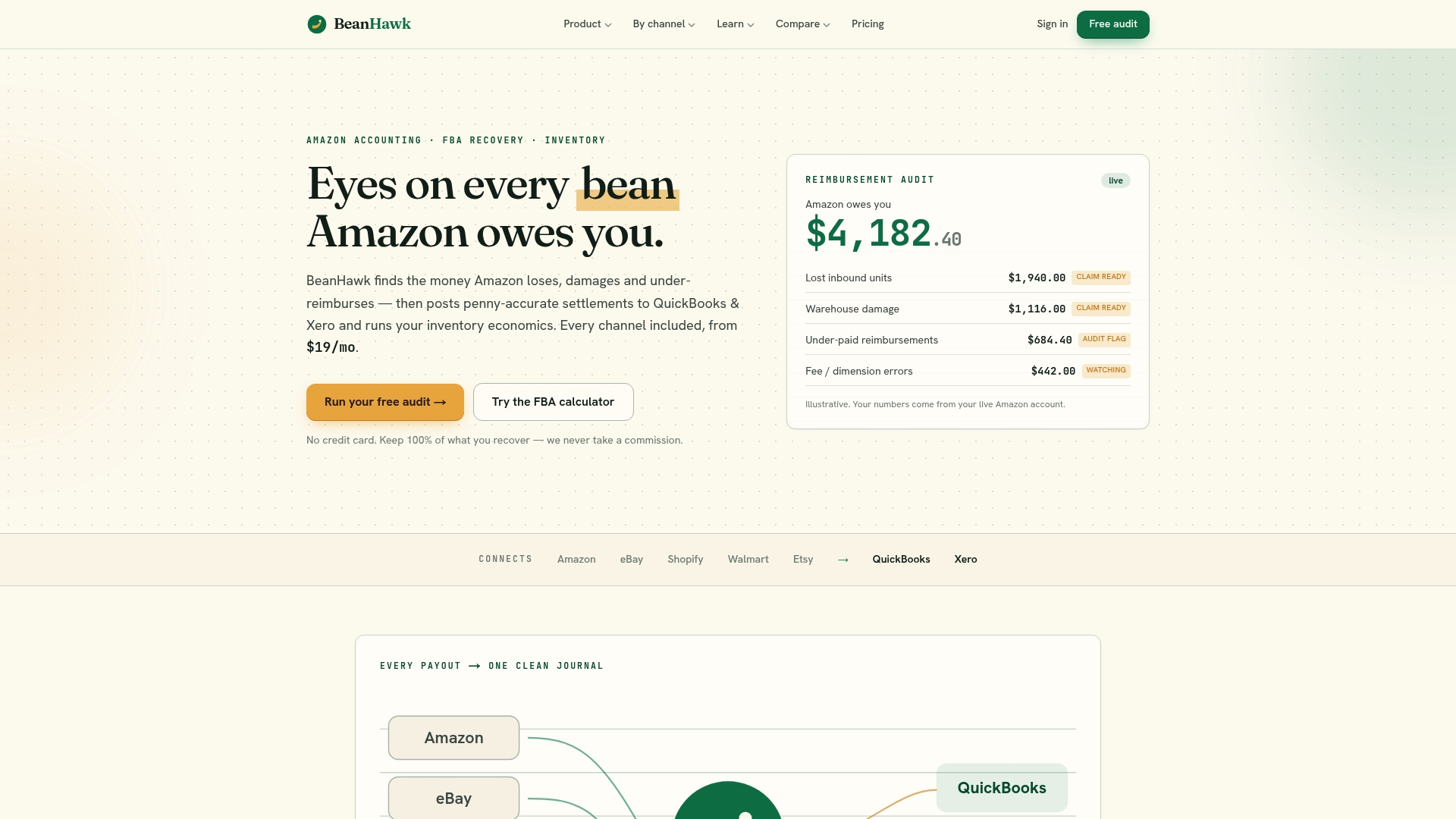
The fastest way to find out whether you’re leaving money on the table is to check, not guess. Our free FBA reimbursement audit reviews your inbound shipment and ledger history for lost, damaged, or under-reimbursed inventory, the exact gap this guide walks through manually.
If the audit turns up recoverable funds, our plans at BeanHawk pricing start with a Free tier and scale through Starter at $19 per month, Growth at $49 per month, and Scale at $99 per month, depending on your order volume, with automated settlement posting and reimbursement monitoring included rather than billed as extras. Check what reimbursement actually means for your account in our FBA reimbursement glossary entry before you start.
This article is general information, not a substitute for advice from a qualified financial advisor. Consult a qualified financial professional about your own circumstances before acting on anything here.
FAQ
How are Amazon fees calculated?
Amazon calculates fees like referral and fulfillment charges based on category, item price, weight, and dimensions, and the exact breakdown is available through Amazon’s own Fee Preview and Revenue Calculator tools in Seller Central. Storage fees are calculated separately based on cubic footage occupied and how long inventory has been in a warehouse.
Is FBA still profitable in 2026?
Profitability under FBA depends heavily on your margins after fulfillment, storage, and referral fees are properly allocated, not on list price alone. Amazon periodically adjusts FBA fees with advance notice and continues to provide its Revenue Calculator so sellers can model the impact on unit economics before committing inventory.
Is it better to do FBM or FBA?
Neither model is universally better: FBA trades fulfillment fees and storage costs for Prime eligibility and reduced hands-on labor, while FBM (fulfilled by merchant) avoids those fees but requires you to handle shipping and storage yourself. The right choice depends on your margins per unit, order volume, and whether Prime eligibility meaningfully drives your sales.
Is Amazon charging a 3.5 percent fee?
Amazon’s fee structure is based on category-specific referral percentages, fulfillment charges, and storage costs rather than a single flat rate across all sellers. Check the current FBA fee documentation or run your own SKU through Amazon’s Fee Preview tool for an accurate figure, since rates vary by product category.
Sources
- Understanding Your Form 1099-K | Internal Revenue Service
- A guide to Amazon FBA fees | Sell on Amazon - Sell on Amazon
- Connect Amazon Seller Central to QuickBooks Online | QuickBooks Help