
Amazon Bookkeeping Automation: Audit, Connect, Validate in 30,60 Days

Yes, you can automate most repetitive Amazon bookkeeping tasks: settlement ingestion, fee categorization, COGS updates, and reimbursement discovery. The highest-return move is building a reliable data pipeline from Amazon’s settlement reports into your accounting platform, with rules that categorize transactions and flag exceptions automatically. Start by mapping your settlement report fields to your chart of accounts, then schedule the imports.
TL;DR:
- Automation can map settlement amount types and descriptions to ledger accounts, link SKU costs and advertising spend to products, and continuously flag reimbursement gaps.
- Keep unusual settlement lines, disputed reimbursements, and tax or entity decisions in manual review, because automation handles volume better than judgment.
- A phased rollout can take 30 to 60 days; validate it against manual books for one complete settlement cycle before tax or investor reporting.
- Sellers carrying inventory generally need accrual accounting, and they should retain raw settlement files, posting audit trails, and controls that document automated functions.
- When sales span Amazon, Shopify, and wholesale, use a shared inventory ledger keyed by SKU, while mapping each channel’s distinct fees separately.
Table of Contents
- Which bookkeeping tasks you can (and should) automate
- Tools, connectors, and the data flows that make automation reliable
- Implementation roadmap: how to automate bookkeeping in 30 to 60 days
- Accounting rules and recordkeeping you need to preserve when you automate
- How BeanHawk fits into an automated bookkeeping workflow
- Integrating multi-channel sales and inventory beyond Amazon
- Security and data privacy considerations when automating bookkeeping
- Customization and scalability as your business grows
- Author perspective: automation plus oversight, not automation alone
- Start with a free FBA reimbursement audit
- FAQ
- Sources
Which bookkeeping tasks you can (and should) automate
Not every task carries the same payoff. Scheduled settlement ingestion using the settlement report schema is the backbone of automation because it feeds everything downstream: categorization, COGS, and reconciliation all depend on clean itemized data arriving on a predictable cadence.
Once that data flows in, several tasks become candidates for automation:
- Transaction categorization: map each settlement amount-type and description to the right ledger account instead of hand-sorting fees
- COGS tracking: push SKU-level costs automatically from purchase order and landed cost feeds as units sell
- PPC allocation: use rules to tie advertising spend back to specific ASINs or SKUs for real product-level margins
- Reimbursement monitoring: run continuous checks for lost, damaged, or under-reimbursed inventory rather than periodic manual audits
Some steps still need a human. Unusual settlement line items, disputed reimbursements, and anything touching tax elections or entity-level accounting decisions should route to manual review before they post. Automation handles volume well; it handles judgment poorly.
Tools, connectors, and the data flows that make automation reliable
Three classes of tools handle Amazon bookkeeping automation: API-based direct connectors that pull data straight from Amazon’s Selling Partner API, middleware or sync services that sit between Amazon and your books, and accounting platforms like QuickBooks or Xero that offer their own import automation. Each needs the same underlying data to work well: itemized settlement lines, amount-type and description fields, SKU or ASIN identifiers, settlement and deposit totals, and timestamps for every transaction.
Whatever platform you land on needs a few non-negotiable capabilities:
- Double-entry support with automated journal posting, not just a transaction feed
- Built-in reconciliation workflows that match settlements to bank deposits
- Audit logs that record what posted, when, and under what rule
- Idempotent posting so a re-run import never duplicates entries
- Scheduled pulls with raw report retention and an exportable audit trail
Pro Tip: Keep the raw settlement file every time you import it, even after it posts successfully. Reprocessing a corrected report is far easier when you still have the original.
Implementation roadmap: how to automate bookkeeping in 30 to 60 days
A phased rollout lowers risk because you catch mapping errors before you depend on the output for tax filings or investor reporting.
- Phase 1, audit (days 1 to 10): pull your settlement reports, transaction history, inventory data, and FBA ledger events. Document your current chart of accounts so you know what you’re mapping against.
- Phase 2, design the data flow (days 10 to 20): decide between API-based ingestion and scheduled CSV exports, then write mapping rules for each fee type and a SKU-to-ASIN crosswalk.
- Phase 3, configure automation (days 20 to 35): schedule the pulls, set posting rules for each account, and turn on COGS or landed cost updates tied to unit sales.
- Phase 4, validate (days 35 to 50): run automated and manual books in parallel for one full settlement cycle, reconcile every deposit against your bank statement, and adjust rules where mismatches appear.
- Phase 5, operate (days 50 to 60 and ongoing): set a monthly review cadence, build an exception-handling process for anything automation can’t resolve, and define an escalation path for reimbursements that stay unresolved past a cycle.
Practitioners report major time savings when they move from manual spreadsheets to automated connectors that push itemized settlement data directly into accounting software, freeing hours previously spent on fee categorization and PPC allocation for actual margin analysis.
Reconciliation itself follows a repeatable pattern: match settlement lines to fulfillment records and bank deposits daily, keep an open match list for items that settle in the next cycle, and close the loop once every line has a corresponding deposit or documented exception.
Accounting rules and recordkeeping you need to preserve when you automate
Automation has to work inside the accounting rules that already govern your business, not around them. The IRS requires an accounting method that clearly reflects income, and accrual accounting is generally required when inventory is an income-producing factor, which covers most Amazon sellers carrying physical stock.
A computerized bookkeeping system needs documentation and controls so that machine-sensible records reconcile cleanly with your tax return, including a description of the automated functions and the controls that prevent unauthorized changes.
IRS Publication 583 spells out what that documentation looks like in practice:
- Keep your chart of accounts, a description of each automated flow, and the controls guarding them
- Retain every raw settlement export alongside the audit trail of what it posted
- Preserve records that tie each automated entry back to its underlying source document
Owners remain accountable for what the system posts. Automated output still needs a human to verify it before you file taxes or hand books to an accountant.
How BeanHawk fits into an automated bookkeeping workflow
Generic settlement automation handles the predictable math: fees, categorization, deposits matching. It tends to miss the reimbursement gap, the inventory Amazon loses, damages, or under-pays for that never shows up as a clean settlement line.
We built our monitoring to close that specific gap:
- Continuous inbound shipment and FBA ledger event monitoring that catches reimbursement triggers as they appear, not on a delayed audit cycle
- Automated settlement posting to QuickBooks and Xero so summarized settlements land in your books without manual entry
- Centralized reconciliation across channels, keeping inventory economics and COGS aligned as units move
Pro Tip: When you evaluate any reimbursement or posting tool, check for API-level access, a clear posting method, exportable audit logs, and a sample report before you commit, so you know exactly what lands in your books.
That combination, reimbursement recovery plus accurate posting, addresses the part of the bookkeeping stack most generic connectors leave to manual review.
Integrating multi-channel sales and inventory beyond Amazon
Most sellers running Amazon also sell through Shopify, Walmart, eBay, or retail wholesale, and each channel generates its own settlement format, fee structure, and inventory draw against the same physical stock, which can be managed efficiently with marketplace commission splitting. Treating Amazon bookkeeping in isolation creates a blind spot: a unit sold on Shopify still reduces the inventory pool that your Amazon COGS calculations depend on.
The practical fix is a shared inventory ledger that every channel’s automation writes to and reads from, with SKU as the common key across platforms. Settlement data from each channel still needs its own mapping rules, since fee types and report formats differ, but the inventory and COGS layer underneath should stay unified. Without that, you end up with COGS figures that look accurate per channel but misstate your actual margin once you roll everything up.

This matters more as a seller’s channel count grows. A single-channel seller can get away with simpler tooling. A seller running Amazon, Shopify, and a wholesale account needs automation that reconciles inventory draws across all three before it posts a COGS entry anywhere, or the numbers in each channel’s books will quietly drift apart over time.
Security and data privacy considerations when automating bookkeeping
Automating your books means granting API access to financial and inventory data, and that access needs the same scrutiny you’d give a new employee with login credentials. Look for connectors that use read-scoped API keys rather than full account access, support multifactor authentication, and log every connection and data pull.
Regulatory guidance around AI-assisted automation consistently points the same direction: automated outputs need independent human review before anyone relies on them for filings or financial decisions. That applies directly to bookkeeping automation, where a miscategorized fee or a bad reconciliation rule can compound across months before anyone notices.
Practical safeguards worth building into your workflow include revoking API access for any tool you stop using, storing raw settlement exports somewhere access-controlled, and keeping your exception-review process documented so an auditor or new accountant can follow it. None of this requires exotic security tooling, just the same discipline you’d apply to any system handling bank-level financial data.
Customization and scalability as your business grows
A seller moving a few hundred units a month needs different automation than one running a seven-figure, multi-brand operation. Early on, the priority is usually just getting settlement data into the books reliably and categorized correctly, since manual bookkeeping at low volume, while tedious, is still error-correctable by hand.
As order volume climbs, the cost of manual error climbs with it, and the case for automation shifts from convenience to necessity. Larger sellers typically need more granular mapping rules, since a bigger SKU catalog means more fee-type edge cases and more opportunities for a transaction to land in the wrong account. Multi-brand or multi-entity sellers add another layer: automation needs to split postings by entity or brand rather than lumping everything into one set of books.
The tooling you choose should scale with that complexity rather than forcing a rebuild at each stage. A system that supports more granular rule sets, multiple entities, and higher transaction volume without a platform change saves the rework that comes from outgrowing a tool built for a smaller operation.

Author perspective: automation plus oversight, not automation alone
Automation cuts hours and catches errors a spreadsheet would miss, but it still needs monthly review and retained source documents to hold up under an audit. Automate the repeatable work first. Route everything else through a documented exception process.
, Tim
Start with a free FBA reimbursement audit
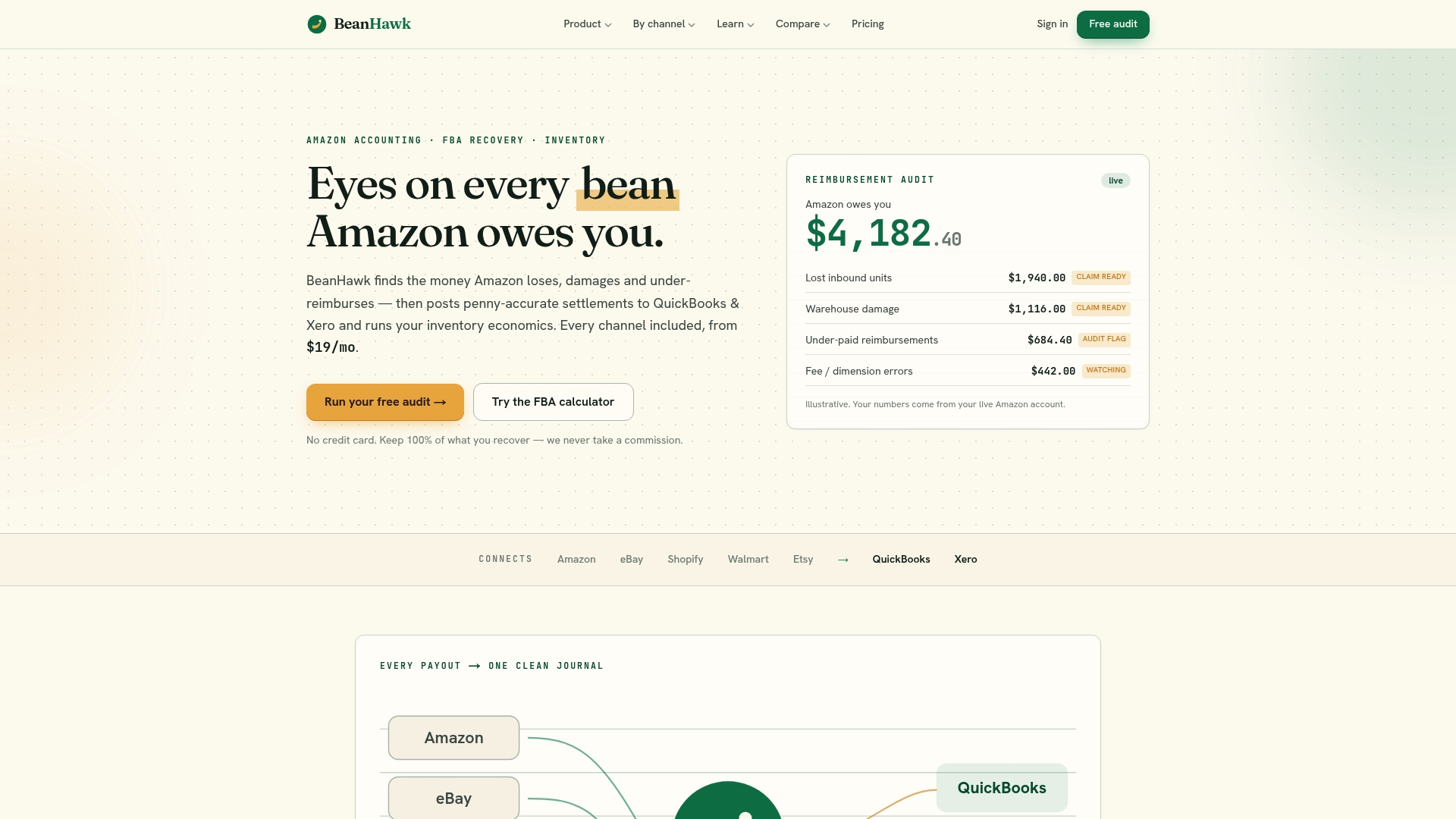
Reimbursement discovery is the piece of this roadmap that’s hardest to automate well on your own, since the triggers (returns, inbound damage, miscounts) scatter across different report types and posting windows. Our free FBA reimbursement audit surfaces unreimbursed events during your Phase 1 audit, and our automated settlement posting to QuickBooks and Xero gives you something concrete to test during Phase 3 configuration.
Our plans run flat, with no commission on recovered funds. Pricing tiers vary depending on the level of service.
Run the audit first, see what it finds, and decide from there. Check pricing and start your audit when you’re ready to connect your books.
This article is general information, not a substitute for advice from a qualified financial advisor. Consult a qualified financial professional about your own circumstances before acting on anything here.
FAQ
What is the best software for Amazon sellers?
The right choice depends on what you need automated: general accounting platforms like QuickBooks and Xero handle double-entry bookkeeping well, while specialized tools layer on top to automate settlement posting, reimbursement recovery, and multi-channel reconciliation. Most sellers end up running an accounting platform alongside a connector or specialized tool rather than relying on one piece of software for everything.
What are the three types of bookkeeping?
The three common methods are cash basis, accrual basis, and a hybrid approach some small businesses use for specific transactions. Amazon sellers carrying inventory generally need accrual accounting because inventory is treated as an income-producing factor under IRS rules.
Can AI do my bookkeeping?
AI and automation tools can handle the repetitive parts reliably, like categorizing settlement line items, posting journal entries, and flagging reimbursement discrepancies. Regulatory guidance still recommends human review of automated outputs before you rely on them for tax filings or financial decisions.
Who is Amazon’s accountant?
Amazon does not provide individual sellers with an accountant. Each seller is responsible for their own bookkeeping and tax compliance, typically using accounting software, a hired bookkeeper or accountant, or automation tools that ingest Amazon’s settlement data into their own books.
How do I reconcile Amazon settlement reports with my bank deposits?
Match each settlement report line to the corresponding bank deposit using the settlement report’s structured fields, such as settlement ID and posted date, then flag any item that doesn’t resolve for follow-up in the next cycle. Keeping this match process on a daily or weekly cadence catches discrepancies while they’re still easy to trace.
Sources
- Publication 538 (Accounting Periods and Methods) | IRS
- Report type values: settlement (Amazon SP-API)
- Reconciling with Amazon Pay settlement reports | Amazon Pay