
90 Days to Recover FBA Fee Overcharges for Amazon Sellers After 2026

Most measurable FBA overcharges are recoverable if you catch them in time. Pull your Fee Preview report and Payments or Transaction View, compare them line by line, and open a “Fees charged in error” case with your measurements attached. Many itemized fee disputes carry a 90-day submission window, so the clock matters as much as the evidence.
TL;DR:
- Overcharges often result from size-tier reassignments or discrepancies between estimated and actual fees, which can be detected with specific reports within 90 days.
- Filing a dispute requires matching the actual charge with shipping data, photographing the product, and submitting detailed evidence, including export files and measurements.
- After the 2026 fee overhaul, increased surcharges and restructured rates make regular checks more critical, especially for bulky SKUs or items near a price-band edge.
- Setting up monthly monitoring routines and using automated tools like BeanHawk can catch fee drift early and prevent recurring overcharges.
- Most sellers recover overcharges only if they check frequently enough within the claim windows, emphasizing the importance of continuous ledger and settlement data oversight.
Table of Contents
- How to identify FBA fee overcharges: reports and red flags
- Step-by-step: file a reimbursement claim in Seller Central
- Which fees and deadlines apply: 90 days, 18 months, and fee categories
- Exact evidence and reports to attach
- Preventing repeat overcharges: monitoring routines and operational fixes
- Publisher perspective: how continuous monitoring shortens recovery risk
- How BeanHawk helps: free FBA reimbursement audit and next steps
- Sources
- FAQ
How to identify FBA fee overcharges: reports and red flags
Overcharges hide in the gap between what Amazon estimated it would charge and what it actually billed. Start by pulling Fee Preview for your active SKUs, then export your settlement or Transaction View report for the same period and line up the “expected” and “charged” fulfillment fee columns side by side. A mismatch of even a few cents per unit adds up fast across thousands of orders.
Four reports do the real work here. Fee Preview shows Amazon’s current estimate based on your listed dimensions and weight. Inventory Ledger tracks unit movement and flags when items get reassigned to a different size tier mid-cycle. Payments or Transaction View shows the actual charge per order. Monthly Storage Fees breaks out cubic-foot rates by size tier, which is where storage overcharges usually surface.
One trap sellers fall into is date logic. Business Reports run on order date, while settlement reports run on ship date, so a naive comparison across the same calendar window can produce a false positive that looks like an overcharge but is really a timing mismatch.
Watch for these red flags:
- A sudden per-unit fee jump with no change to your product or packaging.
- A size-tier reassignment you never requested or approved.
- Small recurring cents-level discrepancies that repeat across every order for a SKU.
- The same fee charged twice on one shipment or order.
To estimate total exposure, multiply the per-unit fee difference by units sold in the affected window. That number is what you will ask Amazon to reimburse.
Step-by-step: file a reimbursement claim in Seller Central
Once you have confirmed a real discrepancy, move fast and file clean.
- Record the charge metadata: ASIN, FNSKU, settlement ID, and the exact charge date for every affected order.
- Calculate the disputed total by multiplying the fee difference by affected units, and keep that math in your claim notes.
- Photograph the product next to a measuring tape showing length, width, and height, and photograph it on a scale for weight.
- Pull a weight certificate or product spec sheet if you have one on file from your supplier.
- Export the Fee Preview report and the settlement CSV covering the disputed period.
- Go to Help, then Contact Us, then Shipping and FBA, then FBA issue, then select “Fees charged in error.”
- In your opening message, state the ASIN, the disputed amount, the date range, and attach every file from steps 3 through 5.
- Explicitly request remeasurement of the item and reimbursement of the fee difference, not just a generic review.
- Expect an initial response within a few business days; if the case closes without addressing your evidence, reply in the same case rather than opening a new one, and escalate to Seller Support’s case review team if it stalls.
Pro Tip: Attach your measurement photos before you submit, not after; cases opened with complete evidence get resolved faster than ones support has to send back for documentation.
One rule catches sellers out: referral fee disputes typically allow only one claim per charge. Once you file, that decision tends to be final, so confirm every figure and attachment is correct before you hit submit.
Which fees and deadlines apply: 90 days, 18 months, and fee categories
Not every fee dispute runs on the same clock. Itemized errors tied to measurement, like fulfillment fees and storage fees driven by an incorrect size tier, generally need to be filed within 90 days of the charge. Non-itemized fees, including some removal, destroy, and prep service charges, can carry windows stretching out to 18 months.

Referral fees sit in their own category: Amazon generally allows a single claim per disputed charge, and once that claim is resolved, it is treated as final.
The 2026 fee overhaul adds urgency to all of this. New price bands restructured the fulfillment fee card, and a 3.5% fuel and logistics surcharge now applies on top of published rates, meaning the rate table you download does not reflect what actually gets charged. Combined with low-inventory and aged-inventory rules, sellers with bulky SKUs or items sitting near a price-band edge are seeing more variance per unit than in prior years, which makes monthly checks worth the time they take.
Exact evidence and reports to attach
Support agents move faster when they can verify a claim without asking follow-up questions. Build your evidence package before you open the case, not during it.
- Export the Fee Preview report and highlight the estimated fulfillment fee column for the disputed SKU.
- Export Inventory Ledger and flag the date of any size-tier change.
- Export the Transaction View or settlement CSV and highlight the actual charged fee for the same orders.
- Pull Monthly Storage Fees if the dispute involves storage or aged-inventory charges.
- Photograph the product with a tape measure visible on all three dimensions, plus a scale reading for weight.
- Include your product spec sheet or a supplier weight certificate if one exists.
Assemble a one-page summary listing the disputed total, the SKUs affected, and the date range in plain numbers Amazon’s agent can check against your attachments. Name your files clearly, something like FeePreview_SKU123_Jan2026.csv and Weight_Photo_SKU123.jpg, and group them by SKU in a single folder before uploading. Clear naming shaves days off review time because the agent is not opening five identically named files to find the right one.
Preventing repeat overcharges: monitoring routines and operational fixes
The cheapest recovery is the overcharge you catch before it repeats. Set a monthly reminder to run Fee Preview against your settlement report, multiplied by units sold, so a one-cent drift on a high-volume SKU gets flagged before it becomes a four-figure loss.
On the operational side, double-check your packaging before every shipment. A box that is a half-inch over your listed dimensions triggers a size-tier bump that persists until you catch it. Confirm measured dimensions match your listing before you ship, and look into SIPP if your packaging qualifies, since it can reduce the chance of a damage-driven remeasurement.
Our FBA fee calculator is a fast way to check expected fees against what actually posted. Once your SKU count or order volume makes manual monthly checks unrealistic, that is usually the point to move from a DIY spreadsheet to automated monitoring.

Publisher perspective: how continuous monitoring shortens recovery risk
The uncomfortable truth about FBA fee overcharges is that most sellers only find them by accident, usually months after the charge, well past the point where a quick fix would have worked. A monthly manual check catches the obvious jumps. It misses the slow cents-level drift on your top SKU that quietly costs more than any single dramatic error ever will.
This gap can be addressed by continuous monitoring of ledger events and settlement data to catch remeasurement and fee mismatches close to the date they happen, while the claim window is still open, and by posting the resulting settlements to accounting platforms automatically to avoid errors between finding the issue and filing the claim.
The sellers who recover the most are not the ones who read the most about FBA fees. They are the ones who check often enough that nothing sits unnoticed for 89 days.
, Tim
How BeanHawk helps: free FBA reimbursement audit and next steps
Running monthly reconciliations by hand works until your catalog grows past a few dozen SKUs, and then the spreadsheet stops keeping up with the ledger. BeanHawk’s free FBA reimbursement audit checks your inbound shipments and fee history for likely recoveries without you exporting a single report yourself.
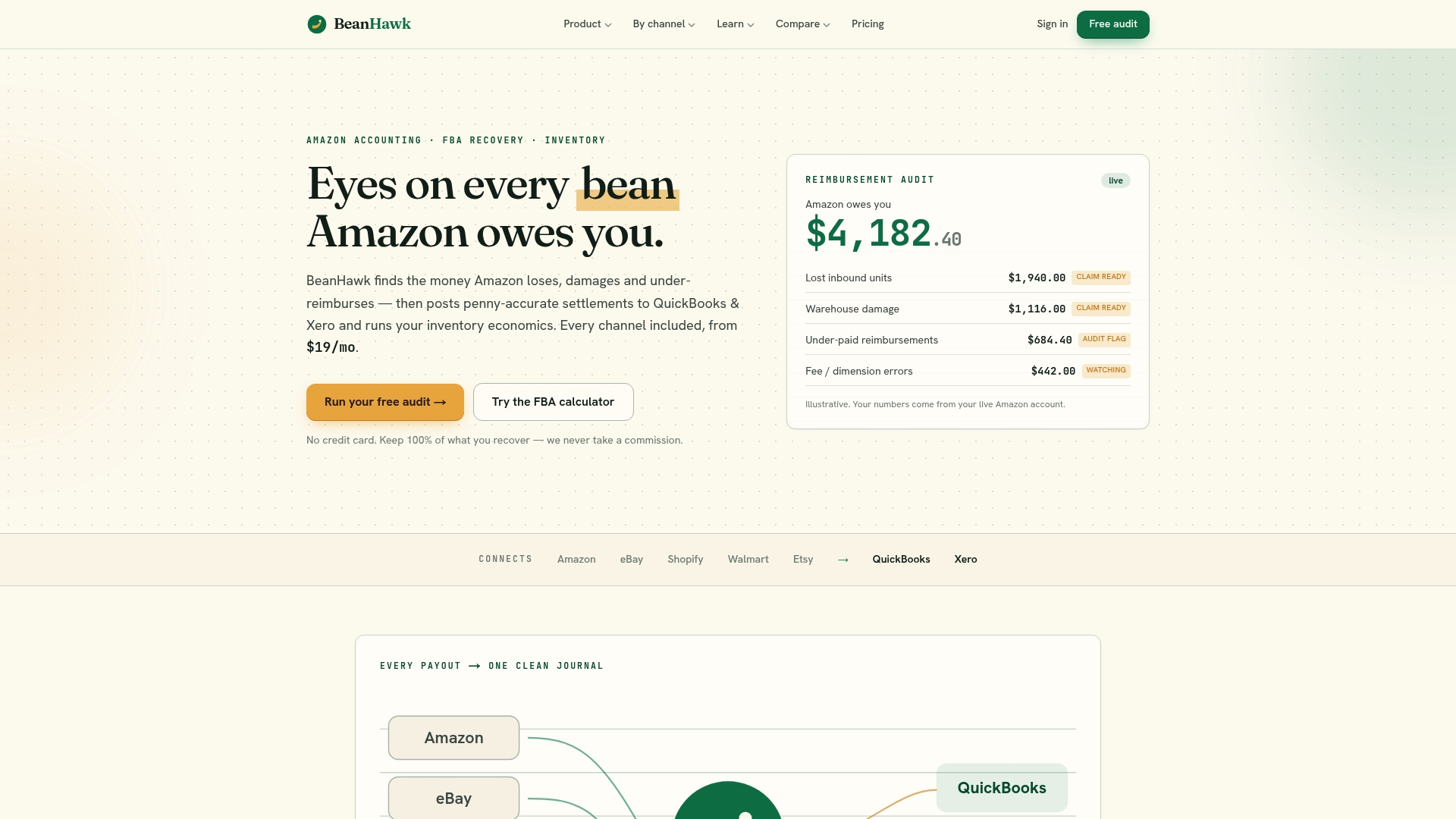
- The audit scans your ledger and settlement history for measurement, storage, and duplicate-fee mismatches.
- If your order volume makes manual checks impractical or your bookkeeper needs clean QuickBooks or Xero entries, a managed plan picks up where the audit leaves off.
- Plans run from Starter at $19 per month to Scale at $99 per month, with no commission taken on what gets recovered.
Start with the free audit and see what Amazon might already owe you.
Sources
For deeper reading, see Amazon’s size tier and fee reference and Worldwide Express’s freight claim process guide for inbound shipping documentation.
- Amazon Seller Central , FBA size tiers and fees (help page)
- Beancount , Amazon’s 2026 FBA fee overhaul
FAQ
Why is my FBA fee so high?
Your fee is often high because of a size-tier misclassification, an unclaimed 3.5% fuel surcharge applied on top of published rates, or packaging that measures larger than your listed dimensions. Compare your Fee Preview estimate against your actual settlement charge to see exactly where the gap is.
How much will Amazon FBA fees increase in 2026?
Amazon restructured its fulfillment fee card with new price bands and added a 3.5% fuel and logistics surcharge on top of published rates in 2026. The exact increase varies by SKU, with bulkier items and those near a price-band edge seeing the largest changes.
How can I reduce Amazon FBA fees?
Confirm your packaging matches your listed dimensions before every shipment, since oversized boxes trigger a costlier size tier. Running a monthly reconciliation between Fee Preview and your settlement report also catches errors early enough to file a claim and recover the difference.
Why is Amazon charging me $40?
A one-time or recurring charge usually traces to a specific fee line such as a removal, disposal, or high-value size-tier fulfillment fee, and the exact reason shows up in your Transaction View report next to the order or shipment ID. Check that line against Fee Preview to confirm whether the amount matches Amazon’s own estimate or reflects an error worth disputing.
How long do I have to dispute an FBA fee error?
Itemized fee errors tied to measurement, like fulfillment and storage fees, generally need to be filed within 90 days of the charge. Some non-itemized fees, such as certain removal or prep charges, allow windows of up to 18 months.