
48 Hour Evidence Plan for FBA Inbound Discrepancies

When your units expected and units located don’t match, check the Shipping Queue first and wait for a “Closed” status before opening a case. While you wait, pull together your proof of delivery, supplier invoices, packing lists, and carton photos. Once the shipment closes, open a Shipment Reconciliation request and expect a response in 2 to 30 days, or occasionally longer.
TL;DR:
- Presenting complete, organized evidence within 48 hours greatly increases the chance of reimbursement, including proof of delivery, invoices, and carton photos, all properly labeled.
- Selecting the correct discrepancy category in Seller Central and attaching files with clear, descriptive names speeds up case processing and reduces denial risk.
- Amazon resolves most cases within 2 to 30 days, but complex disputes can take up to 60 days, emphasizing timely and thorough documentation.
- Submitting only proof of delivery frequently leads to denial; comprehensive evidence including SKU-level packing lists and physical labels improves success rates.
- Automating early discrepancy detection and evidence collection via monitoring tools like BeanHawk shortens resolution times and minimizes manual effort.
Table of Contents
- 48-hour checklist: preserve proof and document everything
- How to run the investigation inside Seller Central (step-by-step)
- Complete evidence checklist: what Amazon accepts and what it ignores
- How long will this take? Amazon’s timelines and how scanning and binning affect results
- If Amazon denies or partially reimburses: concrete next steps
- Practical fixes to reduce future inbound discrepancies
- How BeanHawk automates detection and recovery for inbound discrepancies
- Author perspective: practical priorities when managing inbound discrepancies
- Free audit and how to get started with BeanHawk
- FAQ
- Sources
48-hour checklist: preserve proof and document everything
The sellers who recover the most money are the ones who treat the first two days after noticing a discrepancy as an evidence-gathering sprint, not a waiting game. Amazon’s reviewers decide cases on documentation, so what you collect now determines what you can prove later.
- Confirm the shipment’s delivery and “Closed” status in the Shipping Queue, and screenshot the Contents tab showing units expected versus units located.
- Download and archive every carrier tracking event, including a signed proof of delivery when the carrier offers one.
- Gather your original supplier invoices, signed packing slips, and the per-box manifest for the shipment in question.
- Photograph every carton, shipping label, and LPN or FNSKU sticker before they’re discarded, and log the box count against your manifest.
- Start a chronological log of every Seller Support interaction, noting case IDs, dates, and the exact wording of each response.
Keep all of this in one folder named for the shipment ID. A case that drags into escalation often comes down to whether you can hand a reviewer a complete, dated paper trail instead of scattered screenshots pulled together under pressure. The goal isn’t volume. It’s a clean sequence that ties the carrier’s delivery record to your invoice quantities to the box-level photos, so nothing has to be explained twice.
How to run the investigation inside Seller Central (step-by-step)
Start in the Shipping Queue and open the shipment in question. The Contents tab shows “Units expected” next to “Units located,” and that gap is what defines your discrepancy. According to seller forum guidance on using the reconciliation tool, this comparison is the entry point for every formal research request, and choosing the wrong category here is one of the most common reasons cases stall.
- Select “Units not shipped” when your invoice and manifest show you shipped the full count but Amazon’s receiving numbers are lower.
- Select “Research missing units” when some units were scanned in but a portion never appears in your ledger.
- Select “Extra units shipped” when Amazon’s receiving count exceeds what your paperwork shows, which sometimes signals a carrier consolidation error rather than a loss.
Once you pick the right category, attach your evidence files. PDF invoices and packing slips upload cleanly, while photos work best as JPEGs under a few megabytes each. Name files so a reviewer can understand them at a glance: “ShipmentID_Invoice.pdf,” “ShipmentID_BoxPhoto_01.jpg,” “ShipmentID_POD.pdf.” A reviewer working through dozens of cases a day moves faster, and more favorably, through evidence that’s labeled instead of dumped in as “scan1.jpg.”
Pro Tip: Attach your invoice and packing list as separate files rather than one combined PDF. Reviewers often skim the first page of a multi-document upload and miss supporting details buried further in.
After submission, monitor the case status directly in the Shipping Queue rather than relying only on email notifications, since case updates sometimes post there first. Check in every 5 to 7 business days. If you’ve passed the 30-day mark with no substantive update, that’s your signal to follow up with Seller Support directly and reference your case ID, rather than opening a duplicate request, which can reset the clock. Our FBA reconciliation guide walks through how to read the ledger differences that often prompt these research requests in the first place.

Complete evidence checklist: what Amazon accepts and what it ignores
Not all documentation carries equal weight with Amazon’s reviewers, and submitting the wrong mix is a common reason cases get denied even when the seller is in the right.
- Proof of ownership: original supplier invoices showing SKU, quantity, unit cost, and date. Pro-forma invoices are generally rejected outright.
- Proof of delivery: a signed POD for non-partnered carriers, plus the full tracking history. On its own, POD confirms the truck arrived, not that every unit was scanned and binned correctly.
- Packing-level evidence: per-box manifests, packing lists, and photos of LPN or FNSKU labels, paired with your own box count log.
- Supporting files: inventory ledger exports, transaction IDs from prior related cases, and a letter of authorization if you’re not the brand owner.
According to forum threads documenting denied reimbursement claims, Amazon frequently denies cases where sellers submit only a proof of delivery, because POD confirms a delivery event, not a reconciled unit count. The same threads note that cases recommending a letter of authorization for non-brand-owner sellers see fewer authenticity-related follow-up requests. Compress multi-file evidence into a single archive when the upload tool allows it, and keep file names consistent across every document tied to the same shipment ID.
How long will this take? Amazon’s timelines and how scanning and binning affect results
Amazon’s own guidance sets resolution at 2 to 30 days for most inbound discrepancy cases, with complex cases running as long as 60 days. A shipment showing “Delivered” at the carrier level is not the same as a shipment that’s been scanned and binned into inventory, and that gap is where most of the early confusion happens.
- Expect the first 2 to 5 days after delivery to cover basic receiving and scanning before any discrepancy becomes visible in your ledger.
- Treat day 30 as your checkpoint: if the case hasn’t resolved by then, follow up referencing your case ID rather than waiting indefinitely.
- Reserve escalation expectations for cases flagged as complex, which can legitimately run to 60 days.
- Log every date, from shipment closure to case submission to each follow-up, since that log becomes your evidence if you need to escalate.
These timelines matter beyond the case itself. A discrepancy sitting open for 30 to 60 days means inventory value and COGS in your books don’t match what Amazon’s ledger eventually confirms, which is exactly the kind of gap that makes monthly reconciliation unreliable until the case closes.
If Amazon denies or partially reimburses: concrete next steps
A denial or partial reimbursement is rarely the end of the conversation. It’s usually a sign that your evidence package was missing one specific piece.
- Read the denial message closely and map it against your evidence: a “different items” response usually means Amazon needs clearer SKU-level matching between your invoice, packing list, and box photos.
- For partial reimbursements, recalculate the gap between units claimed and units paid, and resubmit with the specific missing documentation rather than the full case again.
- File a carrier claim in parallel when a non-partnered carrier was involved, since carrier evidence can support an Amazon case rather than replace it.
- Escalate to Seller Support with your full chronological log when a case exceeds Amazon’s own stated timeline without resolution.
One documented forum case shows a shipment marked “different items” despite being a single-SKU shipment with delivery confirmation on file. The resolution came only after the seller submitted per-box photos showing matching SKU labels alongside an invoice whose quantities and descriptions lined up exactly with the packing list, not a single high-level summary invoice.
Pro Tip: When rebutting a “different items” claim, lead with photo evidence of the label, not the invoice. Reviewers weigh physical label matches heavily because they rule out picking or packing errors on Amazon’s side.
Our glossary on FBA reimbursement breaks down which outcomes qualify for automatic reimbursement versus which require this kind of manual rebuttal.
Practical fixes to reduce future inbound discrepancies
Most inbound discrepancies trace back to a handful of repeatable mistakes in how shipments are packed, labeled, and handed off.
- Keep box counts consistent across a shipment, and use one SKU per box wherever your product mix allows it, since mixed boxes are harder for receiving staff to verify.
- Make sure LPN and FNSKU labels are placed flat and unobstructed, since a scan failure at receiving is one of the most common root causes of a “missing units” discrepancy.
- Weigh Amazon’s Partnered Carrier program against third-party carriers: partnered shipments remove most POD disputes, while third-party carriers require you to secure signed POD yourself.
- Assign one person as the shipment owner internally, reconcile unit counts at tender rather than after the fact, and retain manifests for at least 90 days.
Fulfillment cost increases from shipment errors compound over time, and analysis of fulfillment cost drivers shows how inventory discrepancies ripple into broader cost inefficiencies beyond the immediate reimbursement question. Setting a clear internal SLA, for example, requiring evidence collection within 24 hours of a flagged discrepancy, closes the gap between when a problem happens and when you can actually act on it.
How BeanHawk automates detection and recovery for inbound discrepancies
We built our monitoring to catch inbound discrepancies the moment a shipment’s status changes in Amazon’s system, rather than waiting for a seller to notice a ledger gap weeks later. We continuously track inbound shipments and FBA ledger events, which means the evidence window, the period before carrier records and warehouse logs age out, stays open longer because we’re flagging issues earlier.
- We centralize the evidence a research case needs: invoices, packing data, and ledger history, in one place instead of scattered spreadsheets and e-mail threads.
- We automate settlement posting to QuickBooks and Xero, so once a case resolves, the reimbursement lands in your books with the correct journal entry attached.
- We never take a commission on recovered funds, and our pricing stays flat regardless of how much we help you recover.
Consistent, complete evidence uploads are exactly what gets cases resolved faster, and automating that preparation removes the manual bottleneck most sellers hit when discrepancies pile up across multiple shipments at once.
Author perspective: practical priorities when managing inbound discrepancies

The sellers who recover reimbursements consistently aren’t the ones with the best legal arguments. They’re the ones with the most boring, repeatable documentation habits: the same file names, the same folder structure, the same checklist run every single time a shipment closes. Most disputes aren’t won on a single piece of evidence. They’re won because nothing in the chronological record has a gap.
The conventional advice to “just file a case and let Amazon figure it out” undersells how much the burden of proof sits with the seller. Treat every shipment like it might need to be reconstructed from scratch in 30 days, because sometimes it will.
, Tim
Free audit and how to get started with BeanHawk
If you’re not sure how much you’re currently leaving on the table, our free FBA reimbursement audit reviews your shipment and ledger history to surface discrepancies you may not have caught yet, at no cost and with no commitment.
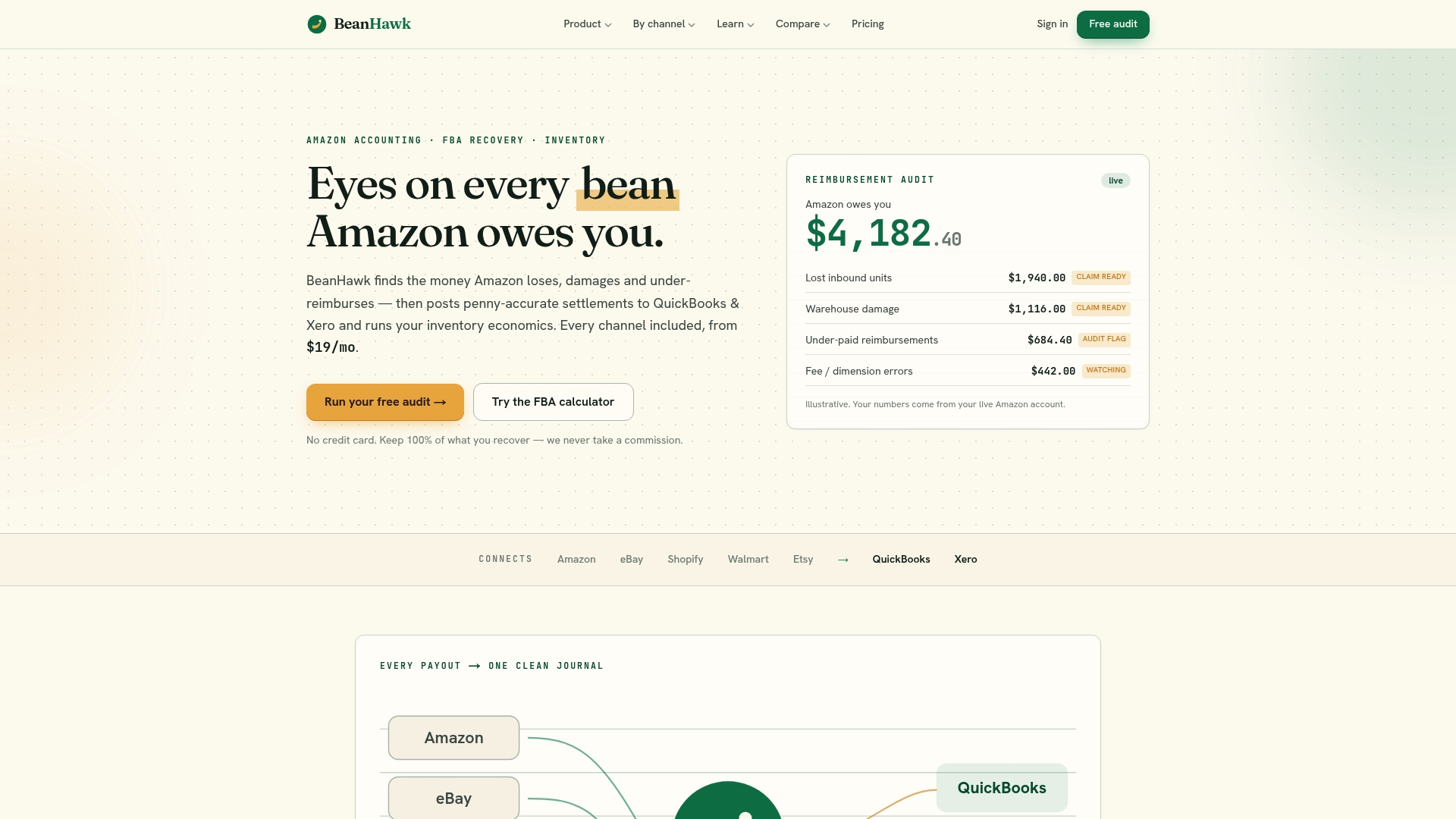
- We check your inbound shipment history against your FBA ledger for gaps between units shipped and units reimbursed.
- We flag cases still inside Amazon’s resolution window so you know what’s recoverable now versus what needs a fresh case.
- We show what automated monitoring would have caught earlier, so you can compare it against your current manual process.
From there, our pricing page outlines plans built around continuous monitoring and automated settlement posting rather than a one-time check.
FAQ
What is FBA inbound?
FBA inbound refers to the process of shipping your inventory to Amazon’s fulfillment centers so it can be stored, picked, and shipped to customers under Fulfillment by Amazon. It covers everything from creating a shipment plan to the point where Amazon’s warehouse scans and bins your units into available inventory.
Is Amazon FBA oversaturated?
Market saturation varies widely by category and isn’t something Amazon or Seller Central publishes a definitive figure on. The more practical concern for established sellers is less about saturation and more about operational accuracy, since unresolved inbound discrepancies quietly erode margin regardless of how competitive a category is.
What does “shipment discrepancy” mean?
A shipment discrepancy is a mismatch between the units you shipped and the units Amazon recorded as received, visible in the Shipping Queue as a gap between “units expected” and “units located.” It can mean units went missing in transit, were scanned incorrectly at the warehouse, or were logged under the wrong shipment.
What does “inbound” mean in Amazon FBA?
“Inbound” describes any shipment moving from you, the seller, toward an Amazon fulfillment center, as opposed to “outbound,” which covers shipments going to customers. Every inbound shipment moves through stages including shipped, delivered, and ultimately closed once Amazon finishes receiving and reconciling it.