
Recover Missing FBA Units in 15 Days: Evidence Checklist & 2026 Rule for Sellers

If Amazon marks your inbound shipment short shipped, your first move is to stop and preserve evidence, not to remove or restock the disputed units. Pull your supplier invoices, signed packing slips, proof of delivery, and the shipment ID, then open a Seller Central case while the receiving window is still open. Because Amazon now reimburses based on manufacturing cost in many cases, the documents that prove your product cost matter as much as proving the units ever left your warehouse.
TL;DR:
- Most short shipments result from packing errors, mislabeling, or scanning mistakes at the fulfillment center, not carrier loss or warehouse issues.
- Accurate proof of delivery alone is insufficient; supplier invoices and packing slips showing unit costs are crucial for successful reimbursement claims.
- Collect and organize shipment documents, including invoices, packing slips, and FNSKU/LPN mappings, within 15 days of spotting discrepancies to preserve your claim.
- Reimbursed amounts now reflect manufacturing costs, and Amazon enforces strict adherence to the original shipping plan for claim approval.
- Continuous reconciliation tools can automatically identify and recover lost reimbursements across many SKUs, especially beneficial for high-volume sellers.
Table of Contents
- What FBA short shipped means for your inbound shipment
- Why shipments get marked short and what the 2025 policy means
- The first 15 days: steps to preserve your claim
- Building a claim Amazon is more likely to approve
- Prevention: packing, labeling, and carrier habits that cut your risk
- When to escalate and what reimbursement to expect
- How continuous reconciliation catches what manual checks miss
- DIY claims versus automated recovery: an honest take
- Get a free look at what Amazon might owe you
- Where to verify these policies yourself
- Sources
- FAQ
What FBA short shipped means for your inbound shipment
A shipment is marked short shipped when the units Amazon records as received do not match the quantity on your shipping plan. You will typically see this as a partial receive status, a 0 received status, or a stranger message called “additional unit encountered,” which shows up when Amazon’s system attributes a scanned unit to a different shipment than yours.
These mismatches often trace back to how receiving actually works at the fulfillment center:
- Boxes are opened and scanned individually, so a single missed carton can register as a full short.
- Each unit is tied to an LPN and FNSKU, and a scanning error at either level can misassign inventory.
- A shipment can look short even when every unit you packed was correct, simply because the FC’s internal counting did not match it to your plan.
Why shipments get marked short and what the 2025 policy means
Three causes account for most short-shipped inbounds: a packing error where the box contents do not match the shipping plan, a label that was misapplied or duplicated, and a scanning mistake at the fulfillment center itself. Carrier loss is also possible but less common than sellers assume, since most freight loss shows up as a tracking exception rather than a quiet quantity mismatch.
Amazon updated its FBA reimbursement policy effective March 10, 2025, so lost inbound units are now reimbursed based on manufacturing cost rather than retail price, and Amazon also offers automatic reimbursement in some lost-in-FC cases without a manual claim.
One documented case involved $200,000 in reimbursements denied over what Amazon labeled “unexpected units.” The seller had shipped correctly but the case shows how strictly Amazon enforces exact shipping-plan matches.
- Common causes: mispacked boxes, incorrect box-content declarations, mislabeled cartons, and FC scanning errors.
- Amazon’s own representatives in that forum thread say investigations are limited and that exact shipping-plan adherence is the seller’s main defense.
- Retail price is no longer the basis for reimbursement, so manufacturing-cost documentation now carries more weight in any claim.
The first 15 days: steps to preserve your claim
Once you spot a discrepancy, speed and documentation decide the outcome. Work through these steps in order:
- Stop and preserve. Do not create a removal order for the disputed units and do not discard any packing materials, labels, or box paperwork tied to that shipment.
- Pull your invoices. Gather original supplier invoices (not pro-forma quotes), signed packing slips, proof of delivery with a signature, the shipping manifest, and the shipment ID.
- Map the units. Compile your ASIN and FNSKU list along with LPN records so every carton can be tied back to a specific product and quantity.
- Log your internal counts. Pull warehouse scan logs or packing timestamps that show the exact quantity that left your facility and when.
- Open the case fast. File a Seller Central case with a clear subject line, the shipment ID, and one organized set of attachments rather than several scattered messages.
Pro Tip: Name every file with the shipment ID first, so a support agent can match your evidence to the case without asking you to resend anything.
Building a claim Amazon is more likely to approve
A strong missing-inbound claim reads like a reconciliation, not a complaint. Build a simple table that maps each packing-slip line to its ASIN, FNSKU, and box LPN, then attach a one-page cover letter summarizing the discrepancy in plain numbers: units shipped, units received, and units missing.
Seller forum threads confirm that proof of delivery alone is usually not enough: Amazon support has stated that POD confirms the carrier dropped off a shipment, not that every unit inside matched your count. Original supplier invoices and signed packing slips remain the documents Amazon leans on most, especially now that reimbursement is tied to manufacturing cost rather than retail value.
- Include supplier invoices that clearly show unit cost, not just total order value.
- Name files with the shipment ID and document type together, for example “FBA123456_invoice.pdf.”
- Submit one complete attachment set rather than multiple follow-up messages.
- Auto-reimbursement may apply for some lost-in-FC cases, but a mismatch against the shipping plan usually requires a manual claim with full documentation.
For sellers who want a template for this reconciliation step, our guide on building an FBA reconciliation report walks through mapping ledger events to shipments in more detail.
Prevention: packing, labeling, and carrier habits that cut your risk
Most short shipments are preventable at the packing table, not the fulfillment center. A few habits make the biggest difference:
- Verify pack counts against the shipping plan before sealing each box, and keep a per-box manifest.
- Use one FNSKU per box where the product mix allows it, so a scanning error can’t spread across multiple SKUs.
- Place labels consistently and double-check that your shipping-plan-to-box mapping matches what’s actually going on the truck.
- Require proof of delivery with a signature and photograph cartons at pickup, preferring Amazon-partnered carriers when your freight volume allows it.
- Run random QC audits on outbound pallets before dispatch to catch packing mistakes before they become disputes.
Pro Tip: Photograph the inside of each carton before sealing it. It costs a few extra seconds and becomes your strongest piece of evidence if Amazon later disputes the count.
When to escalate and what reimbursement to expect
Most denied claims fail for one of two reasons: the count doesn’t match the original shipping plan exactly, or the documentation is incomplete. Before escalating, check your submission against both.
- If a case closes without resolution, reopen it with new evidence rather than filing a fresh case from scratch.
- Ask explicitly for a review when the first response cites “investigation limitations” without specifics, since forum threads confirm Amazon representatives often cannot share granular investigation detail.
- Expect any successful reimbursement to reflect manufacturing cost, not retail price, under the current policy, so a partial recovery is common even on approved claims.
- For sellers filing repeat claims across many SKUs, continuous reconciliation becomes worth the cost simply because manual tracking at that volume misses cases before the window closes.
How continuous reconciliation catches what manual checks miss
Some services monitor inbound shipments and FBA ledger events continuously, matching what was shipped against what Amazon recorded as received, and flag discrepancies as soon as they appear rather than weeks later when the receiving window has closed.
- It identifies missing or short reimbursements automatically instead of relying on a seller to notice a shortfall in a report.
- Recovered settlements can post directly to QuickBooks or Xero as summarized entries, reducing some of the manual reconciliation work involved.
- Faster detection means evidence like packing manifests and scan logs can be pulled while it’s still fresh, important for sellers running multiple inbound shipments a month.
- Such services often charge flat subscription pricing without commissions on recovered funds.
For a deeper look at what qualifies as a short shipment versus other lost-inventory cases, see our breakdown of what FBA sellers must do about lost inventory.
DIY claims versus automated recovery: an honest take
A single short shipment is worth handling yourself, invoices and a Seller Central case are usually enough. Once discrepancies recur monthly across dozens of SKUs, manual tracking starts missing cases before the receiving window closes. Evaluate any service on three things: does it monitor continuously, does it post directly into your accounting software, and is the pricing flat with no cut of what you recover.
, Tim
Get a free look at what Amazon might owe you
Chasing missing inbound units by hand works until your shipment volume outpaces the hours you have to track it. BeanHawk’s free FBA reimbursement audit checks your account for missed reimbursements and shows you what’s recoverable before you commit to anything.
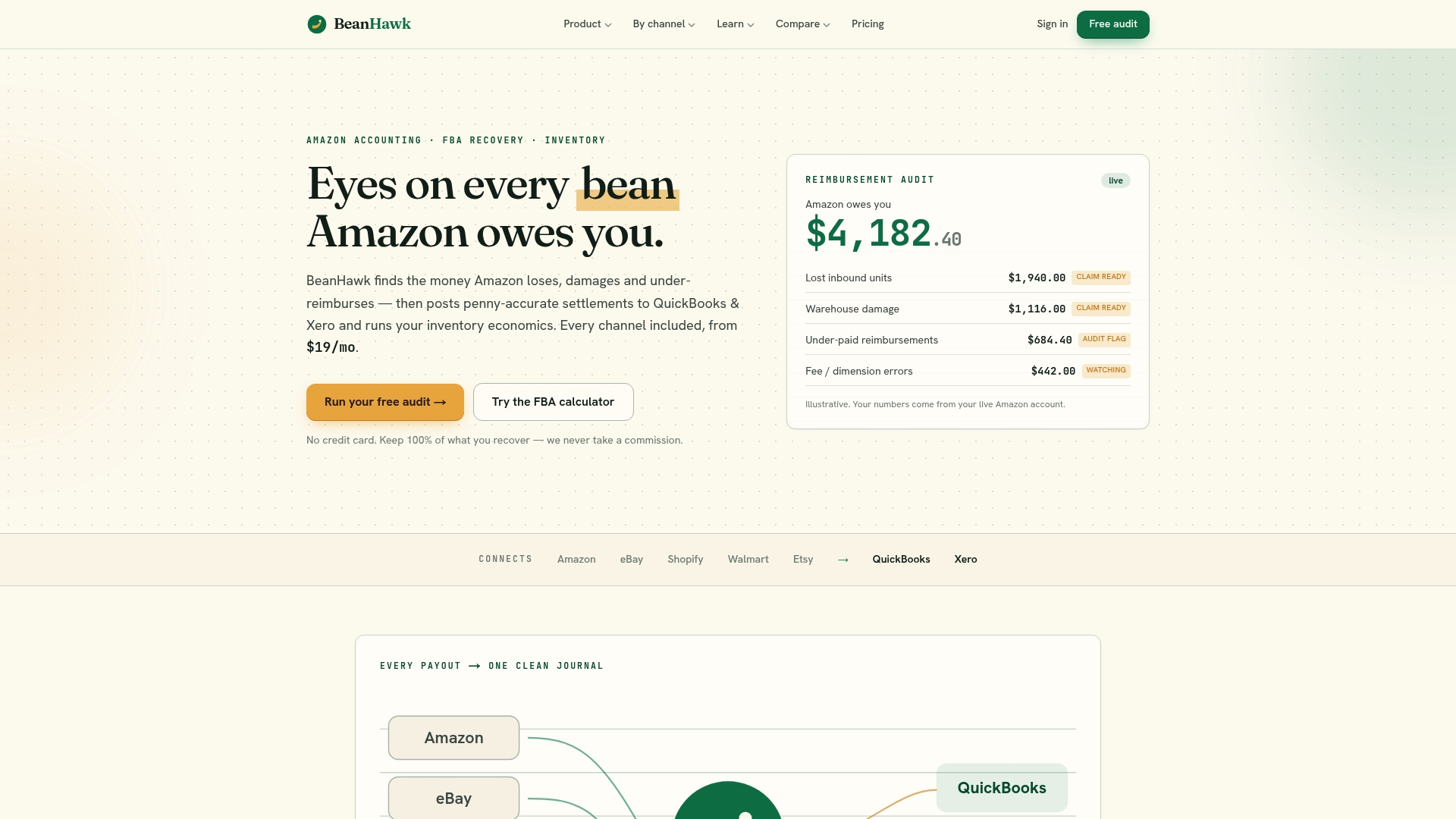
- The audit identifies discrepancies across your inbound shipments and ledger events at no cost.
- Paid plans start with Starter at $19 per month, scaling up to Growth and Scale for higher order volumes.
- Automation pays off most for sellers with recurring short shipments or a high SKU count, not for a one-time dispute.
Start with the free audit to see what’s sitting in your account before deciding whether ongoing monitoring makes sense for your volume.
Where to verify these policies yourself

Read Amazon’s own reimbursement policy update for the manufacturing-cost rule, and browse Seller Central forum threads for real case outcomes and documentation requirements.
Sources
- Update to U.S. referral and Fulfillment by Amazon fees for 2026 - Amazon Selling Partners
- $200,000 REIMBURSEMENTS DENIED DUE TO “UNEXPECTED UNITS" - Request for Clarity
FAQ
What counts as proof of delivery for an FBA claim?
Proof of delivery is a carrier record showing a shipment arrived, usually with a signature, but Amazon has stated it confirms dropoff rather than exact item counts. You’ll also need supplier invoices and signed packing slips to support the specific quantity you’re disputing.
Does Amazon reimburse based on retail price or manufacturing cost?
As of the March 10, 2025 policy update, Amazon reimburses lost inbound inventory based on manufacturing cost, not the retail price you sell at. This means the invoices you submit should clearly show unit cost.
What does FBA mean in freight?
In a freight context, FBA (Fulfillment by Amazon) refers to inventory shipped in bulk to Amazon’s fulfillment network rather than direct-to-consumer parcels. Freight forwarders and carriers treat these as inbound shipments tied to a specific shipment ID and shipping plan.
Why do FBA short shipment claims get denied?
Most denials happen when the claimed quantity doesn’t match the original shipping plan exactly, or when documentation is incomplete, such as missing supplier invoices. Amazon representatives have said in forum threads that investigations are limited, so exact shipping-plan adherence is the strongest prevention.
Is automated reconciliation worth it for FBA sellers?
For sellers with occasional discrepancies, filing a manual claim is usually enough. Sellers with recurring short shipments across many SKUs benefit from continuous monitoring tools like BeanHawk, which detect discrepancies faster and post recovered settlements directly into accounting software.