
Accountant Ready Inventory Reconciliation Automation for Amazon FBA

Inventory reconciliation automation means continuously monitoring your FBA and multichannel ledger events, catching reimbursements Amazon owes you but hasn’t paid, and posting penny-accurate settlement journals straight into QuickBooks or Xero. Done right, it recovers cash that would otherwise vanish into “adjustment” line items, keeps your COGS honest, and cuts the hours your bookkeeper spends chasing spreadsheet mismatches every month.
TL;DR:
- Regularly review discrepancies over $5 in settlement reports to prevent missing stranded inventory or uncredited returns nearing claim deadlines.
- Reconcile reimbursements with inventory adjustments monthly and verify sourcing costs to ensure accurate margins and claims.
- Implement continuous monitoring for inbound shipments, adjustments, and settlement anomalies to catch issues before Amazon’s claim window closes.
- Use summarized settlement entries for QuickBooks or Xero to handle high volumes efficiently and maintain clear, traceable audit logs.
- Start with a free audit to identify unclaimed reimbursements and pilot automation on low-volume SKUs before expanding to full-scale, scalable monitoring.
Table of Contents
- What Does Inventory Reconciliation Automation Mean for FBA Sellers?
- Why Does Reconciliation Automation Matter for Sellers and Accountants?
- What Reports and Evidence Do You Need to Reconcile?
- How Do Automation Workflows Catch and File Claims?
- How Should Settlements Post to QuickBooks and Xero?
- What’s the Right Cadence for Reconciliation and Claim Windows?
- Self-Service Audit, Commission Recovery, or Full Automation?
- What Controls Keep Reconciliation Accurate at Scale?
- What I’ve Learned Watching Sellers Lose Money to Their Own Ledgers
- Get an FBA Reimbursement Audit Before You Automate Anything
- Sources
- FAQ
What Does Inventory Reconciliation Automation Mean for FBA Sellers?
For this article, inventory reconciliation automation refers specifically to Amazon FBA and multichannel ledger monitoring: tracking inbound shipments, reimbursements, and settlement data, then recovering underpaid claims and posting the results to your books. It is not the same discipline as warehouse or ERP reconciliation, which matches physical stock counts against inventory records inside a distribution center.
The systems built for this job track ledger events like lost or damaged inventory adjustments, reimbursement postings, removal orders, and settlement deposits. Scope discipline matters here because an accountant using warehouse-reconciliation logic on an Amazon ledger will miss the claim windows, the sourcing-cost rules, and the settlement-matching fields that actually determine whether you get paid.
Why Does Reconciliation Automation Matter for Sellers and Accountants?
Missed or mis-posted reimbursements distort your margins directly. If Amazon loses 40 units of a $12 sourcing-cost item and never reimburses you, your COGS stays overstated on paper while your actual inventory is gone. Multiply that across a few hundred SKUs a year and the number stops being rounding error.
Statistic Callout: Accountants who specialize in e-commerce apply a $5 investigation rule: any settlement variance above that amount gets investigated, because it usually signals stranded inventory or an uncredited return closing in on its 60-day claim deadline.
Amazon’s own auto-reimbursement system helps, but it isn’t a substitute for verification. The sourcing-cost policy rolled out across seller accounts pays sellers automatically for some lost items, using Amazon’s default valuation unless you’ve submitted your own sourcing cost. That default is frequently lower than what you actually paid, which means the “automatic” credit often underpays without anyone flagging it.
What Reports and Evidence Do You Need to Reconcile?

Every reconciliation cycle starts with pulling the right reports and lining up the fields that let you match a loss to a payout. Skip a report, and you’ll miss the discrepancy; skip the evidence, and you’ll lose the case even when you’re right.
Pull these from Seller Central each cycle:
- Reimbursements report , shows what Amazon already paid you, and for what
- Inventory Adjustments report , shows units marked lost, damaged, or disposed
- Settlement reports , the actual deposits, itemized by fee and reimbursement type
- Returns report , flags customer returns that never made it back to sellable inventory
- Inbound shipment reconciliation , compares units shipped to units received at the fulfillment center
- Manage Your Sourcing Cost , confirms which valuation Amazon has on file for each ASIN
Match these by FNSKU, shipment ID, settlement ID, and date range, then compare quantity against your submitted sourcing cost. For each suspected underpayment, evidence assembly needs a supplier invoice supporting your cost basis, carrier proof of delivery for inbound shortages, and the specific inventory-adjustment row tying the loss to a case number.
How Do Automation Workflows Catch and File Claims?
A reconciliation system that only checks once a month misses claim windows that close in as little as 30 days. Continuous monitoring means the system is watching four categories of events as they post: inbound receipts, negative inventory adjustments, reimbursements, and settlement anomalies.
The workflow generally runs in four stages:
- Detect , the system flags a variance the moment it appears, comparing received quantity against shipped quantity or reimbursed amount against expected payout.
- Threshold check , a rule engine decides whether the gap crosses a dollar or percentage line worth acting on, rather than surfacing every $0.03 rounding difference.
- Evidence assembly , for anything that clears the threshold, the system pulls the supporting report rows, shipment IDs, and invoice references automatically.
- File and verify , the case gets submitted (or routed to a human for review), then tracked until Amazon pays, denies, or requests more information.
Pro Tip: Set your underpayment threshold in dollars, not percentage, for low-cost SKUs. A 20% shortfall on a $4 item is $0.80. It’s not worth a case file. A $5 gap on a $60 item is worth chasing every time.
Anything that doesn’t clear automatic filing thresholds gets routed for manual review instead of silently dropped, which is where most sellers lose money without ever noticing it.
How Should Settlements Post to QuickBooks and Xero?
Posting every individual Amazon transaction to your books line by line doesn’t scale past a few hundred orders a month. Summarized settlement posting is the pattern that holds up: each settlement period becomes one journal entry, broken into components instead of hundreds of bank-feed splits.
A typical settlement journal maps to accounts like these:
- Amazon clearing account , receives the net settlement deposit
- Reserve asset account , tracks funds Amazon is holding but hasn’t released yet
- Reimbursement income , kept separate from sales revenue so recovered funds don’t inflate top-line performance
- Fees expense , referral, FBA, and storage fees for the period
- COGS , adjusted when reimbursed units are written off inventory
Statistic Callout: Practitioner guides recommend reconciling reimbursements against inventory adjustments monthly at minimum, comparing settled payout to quantity multiplied by sourcing cost, and flagging anything that does not precisely match.
Best practice writes off the lost or damaged inventory first, separately, before recording the reimbursement as its own income line. That sequencing keeps reimbursements from masquerading as sales and keeps your COGS defensible during a tax review or a buyer’s due diligence.
What’s the Right Cadence for Reconciliation and Claim Windows?
Amazon’s claim windows are unforgiving, and reconciliation cadence has to be built around them, not around your bookkeeper’s calendar.
Run these on a fixed schedule:
- Monthly, minimum: compare the Reimbursements report against Inventory Adjustments and confirm your sourcing cost is current in Manage Your Sourcing Cost.
- Days 15 through 60 after each inbound shipment: check received quantity against shipped quantity, since this is the window practitioner guides flag for catching short-ships before Amazon closes the case.
- Within 30 days of a removal order arriving back: verify the returned unit condition matches what Amazon reported, or file before the window shuts.
- Every settlement, on close: reconcile the clearing account balance to zero and investigate anything over the $5 threshold.
High-volume sellers should tighten monthly checks to weekly or daily; low-volume sellers can usually hold at monthly without missing much.
Self-Service Audit, Commission Recovery, or Full Automation?
Three operating models cover most sellers, and the right one depends almost entirely on order volume. Manual spreadsheet work breaks down past a few hundred transaction rows a month, which is roughly where most sellers start looking at a paid option.
- Low-volume DIY: manually pull reports and file cases yourself; fine under a few dozen SKUs and light shipment activity.
- Commission-based recovery services: a third party files claims and takes a percentage of what’s recovered, which can erode net recovery fast at higher volumes.
- Flat-fee or subscription automation: continuous monitoring and filing for a fixed monthly cost regardless of how much gets recovered.
Before picking one, estimate expected monthly recoveries, how much staff time you actually have for case filing, and whether you need audit-ready records for a lender or buyer. Commission models look free until recovery volume climbs; flat pricing usually wins once you’re past low volume.
What Controls Keep Reconciliation Accurate at Scale?
Rolling out automation without controls just moves the risk of error from spreadsheets to software. Start with permissions: give any tool read access to Seller Central reports through Amazon’s own authorized API connections, not shared logins.
Build in these controls before you scale:
- Case ID tracking so no unit gets filed twice under two different case numbers.
- A hold on auto-reimbursed units until you’ve verified the payout against your actual sourcing cost, since Amazon’s automatic credit can underpay silently.
- An audit log for every journal post, tying each accounting entry back to its source settlement ID.
Pilot on a handful of SKUs or one marketplace first, confirm the postings match your general ledger cleanly, then expand. Rolling out to your entire catalog on day one is how errors compound before anyone catches them. A documented inventory reconciliation process makes this rollout easier to audit later, and a clear audit trail matters just as much for financial software as it does for any other regulated recordkeeping system.
What I’ve Learned Watching Sellers Lose Money to Their Own Ledgers
The recurring problem isn’t that sellers don’t care about reconciliation. It’s that Amazon’s ledger produces enough noise that a real discrepancy looks identical to a rounding error until someone actually pulls the matching report and does the math. Most sellers I’ve seen lose money aren’t victims of some rare glitch. They’re victims of a $6 variance nobody investigated in March, repeated fifty times across the year.
Running the checklist in this article once won’t fix that. Running it every month, on a fixed cadence, against a fixed threshold, is what actually recovers money instead of just identifying that some exists somewhere.
, Tim
Get an FBA Reimbursement Audit Before You Automate Anything
Beanhawk exists for exactly the problem this article walks through: continuous ledger monitoring that catches reimbursement shortfalls Amazon’s own auto-credit system misses, then posts penny-accurate summarized settlements straight into QuickBooks or Xero. No commission is taken on what gets recovered, and pricing stays flat regardless of how much comes back.
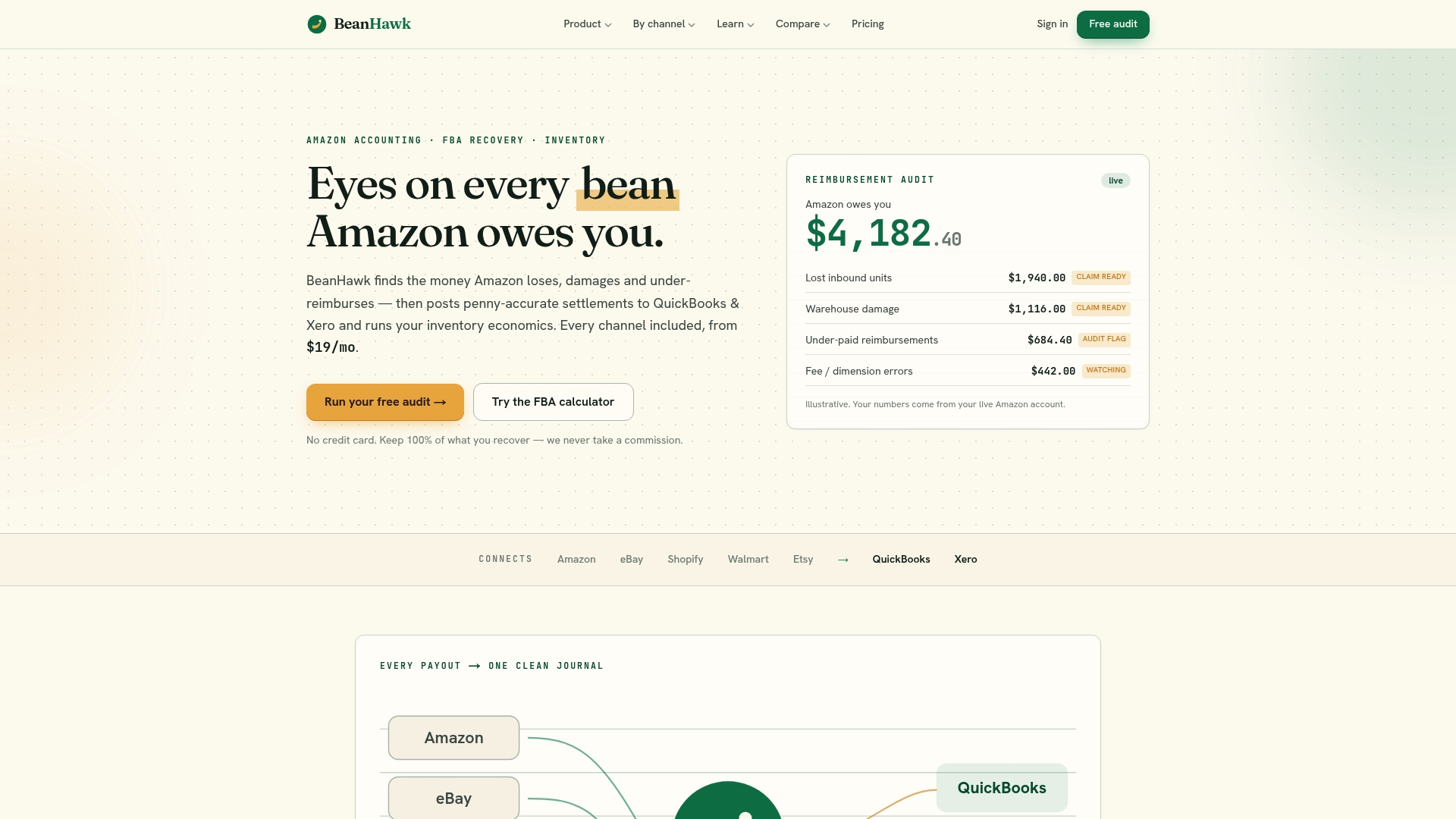
The most practical first step is running a free FBA reimbursement audit to see what’s already sitting unclaimed in your account. From there, pilot the automation on a sample of SKUs, compare your month-one recoveries against what you were catching manually, and decide from actual numbers instead of guesswork. Plans start with a Free tier, scaling up through Starter at $19 per month, Growth at $49, and Scale at $99 as order volume grows.
Sources
For verifying claim windows and sourcing-cost rules directly, the Amazon FBA reimbursement policy breakdown covers filing procedure in detail. For settlement journal design, the Amazon FBA accounting guide explains posting mechanics. Beanhawk’s own Amazon inventory reconciliation piece walks through ledger basics for sellers new to the process.
- Ecommerce inventory accounting and reconciliation guide
- Amazon FBA Reimbursement in 2026: How the Sourcing-Cost Policy Works and How to File | AMZBase
- Amazon FBA Accounting: Settlements, Fees & FBA Inventory
- Amazon Reimbursement Recovery: How Much Are You Owed?
FAQ
What Counts as Inventory Reconciliation Automation for Amazon Sellers?
It means software that continuously monitors your FBA and multichannel ledger, flags missed or underpaid reimbursements, and posts settlement summaries directly into your accounting system. It’s distinct from warehouse or ERP reconciliation, which matches physical counts rather than marketplace ledger events.
How Often Should I Run Reconciliation Checks?
Monthly is the minimum for comparing Reimbursements against Inventory Adjustments and verifying your sourcing cost is on file. High-volume sellers should check weekly or daily, and inbound shipments need review within the day 15 to day 60 window to catch short-ships before the case closes.
Which Settlement Variance Should I Actually Investigate?
Any variance over $5 is worth a look, since smaller gaps rarely justify the time and larger ones often trace back to stranded inventory or uncredited returns nearing their claim deadline. Setting the threshold in dollars rather than percentage keeps low-cost SKUs from generating noise.
Does Amazon’s Auto-Reimbursement Mean I Don’t Need to Check Anything?
No. Amazon’s automatic credits use its own default valuation unless you’ve submitted your sourcing cost, and that default is often lower than what you actually paid. Verifying auto-reimbursed units against your real cost is still necessary to catch underpayments.
What Does Beanhawk Cost?
The service offers a free plan and several paid tiers priced by order volume, without charging commissions on recovered funds. Full details are available on the pricing page. Full details are on the pricing page, and a free reimbursement audit is available before committing to a plan.