
Proof First Fixes for Amazon Inbound Shipment Problems

When an inbound shipment shows a discrepancy, open the Shipment Summary page in your Shipping Queue first, then pull the Inbound Performance report for that shipment ID. Gather your carrier proof of delivery and supplier invoice before you contact support. Most cases resolve as a delay or a mis-scan that gets corrected once Amazon finishes receiving; a smaller share end up as genuinely lost inventory that needs a formal claim.
TL;DR:
- Most inbound shipment discrepancies are resolved within a few days through delays, mis-scans, or internal transfers; genuine losses are less common.
- Confirm delivery with carrier proof of delivery and Amazon’s tracking before escalating, and cross-check shipment and receipt details in both the Shipment Summary and Inbound Performance report.
- Common causes include quantity mismatches, misrouting, labeling errors, and scans that never occurred, with photographing cartons and labels beforehand preventing disputes.
- Wait for the shipment to fully finish processing, as units can take up to 18 days to become visible for sale, and automatic closure rules may alter final status reports.
- Using detailed reports, supporting documents, and a consistent pre-shipment process significantly reduces future errors and streamlines dispute resolution.
Table of Contents
- Quick triage checklist for the first 24 to 72 hours
- How Amazon receives shipments and the timeline you should expect
- Common causes of inbound shipment discrepancies
- Step-by-step reconciliation and investigation procedure
- Using Amazon’s reports to prove your case
- Prevention: packing, labeling, and shipping plan habits that reduce future errors
- How BeanHawk helps sellers recover from inbound problems
- A straight take on inbound shipment headaches
- If you want help, BeanHawk’s free audit fits right into this workflow
- FAQ
- Sources
Quick triage checklist for the first 24 to 72 hours
Before you file anything, confirm what actually happened. A shipment that looks “lost” on day one is often still moving through receiving.
- Check your carrier’s tracking and proof of delivery (POD) against the delivery status shown in Seller Central.
- Open the Shipment Summary page and compare units shipped versus units received, noting any shipment ID mismatches.
- Export the Inbound Performance report and the Shipping Queue details for the specific shipment ID involved.
- Pull together your supporting documents: supplier invoice, packing list, carrier POD, carton photos, and copies of the Amazon labels you printed.
If the numbers still don’t match after the carrier confirms delivery and a few days have passed, you’re likely past a temporary delay and into reconciliation territory.
How Amazon receives shipments and the timeline you should expect
Every FBA shipment moves through a defined sequence: created, in transit, delivered, checked in, receiving, and closed. Each stage gets logged with a timestamp, and gaps between them are normal, not automatically a sign of a problem.

Once units are delivered to a fulfillment center, Amazon may transfer them internally before they’re available for sale. Received units can take up to about 18 days to appear available, and this receiving process cannot be manually expedited no matter how many times you check.
Shipments that sit open too long are also subject to automatic closure rules after a certain period, which can change how a shipment reports its final status even if a few units never got scanned in. Knowing which stage your shipment is stuck in tells you whether to wait or escalate.
Common causes of inbound shipment discrepancies
Most discrepancies trace back to a handful of repeat offenders. According to Amazon’s own inbound problem summary, common causes include sending different quantities than the shipping plan specified, misrouting cartons to the wrong fulfillment center, incorrect or missing carton labels, and shipments that arrive after being canceled, deleted, or closed.
- Labeling problems: a missing, damaged, or poorly printed carton label, or a label mapped to the wrong ASIN or UPC, usually resolves through relabeling or a removal and resend.
- Quantity mismatches: partial cartons or miscounted units are best reconciled against your original packing invoice, carton by carton.
- Misrouting: cartons received against the wrong shipment ID trigger an internal Amazon investigation that can take time to resolve.
- Scan errors: carrier POD confirms delivery, but Amazon’s system shows zero units received, pointing to a receiving dock scan that never happened.
Pro Tip: Photograph every carton label before it ships, not after a problem appears. A clear “before” photo is often the single most persuasive piece of evidence in a labeling dispute.
Sellers in the forums report that reimbursement gets denied citing “carton label missing” even when carrier POD confirms the shipment arrived intact. Carrier delivery and Amazon receiving are two different proofs, and you need both.

Step-by-step reconciliation and investigation procedure
Once you’ve confirmed a real discrepancy, follow this sequence rather than filing a case blind.
- Check the shipment’s closure status and timing in the Shipment Summary; don’t file while a shipment is still actively receiving.
- Export the Inbound Performance report and screenshot the shipment ID, box counts, scan timestamps, and FC received date.
- Cross-check carrier POD timestamps against Amazon’s FC received timestamps for gaps or inconsistencies.
- Attach your supplier invoice, packing list, carrier POD, high-resolution carton photos, and printed Amazon carton labels to the case.
- State plainly what you’re requesting: a locate investigation or a formal inbound investigation, and summarize the evidence you’re attaching in two or three sentences.
Amazon’s own guidance confirms that when a shipment shows “closed with discrepancy,” sellers should export the Shipment Summary and Inbound Performance report, cross-check timestamps, and open a formal investigation with the FBA Inbound Investigation team attaching those files. If the case gets denied on a technicality like a disputed label, escalate with a case review and resubmit paired evidence: box-level photos, your label print log, and the POD together. Track the case ID and follow up if the Inbound Investigation team goes quiet; some sellers get traction by routing a second request through general seller support.
For deeper background on filing a reimbursement case once an investigation confirms a loss, see our guide to Amazon reimbursement claims.
Using Amazon’s reports to prove your case
The Inbound Performance report gives shipment-level detail on issues encountered at the fulfillment center and is the backbone of any investigation request. Pair it with the Shipment Summary for a complete picture.
- Export the Shipment Summary for the shipment ID in question, including shipped and received quantities.
- Pull the Inbound Performance report and flag any status codes tied to that shipment.
- Capture FC received timestamps and compare them against your carrier’s delivery timestamp.
| Field to capture | Where it comes from | Why it matters |
|---|---|---|
| Shipment ID | Shipment Summary | Ties every document to one case |
| Units shipped vs. received | Shipment Summary | Shows the exact size of the gap |
| FC received timestamp | Inbound Performance report | Confirms when Amazon logged receipt |
| Status flag | Inbound Performance report | Identifies the specific problem type |
Format these into a single document or screenshot set ordered by shipment ID before you attach them to a case. Our breakdown of the FBA reconciliation report walks through pulling these exports in more detail.
Prevention: packing, labeling, and shipping plan habits that reduce future errors
Most of these problems are preventable with a short pre-shipment checklist.
- Verify every ASIN to UPC or GTIN mapping before you create the shipping plan.
- Print carton labels directly from Seller Central rather than reusing old templates.
- Run a label print quality check; smudged barcodes are a leading cause of mis-scans.
- Photograph cartons and capture carrier POD at pickup, every time, with no exceptions.
- Audit any 3PL or prep partner’s labeling process on a recurring schedule.
Pro Tip: Build a 10-minute weekly reconciliation habit, scanning Shipment Summary for any open shipment older than two weeks. Small gaps are far easier to fix before a case closes than after.
Keeping your shipping plans clean and your labels accurate, as Amazon’s prevention guidance recommends, cuts down disputes before they start.
How BeanHawk helps sellers recover from inbound problems
We monitor inbound shipments and FBA ledger events to flag units that went missing in transit or came back under-reimbursed. Rather than you manually cross-checking reports every week, we identify those gaps automatically and post the resulting settlements into accounting platforms, so your books can match what Amazon actually owes you. For sellers juggling multiple channels, we help centralize recovery work instead of leaving it scattered across spreadsheets and support tickets. Our background on inventory reconciliation covers how this fits into a broader accounting workflow.
A straight take on inbound shipment headaches
Most sellers panic too early and document too late. Amazon’s receiving timelines are genuinely frustrating, but plenty of “missing” units turn up later as internal transfers finish processing. The habit that actually saves money isn’t faster complaining, it’s capturing carrier proof and carton photos at the moment of pickup, every single time, before you ever need them.
, Tim
If you want help, BeanHawk’s free audit fits right into this workflow
Reconciling inbound discrepancies by hand works, but it takes hours you probably don’t have every week. Our free FBA reimbursement audit scans your account for mis-scans, missing units, and under-reimbursed claims without charging a commission on anything we help you recover.
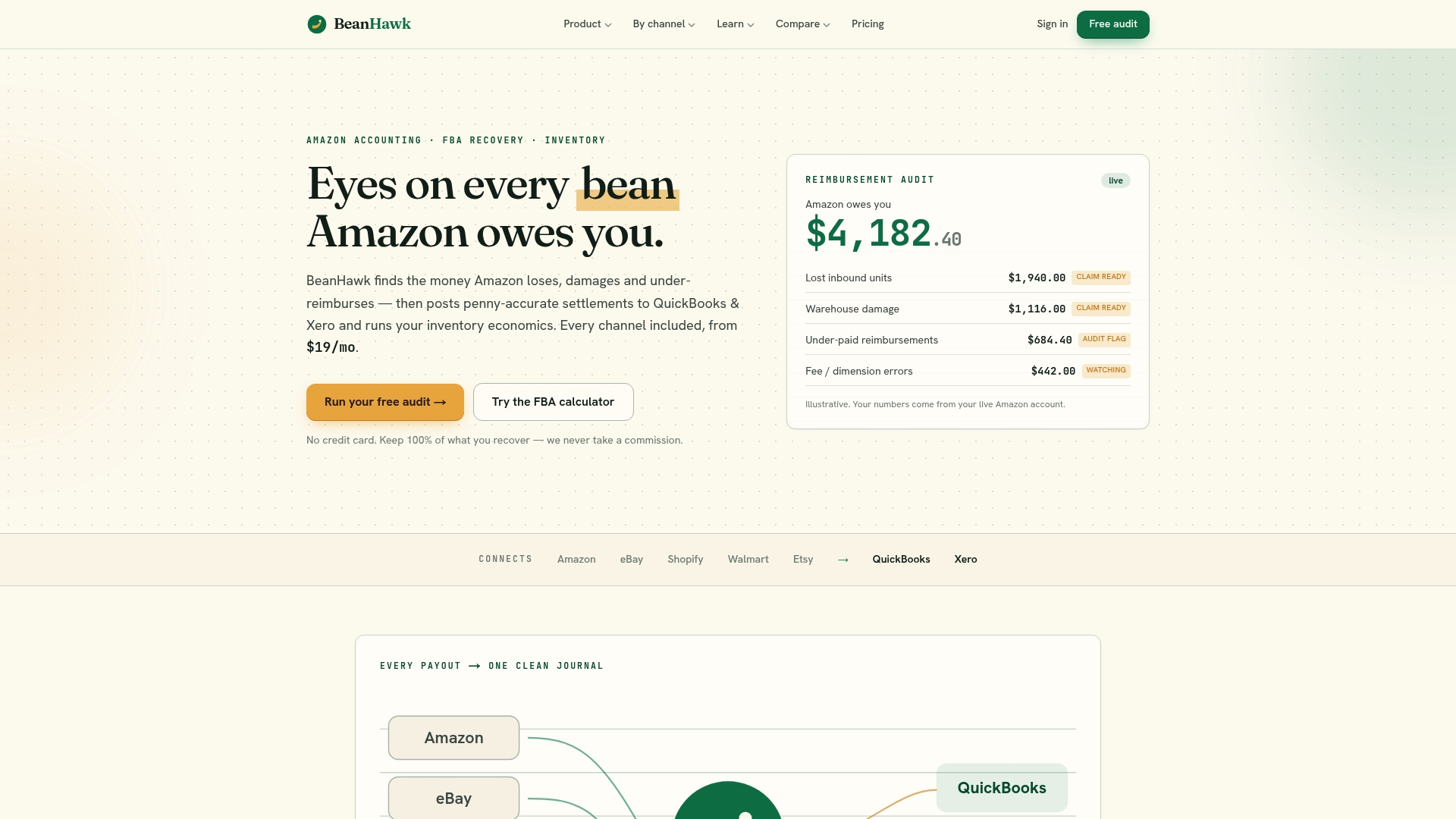
- The audit flags shipments with unresolved discrepancies so you know where to focus first.
- If the numbers justify ongoing monitoring, our pricing page lists Starter, Growth, and Scale plans alongside the free tier.
- Onboarding connects your seller account and your accounting platform to help recovered funds post automatically going forward.
FAQ
Is Amazon having shipping problems right now?
Inbound shipment discrepancies happen continuously across sellers rather than during a single ongoing outage. Most issues trace to labeling errors, quantity mismatches, or misrouting rather than a systemic Amazon shipping failure, according to Amazon’s own inbound problem summary.
What is inbound problem solve at Amazon?
This refers to the process of identifying and resolving discrepancies between what you shipped and what Amazon received for an FBA shipment. It typically involves checking the Shipment Summary and Inbound Performance report, then filing a formal investigation if the gap doesn’t resolve on its own.
Why is Amazon having trouble with deliveries?
Delivery and receiving trouble usually comes down to carrier handling, carton labeling issues, or internal fulfillment center transfers rather than one single cause. Received units can take up to about 18 days to become available for sale even after a successful delivery.
Is there a problem with Amazon deliveries at the moment?
Delivery issues are ongoing and shipment-specific rather than tied to a single current event. Checking your own Shipment Summary and Inbound Performance report for the shipment ID in question is the most reliable way to tell whether your situation reflects a normal delay or an actual discrepancy.
What documents does Amazon want for an inbound investigation?
Amazon generally expects a supplier invoice, packing list, carrier proof of delivery, high-resolution carton photos, and copies of the printed carton labels. Submitting these together, cross-checked against your Inbound Performance report, gives support staff the clearest basis to approve a claim.