
Amazon FBA Reimbursements Without Commission: QuickBooks and Xero

Yes, you can recover eligible Amazon FBA reimbursements without paying a commission. The practical routes are filing claims yourself through Seller Central or using a flat-fee subscription tool that monitors your ledger automatically. Low-volume sellers often do fine with manual audits, mid-volume sellers benefit most from subscription automation, and only the highest-volume catalogs tend to need dedicated staff time to keep pace with claim deadlines.
TL;DR:
- Claim windows vary by type, so identify discrepancies promptly, export shipment and inventory reports weekly, and submit complete evidence before records expire.
- Amazon bases eligible lost or damaged inventory reimbursements on estimated sale price at the time of the event, not purchase cost, so compare payouts against that valuation.
- Claim eligibility can be blocked by active suspension, inventory policy violations, or missing tax and business records; resolve account issues before filing.
- A flat monthly subscription does not rise with recovery volume, and itemized QuickBooks or Xero postings reduce manual settlement reconciliation.
- Providers that charge commissions may retain claim records, complicating audits or switching providers; in house reviews keep documentation under seller control.
Table of Contents
- What Amazon reimbursements are and which ones affect FBA margins
- Eligibility, timelines, and the evidence you must collect
- Step-by-step workflow to file reimbursement claims yourself
- Operating models compared: commission providers, subscription software, and in-house audits
- Practical no-commission options and when to choose each
- Publisher and author credibility: BeanHawk capabilities and supporting proofs
- When no-commission recovery is the strategic choice
- Try BeanHawk: free FBA reimbursement audit and no-commission approach
- FAQ
- Sources
What Amazon reimbursements are and which ones affect FBA margins
An Amazon reimbursement is money Amazon owes you when inventory in its fulfillment network is lost, damaged, or mishandled, or when a fee was charged incorrectly. These adjustments sit outside your normal sales revenue, but they directly affect your real margin once you account for the cost of goods tied up in that inventory.
Several categories show up repeatedly in FBA accounts:
- Lost inventory: units that vanish between receiving, storage, or transfer between fulfillment centers.
- Damaged inventory: units Amazon’s warehouse damages during handling or storage.
- Returns adjustments: customer returns that Amazon doesn’t restock correctly or refunds without returning the item to sellable inventory.
- Misplaced inventory: units that show up in Amazon’s warehouse system in the wrong location or quantity.
- Fee mischarges: incorrect weight, dimension, or category assignments that inflate referral or fulfillment fees.
- Shipment shortages: inbound shipments where the received quantity doesn’t match what you sent.
Amazon automatically reimburses some of these, particularly straightforward lost or damaged inventory cases that its own systems detect. Others, especially fee mischarges and certain shipment discrepancies, require you to file a claim and supply evidence before Amazon will issue payment. According to Seller Central’s reimbursement guidance, eligible adjustments are calculated based on the item’s estimated sale price at the time of the event, not your original purchase cost, which is why discrepancies between what you expected and what Amazon paid are common.
Tracking each category matters because these adjustments rarely show up as a clean line item in your profit and loss statement. A lost shipment that never gets reconciled looks like shrinkage you absorbed rather than money Amazon still owes you. Comparing your FBA inventory event history against what you actually shipped is the only reliable way to catch the gap before it disappears into “cost of goods sold” permanently.
Eligibility, timelines, and the evidence you must collect
Most active Amazon seller accounts qualify to file reimbursement claims, but a few conditions can block you. Accounts under active suspension, those violating inventory performance policies, or those missing required tax and business documentation may not be able to submit or receive claims until those issues are resolved.
Timing matters more than almost anything else in this process. Amazon’s claim windows vary by reimbursement type, and missing one closes the door permanently. Here’s the general order of operations:
- Identify the discrepancy as soon as it appears in your inventory or fee reports, not weeks later.
- Confirm the claim type (lost, damaged, fee error, or returns adjustment) since each has its own documentation path.
- Pull supporting reports from Seller Central before the underlying data ages out of the system.
- Submit within the applicable window, since fee disputes and inventory claims are governed by separate timelines under Amazon’s official reimbursement policy.
- Track the claim status until Amazon issues a decision or requests more information.
The documents you need depend on the claim type, but a few reports come up constantly: inbound shipment packing lists (proving what you sent), FBA inventory event history (proving what Amazon recorded), refund reports (proving what customers received back), and order IDs tied to the specific units in question. Each one proves a different link in the chain between what left your warehouse and what Amazon’s system shows.
Pro Tip: Export your inventory and shipment reports on a fixed schedule, weekly works well, so you always have a clean snapshot before Amazon’s data rolls off and becomes unavailable for a claim.
Store evidence with clear timestamps and keep file names consistent with the shipment or order ID they support. This does two things: it satisfies Amazon’s documentation standards when you submit a claim, and it lets your bookkeeping reconcile each reimbursement back to the original inventory cost later, which matters more than most sellers realize once tax season arrives.
Step-by-step workflow to file reimbursement claims yourself
Filing your own claims costs nothing but time, and the process follows a predictable sequence once you know what to look for.
- Run your reports. Pull the FBA inventory ledger, the inbound shipment reconciliation report, and your reimbursement report from Seller Central. Compare the “shipped quantity” field against the “received quantity” field for every inbound shipment in recent history.
- Spot the common errors. Look for units marked “unfulfillable” without a corresponding reimbursement, customer returns marked “refunded” where Amazon never restocked the item, and fee charges based on dimensions that don’t match your product listing.
- Calculate the expected refund. For lost or damaged inventory, this is typically the item’s average selling price over a recent period, not your wholesale cost. Build a simple spreadsheet column that multiplies the discrepancy quantity by that average price so you have a number to compare against whatever Amazon eventually pays.
- Prepare the evidence package. Attach the packing list, the inventory event history excerpt, and the order ID or shipment ID to a single file per claim. Keep file formats simple (PDF or CSV) since Seller Central’s case forms have size and format limits.
- Submit through Seller Central. Open a case under the relevant category (usually “FBA Inventory Reimbursement” or “Fee Correction”) and state the discrepancy plainly: shipment ID, expected quantity, received quantity, and the dollar amount you’re disputing. Avoid vague language like “some units are missing”; specific numbers get faster responses.
- Monitor and respond quickly. Amazon may ask for additional documentation within a few days. Delayed responses are one of the most common reasons claims stall or get closed without payment.
- Reconcile the payout. Once Amazon issues the reimbursement, it appears as a line item in your settlement report. Match that line back to the original claim and post it to your accounting system as other income or a COGS adjustment, depending on how your bookkeeper structures FBA transactions.
Each claim is time spent, not cash spent: the entire process above costs nothing beyond your own hours, which is the core appeal of the DIY route for sellers with lower transaction volume. According to Amazon’s own reimbursement documentation, claims are evaluated against the evidence submitted at the time of filing, so incomplete packages are the single biggest avoidable cause of denial.
The weak point in this workflow isn’t the filing itself, it’s reconciliation. Sellers who skip the last step often end up double-counting reimbursements as regular sales revenue or missing them entirely, which quietly distorts both margin reporting and inventory cost tracking over time.
Operating models compared: commission providers, subscription software, and in-house audits
Sellers generally choose from four approaches to reimbursement recovery, and each trades off cost, control, and effort differently.
- Manual in-house audits: you or a staff member run reports and file claims directly. Zero direct cost, but it demands consistent time and a working knowledge of Seller Central’s claim categories.
- Subscription or self-service software: a flat monthly fee covers continuous monitoring and claim preparation tools, regardless of how much Amazon actually reimburses you.
- Managed commission-based recovery: a provider files claims on your behalf and takes a percentage of whatever gets reimbursed, often with no upfront cost.
- Full-service operations partners: broader firms that handle reimbursement alongside other back-office functions, usually at a higher blended cost.
The cost comparison isn’t just about the headline fee. Commission-based providers only get paid when they recover money, which sounds attractive until you consider that their cut comes directly off the top of funds that are already owed to you, not money they generated from nothing. Subscription software charges the same fee whether you recover $50 or $5,000 that month, which means the more you recover, the better the economics work in your favor. In-house audits cost only staff time, but that time has a real value that’s easy to underestimate when it competes with sourcing, listings, or customer service.
Control and evidence ownership also diverge sharply. When a commission-based provider files on your behalf, they typically hold the claim history and documentation in their own system, which can complicate things if you switch providers or need historical records for an audit. Subscription tools and in-house audits keep that evidence in systems you control.
A useful decision rule: if your monthly recoverable reimbursements are substantial and arrive regularly, a flat-fee subscription tends to preserve more of that money over time than a percentage-based arrangement, simply because the fee doesn’t scale with your recovery volume. Pairing that subscription with direct QuickBooks or Xero posting also removes a manual reconciliation step that otherwise falls on you or your bookkeeper every month.
Practical no-commission options and when to choose each
Three realistic paths let you recover reimbursements without giving up a percentage: spreadsheet-based audits, subscription software, and automated accounting integrations layered on top of either.
A DIY spreadsheet approach works by pulling the same Seller Central reports mentioned earlier (inventory ledger, shipment reconciliation, reimbursement report) into a shared template on a fixed schedule. Simple formulas comparing expected versus received quantities catch most discrepancies without needing custom code, though some sellers build lightweight scripts to automate the comparison as order volume grows.
Subscription platforms that genuinely replace commission-based providers tend to share a specific feature set:
- Continuous ledger monitoring that flags discrepancies as they happen rather than during a periodic manual review.
- Bulk claim submission so multiple discrepancies get packaged and filed together instead of one at a time.
- FBA event alerts that notify you the moment an inventory adjustment or fee anomaly appears.
- Direct QuickBooks or Xero posting so recovered funds land in your books as reconciled entries, not unexplained deposits.
That last feature matters more than it first appears, since it directly influences your overall fulfillment economics as outlined in a detailed fulfillment cost analysis. When settlement amounts post automatically as structured journal entries, your cost of goods sold stays accurate and your bookkeeper isn’t left guessing whether a deposit was a refund, a reimbursement, or a sale.
Pro Tip: Before subscribing to any reimbursement tool, confirm it posts settlements as itemized journal entries rather than a single lump deposit, since lump-sum postings make it nearly impossible to trace which claims were actually paid.

We built BeanHawk around that exact gap. Our free audit scans your account for recoverable reimbursements before you commit to anything, and our subscription plans, Starter, Growth, and Scale, come with continuous monitoring and automated posting to QuickBooks and Xero built in, with no commission taken on anything recovered.
Publisher and author credibility: BeanHawk capabilities and supporting proofs
We built our reimbursement recovery service around continuous monitoring of inbound shipments and FBA ledger events, which lets us catch discrepancies as they happen rather than during a periodic look back. That monitoring feeds directly into automated settlement posting to QuickBooks and Xero, so every reconciled dollar shows up as a structured journal entry instead of an unexplained deposit, and we never take a commission on what gets recovered.
Our approach centers on integrating data across sales channels into one place, giving sellers a single system to track reimbursements, inventory economics, and accounting reconciliation instead of juggling spreadsheets alongside a third-party portal. We built this specifically for sellers and accountants who need their books to match their bank account, not just a running tally of claims filed.
When no-commission recovery is the strategic choice
If you run a lean catalog with occasional discrepancies, a spreadsheet audit on a monthly schedule is enough. Once reimbursements become a regular, recurring part of your revenue, a subscription tool earns its fee back quickly, especially one that posts settlements directly into your books. Managed commission services make more sense only when you have neither the time for audits nor any interest in bookkeeping accuracy, which is a trade most growing sellers eventually regret.
, Tim
Try BeanHawk: free FBA reimbursement audit and no-commission approach
Recovering what Amazon owes you shouldn’t cost you a percentage of your own money. Our free FBA reimbursement audit scans your account for recoverable lost, damaged, and mischarged inventory before you commit to anything.
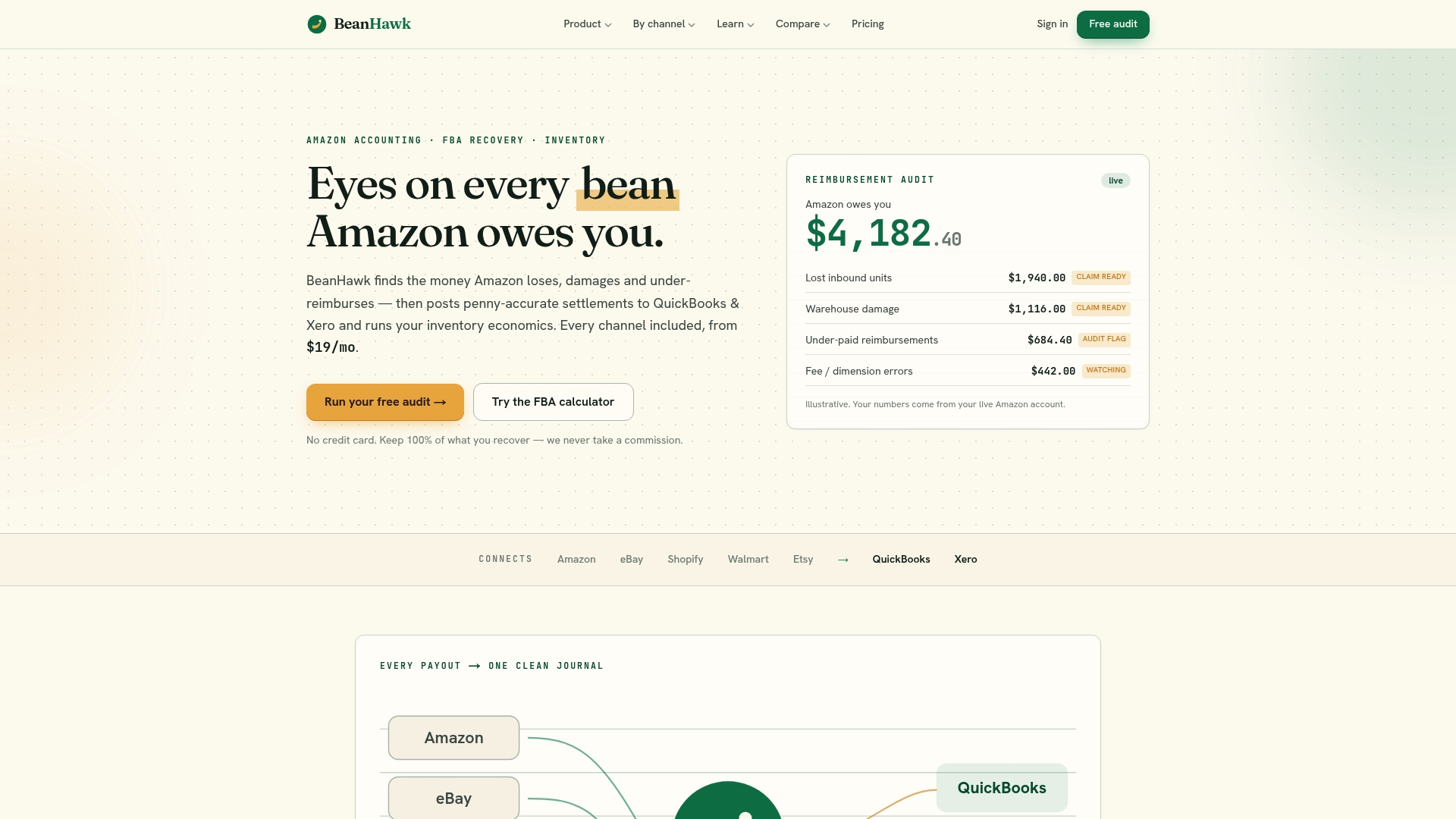
- The audit identifies recoverable reimbursements across your FBA history at no cost to start.
- Our subscription plans post recovered settlements directly to QuickBooks and Xero, itemized and reconciled.
- Pricing is flat and published: Starter, Growth, and Scale plans are listed on our pricing page, with no commission on recovered funds.
Start with the free audit to see what’s recoverable in your account right now.
FAQ
How much will each person get from an Amazon settlement?
Amazon reimbursement amounts are calculated per claim based on the item’s estimated selling price at the time of the event, not a flat payout, so there’s no single figure that applies across sellers. Your actual recovery depends on the specific inventory discrepancies or fee errors in your account, which you can identify by comparing your inventory ledger against shipment records.
Is Amazon really refunding money to sellers?
Yes, Amazon does issue reimbursements for lost inventory, damaged units, and certain fee errors, both automatically in some cases and through filed claims in others. The official Seller Central reimbursement policy outlines which categories qualify and what evidence supports a claim.
How does Amazon reimbursement work?
Amazon reimburses sellers when its fulfillment network loses, damages, or mishandles inventory, or when a fee is charged incorrectly, using reports and ledger data to verify the discrepancy. Some adjustments post automatically, while others require you to file a claim through Seller Central with supporting documentation like packing lists and inventory event history.
How do I know if I’m eligible for an Amazon reimbursement?
You’re generally eligible if your account is active and in good standing, with no major policy suspensions blocking claim submission. The clearest way to check is to pull your FBA inventory and shipment reports and compare what you sent against what Amazon recorded, since any gap is a potential claim.
What’s the difference between commission-based and no-commission reimbursement recovery?
Commission-based providers file claims on your behalf and take a percentage of whatever Amazon reimburses, while no-commission options, whether DIY audits or flat-fee subscription software, let you keep the full recovered amount. Our plans at BeanHawk charge a flat monthly fee regardless of how much gets recovered, which tends to favor sellers with regular reimbursement activity.