
Amazon Sellers: Why BeanHawk Wins the Getida vs Refunds Manager Debate

If you need hands-off reimbursement recovery with accounting reconciliation built in, BeanHawk is the stronger long-term fit; between the two commission-based veterans, Getida edges out Refunds Manager on integration depth and claim transparency, though both charge similar rates. The real question isn’t Getida vs Refunds Manager anymore, but rather how your cash flow management process for small businesses supports accurate reimbursement reporting and accounting integration. It’s whether a straight commission service is even the right model once you factor in what those recoveries do to your books.
TL;DR:
- Continuous monitoring and direct reconciliation into accounting platforms make BeanHawk more effective at capturing recoveries and maintaining accurate books for high-volume or multi-channel sellers.
- Amazon’s recent valuation shift reduces reimbursement payouts, so tools that help ensure accurate sourcing cost entries and integrate directly with COGS are now more valuable.
- Service choice depends on volume, need for automation, and accounting complexity, with managed services justified for high-volume, hands-off operation and self-service tools better for low-volume or tight budgets.
- Contract terms and cancellation policies vary, but BeanHawk’s subscription model avoids exclusivity clauses and simplifies data ownership compared to commission-based providers.
- Clear security and transparency measures are critical, with BeanHawk offering integration with existing accounting systems to enhance data control and security.
Table of Contents
- Getida vs Refunds Manager: How Do the Alternatives Stack Up?
- Comparing Getida, Refunds Manager, and the Alternatives Side by Side
- How Should You Choose Between a Managed Service and Self-Service?
- How BeanHawk Approaches Reimbursement Recovery
- What Are the Contract Terms and Cancellation Policies Like?
- How Do These Services Handle Seller Data Security?
- Which Service Has the Easiest Interface to Actually Use?
- What Do Real Recovery Scenarios Look Like?
- Do These Services Support International Sellers?
- How Fast Do Reimbursements Actually Get Paid Out?
- An Honest Take on Managed Services vs DIY in 2026
- Get a Free Audit and See What You’re Actually Missing
- Sources
- FAQ
Getida vs Refunds Manager: How Do the Alternatives Stack Up?
BeanHawk approaches reimbursement recovery differently than either legacy service. Instead of just filing claims and taking a cut, it runs continuous monitoring on inbound shipments and FBA ledger events, then posts the reconciled settlements straight into QuickBooks or Xero. That matters because recovering cash and knowing where it landed in your books are two different problems, and most reimbursement services only solve the first one. A free audit lets you see what’s recoverable before committing to anything.
Beyond BeanHawk, the market splits into three practical buckets. None of them are wrong choices exactly, but each comes with tradeoffs, sellers underestimate.
Legacy managed commission services. This is where Refunds Manager sits: an established, lower-touch provider that has been in the space for years. Reviews describe it as reliable but dated, with tooling that hasn’t kept pace with newer entrants and support that can feel slower to respond. Commission runs around 25%, comparable to most of the category.
Market-leading managed services. Getida occupies this tier. It’s widely cited as the default choice for hands-off recovery, with deeper Amazon integration, a longer track record of large recoveries, and account management that reviewers consistently call out as a differentiator. The commission is still steep, typically 25%, and some sellers find that hard to swallow once volume climbs.
Self-service audit tools and bundled finders. These range from standalone audit software to refund-finder features bundled inside larger seller-analytics platforms. Tools in this category work well for sellers who have the time and the process discipline. They work poorly for sellers who already feel behind on operations.
Here’s how seller profile tends to map to each bucket:
- High-volume sellers with tight books: BeanHawk’s accounting integration saves the reconciliation headache commission services ignore entirely.
- Sellers who want maximum hand-holding and don’t mind the fee: Getida’s account management and claim transparency justify the commission for many.
- Sellers already locked into a legacy contract: Refunds Manager still recovers real money, just with less modern tooling.
- Lean operators with spare time and low claim volume: self-service tools or bundled finders avoid commissions altogether.
- Sellers managing multiple channels, not just Amazon: a centralized recovery and reconciliation approach beats juggling separate tools per marketplace.
The commission percentages across managed services have converged enough that price alone rarely decides the comparison anymore. Integration depth, claim transparency, and what happens to the money after it lands in your account matter more.
Comparing Getida, Refunds Manager, and the Alternatives Side by Side
Before picking a service, it helps to see the actual mechanics side by side rather than relying on marketing copy. Commission rates cluster tightly, but service model, claim scope, and accounting support diverge a lot more than most comparison pages let on.
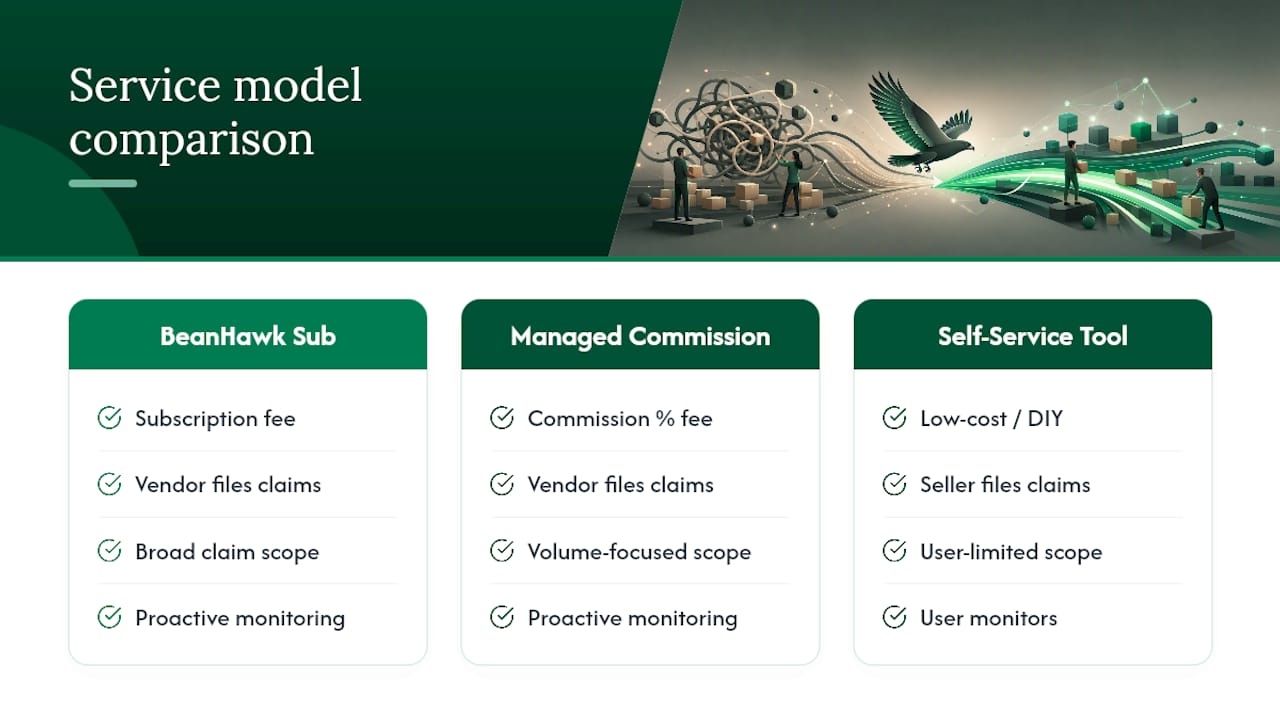
BeanHawk leads with a subscription model rather than a commission cut, which changes the math substantially once recovery volume grows.
Statistic to watch: Amazon changed how it values many reimbursements starting March 31, 2025, shifting pre-sale lost or damaged inventory valuation toward manufacturing and sourcing cost rather than the higher estimates used previously. Sellers who haven’t set accurate sourcing cost entries in Seller Central are seeing meaningfully smaller payouts on eligible claims, because Amazon defaults to a conservative estimate when that field is blank.
That policy shift is why the “which service recovers more” question has gotten more complicated. A commission-based provider recovering the same dollar amount as before now earns the same percentage cut on a smaller base, but the seller’s net recovery has shrunk regardless of which vendor filed the claim. The providers that help sellers keep sourcing cost data accurate, or that reconcile whatever comes through directly into COGS tracking, deliver more net value under the new rules than providers that simply chase claim volume.
Claim transparency also separates providers more than commission rate does. Services that hand over claim IDs, attachment records, and Amazon’s actual response text let sellers verify what happened instead of taking a recovery total on faith. That transparency becomes especially important once clawbacks enter the picture, which the next section covers in detail.
How Should You Choose Between a Managed Service and Self-Service?
Start with a number: what do you expect to recover monthly, and what would a human on your team cost to file those claims manually? If the commission on expected recoveries is lower than the staff hours it would take to do it yourself, a managed or automated service pays for itself. If your claim volume is small and sporadic, self-service tools might genuinely be the cheaper path.
Run through this checklist before signing anything:
- Estimate your monthly reimbursement volume. Pull your last six months of FBA reimbursement history from Seller Central to get a realistic baseline, not a guess.
- Decide how much accounting integration you actually need. If reconciling settlements against COGS already eats hours each month, an automated posting system changes that math fast.
- Assess your documentation capacity. Manual claims require invoices, tracking numbers, and shipment IDs within 60-day windows for many claim types. Can your team actually gather that consistently?
- Compare the true cost of internal handling versus a vendor’s fee. Include the opportunity cost of whoever would otherwise be doing this work.
When you talk to any vendor, ask these questions directly:
- Exactly which claim types do you pursue, and which do you skip?
- Can you show sample case evidence, including claim IDs and Amazon’s response?
- What’s your clawback policy if Amazon reverses a reimbursement after payout?
- Do I retain full data access and export rights if I cancel?
- Does your platform integrate with QuickBooks or Xero, or do I reconcile manually?
- What exactly does the free audit or trial include, and what happens after it ends?
Watch for these red flags in any agreement:
- Opaque clawback clauses that don’t specify how reversed reimbursements affect your account.
- No exportable evidence of what was actually claimed and recovered.
- Zero accounting integration, leaving you to manually match settlements to your books every month.
- Long exclusivity clauses that lock you out of switching providers even after your needs change.
Pro Tip: Before signing any commission-based contract, ask the vendor for a report showing average recoveries per claim type over the trailing 12 months. A provider confident in its numbers will hand this over without hesitation.
How BeanHawk Approaches Reimbursement Recovery
BeanHawk’s core mechanism is continuous monitoring, not periodic audits. It tracks inbound shipment events and FBA ledger activity as they happen, flagging discrepancies between what you shipped and what Amazon’s system recorded, rather than waiting for a monthly or quarterly sweep to catch them. That monitoring approach aims to reduce the amount that slips past standard automatic reimbursement processes, which Amazon’s own systems still miss in cases involving inbound shortages and certain return discrepancies.
The bigger differentiator shows up after a claim resolves. Instead of dropping a lump sum into your account and leaving reconciliation to you, BeanHawk posts settlement details directly into QuickBooks or Xero as reconciled journal entries.
Reconciliation into accounting, meaning matching settlements to COGS and posting them as journal entries, is where a lot of sellers lose visibility into real profit. Automating that step closes a gap that commission-based recovery services typically leave open entirely.
That gap matters more than it sounds. A seller who recovers $4,000 in a quarter but can’t tell which SKUs those recoveries applied to has accurate cash but inaccurate unit economics. Practical outcomes of closing that gap include fewer unreconciled settlement exceptions at month end, cleaner COGS reporting for tax season, and less manual work matching Amazon’s payout reports against your accounting ledger line by line.
What Are the Contract Terms and Cancellation Policies Like?
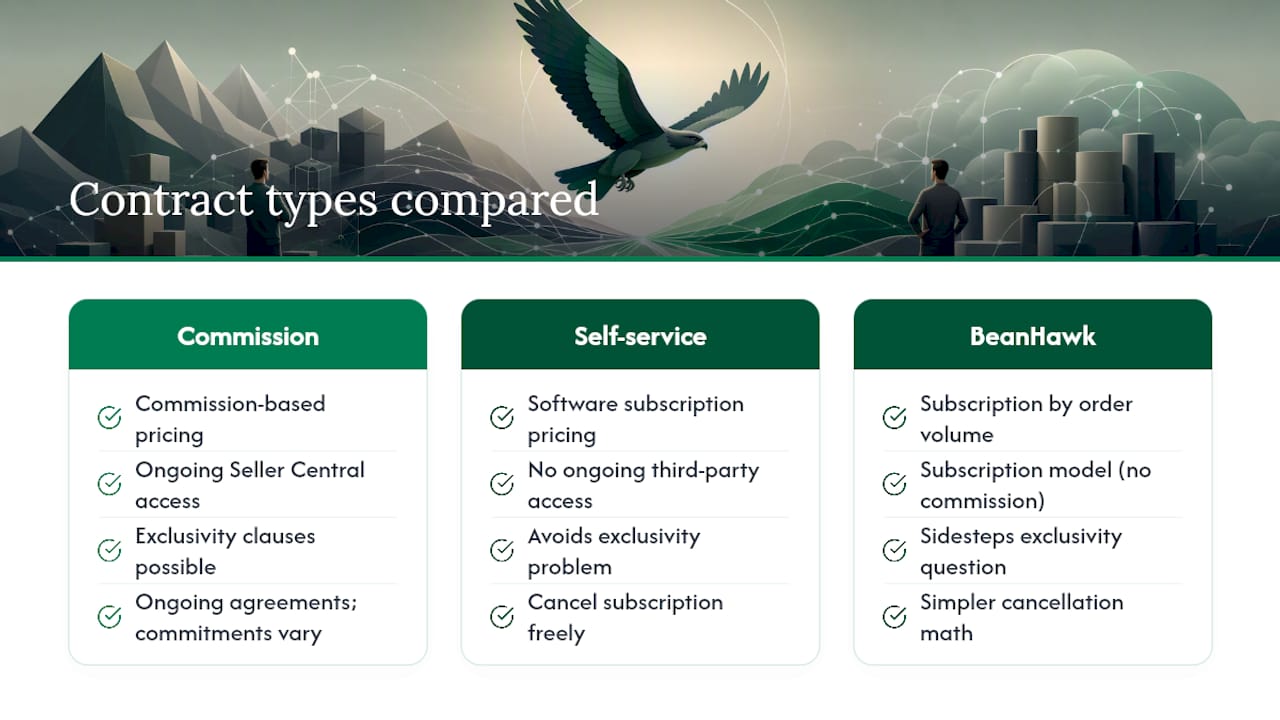
Commission-based managed services like Getida and Refunds Manager typically operate on ongoing agreements tied to your Seller Central account access, and terms vary by provider on minimum commitment length. Some structure pricing around a percentage of recovered funds with no fixed contract term, which sounds flexible until you look at the exclusivity language. Several legacy services include clauses that prevent you from running a second reimbursement provider simultaneously, even if you want to test alternatives.
Self-service tools generally avoid this problem entirely since you’re not granting ongoing access to a third party filing claims on your behalf. You pay for the software, use it when you want, and cancel a subscription without needing to revoke account permissions.
BeanHawk runs on a subscription model tied to order volume rather than a percentage-based agreement, which sidesteps the exclusivity question that commission services often build into their contracts. Because there’s no commission clawback mechanism tied to reversed Amazon decisions, the cancellation math is simpler: you’re not owed or owing a percentage adjustment based on recoveries that got reversed after the fact.
Before signing with any provider, read the cancellation section closely. Look specifically for language about data retention after you leave, whether in-progress claims transfer to you or stay with the vendor, and whether there’s a required notice period before you can terminate. A 30-day notice clause buried in the fine print can trap you in an extra billing cycle you didn’t plan for.
How Do These Services Handle Seller Data Security?
Granting a reimbursement service access to your Seller Central account means handing over visibility into sales history, inventory data, and financial reporting, so the access model matters as much as the recovery rate. Managed commission services typically require some level of API or user-permission access to file claims on your behalf, which means their internal security practices become your exposure too.
Ask any vendor exactly what permissions they request. Full account access is broader than necessary for most reimbursement work, and a provider that only needs read access to inventory and shipment data is inherently lower risk than one requesting broader account controls. This is also where the vendor-question checklist from earlier pays off: transparency about data handling is a reasonable proxy for how seriously a provider treats security generally.
Self-service tools shift the risk profile differently. You’re not granting a third party ongoing access, but you may still be uploading shipment and inventory data into a third-party platform for analysis, so the same due diligence applies to where that data lives and how long it’s retained.
BeanHawk’s architecture centers on integration with your accounting platforms in addition to Amazon data, which means data flows into systems you already control rather than living exclusively inside a third-party dashboard you’d lose access to on cancellation. That’s a meaningfully different data ownership posture than a commission service holding your claim history hostage to a percentage-based relationship.
Which Service Has the Easiest Interface to Actually Use?
Interface quality is where the “market leader” and “legacy” labels in this category earn their reputations. Getida’s dashboard reflects years of iteration, with account managers who walk sellers through claim status rather than leaving them to interpret a raw data table. Refunds Manager’s interface is functional but reviewers consistently describe it as feeling older, with less intuitive claim tracking and a steeper learning curve for sellers who want to self-monitor progress without calling support.
Self-service audit tools vary enormously here. Some are built as clean, purpose-specific dashboards; others are a bolted-on feature inside a broader analytics suite, which means the reimbursement-specific view competes for screen space with unrelated reporting modules.
BeanHawk’s interface is built around the monitoring-and-reconciliation workflow specifically, so the dashboard surfaces discrepancies as they’re detected rather than requiring you to run a report and interpret it after the fact. Settlement posting status into QuickBooks or Xero shows up as part of the same view, so you’re not toggling between a claims dashboard and your accounting software to confirm whether a recovery actually landed where it should.
For sellers who want to check status without waiting on an account manager’s email, that self-service visibility matters more than polish. The best interface, in this category, is the one that answers “did this get resolved and where did the money go” without a support ticket.
What Do Real Recovery Scenarios Look Like?
Picture a seller running 800 SKUs across FBA with recurring inbound shortages on a handful of high-velocity products. A commission-based service like Getida would flag those shortages, file the claims, and take roughly a quarter of whatever comes back, with an account manager handling escalations. That works well if the seller’s main pain point is not having time to file claims at all.
Now picture a seller with the same shortage pattern, but whose real problem is that recovered funds show up in their bank account with no link back to which SKU or purchase order caused the loss. Commission recovery solves the cash problem but leaves the accounting problem untouched. That’s the scenario where BeanHawk’s approach, tracking the ledger event and posting a reconciled entry into Xero, closes a gap a pure commission service was never built to address.
A third scenario: a seller with low claim volume, maybe a few hundred dollars a month in eligible discrepancies, who doesn’t want to give up 25% of a small recovery. A self-service audit tool, or simply filing manually using Amazon’s own documentation requirements, makes more sense here since the commission on a small recovery isn’t worth outsourcing.
These scenarios point to the same conclusion: the “best” service depends heavily on whether your bottleneck is time, money, or accounting accuracy, and those three problems don’t always have the same solution.
Do These Services Support International Sellers?
Amazon’s reimbursement rules and claim windows apply across marketplaces, but coverage and support quality for non-US sellers varies by provider. Getida markets support across multiple Amazon marketplaces including Europe and Canada, with account management structured to handle multi-marketplace claim filing. Refunds Manager’s international coverage is less consistently documented in reviews, and sellers operating primarily outside the US should confirm marketplace coverage directly before signing.
Self-service tools generally work marketplace by marketplace since you’re the one filing, which means coverage is limited only by your own willingness to learn each marketplace’s documentation requirements. That flexibility comes at the cost of needing to understand claim rules that can differ subtly between, say, Amazon.co.uk and Amazon.com.
BeanHawk’s monitoring and reconciliation approach is built around FBA ledger events, which exist across marketplaces where Amazon runs fulfillment. Sellers running multi-channel operations, not just multiple Amazon marketplaces but other sales channels too, benefit from a centralized view rather than juggling separate tools per region. If international marketplace coverage is a deciding factor for your business, confirm current marketplace support directly with any provider before committing, since coverage details shift as Amazon expands or restructures marketplace operations.
How Fast Do Reimbursements Actually Get Paid Out?
Once a claim gets approved, Amazon typically issues the reimbursement as account credit within days, not weeks. The real timeline bottleneck isn’t Amazon’s payout speed. It’s how long it takes a provider to detect the discrepancy, gather documentation, and file the claim in the first place.
Commission-based managed services often batch claim filing on a schedule rather than in real time, which means a discrepancy that occurred in January might not get filed until a monthly review catches it. That delay matters because many claim types carry 60-day documentation windows, and detection speed directly affects whether a claim is even still eligible by the time someone files it.
Continuous monitoring changes that math by catching ledger discrepancies closer to when they happen, shrinking the gap between the actual loss and the filed claim. Once BeanHawk posts a settlement, the accounting entry appears in QuickBooks or Xero without a separate manual reconciliation step, which removes the lag that often exists between “Amazon paid this” and “our books reflect it.”
An Honest Take on Managed Services vs DIY in 2026
The math here is simpler than most comparison articles make it sound: if your expected monthly recoveries, after accounting for the time your team would spend filing claims, exceed what a service charges you, pay for the service. If they don’t, DIY or a self-service tool wins on pure economics. Most sellers never actually run this calculation. They pick based on brand recognition or whichever provider sponsored a podcast they listen to.
What genuinely changed the landscape here is Amazon’s sourcing-cost valuation shift. If you haven’t checked your sourcing cost entries in Seller Central since March 2025, do that before evaluating any provider, because a commission service recovering against an artificially low valuation isn’t underperforming. Amazon’s math is just working against everyone right now.
My practical advice: run a one-month DIY reconciliation test before committing to a commission contract. You’ll learn fast whether your discrepancy volume justifies outsourcing, or a free audit, at minimum, before signing anything long-term.
, Tim
Get a Free Audit and See What You’re Actually Missing
Commission-based services like Getida and Refunds Manager recover money, but they leave you holding the reconciliation problem afterward, matching settlements to SKUs, updating COGS, and figuring out where every recovered dollar actually landed in your books. BeanHawk skips that gap entirely by posting reconciled settlements directly into QuickBooks or Xero as they happen, so recovery and accounting accuracy stop being two separate jobs.
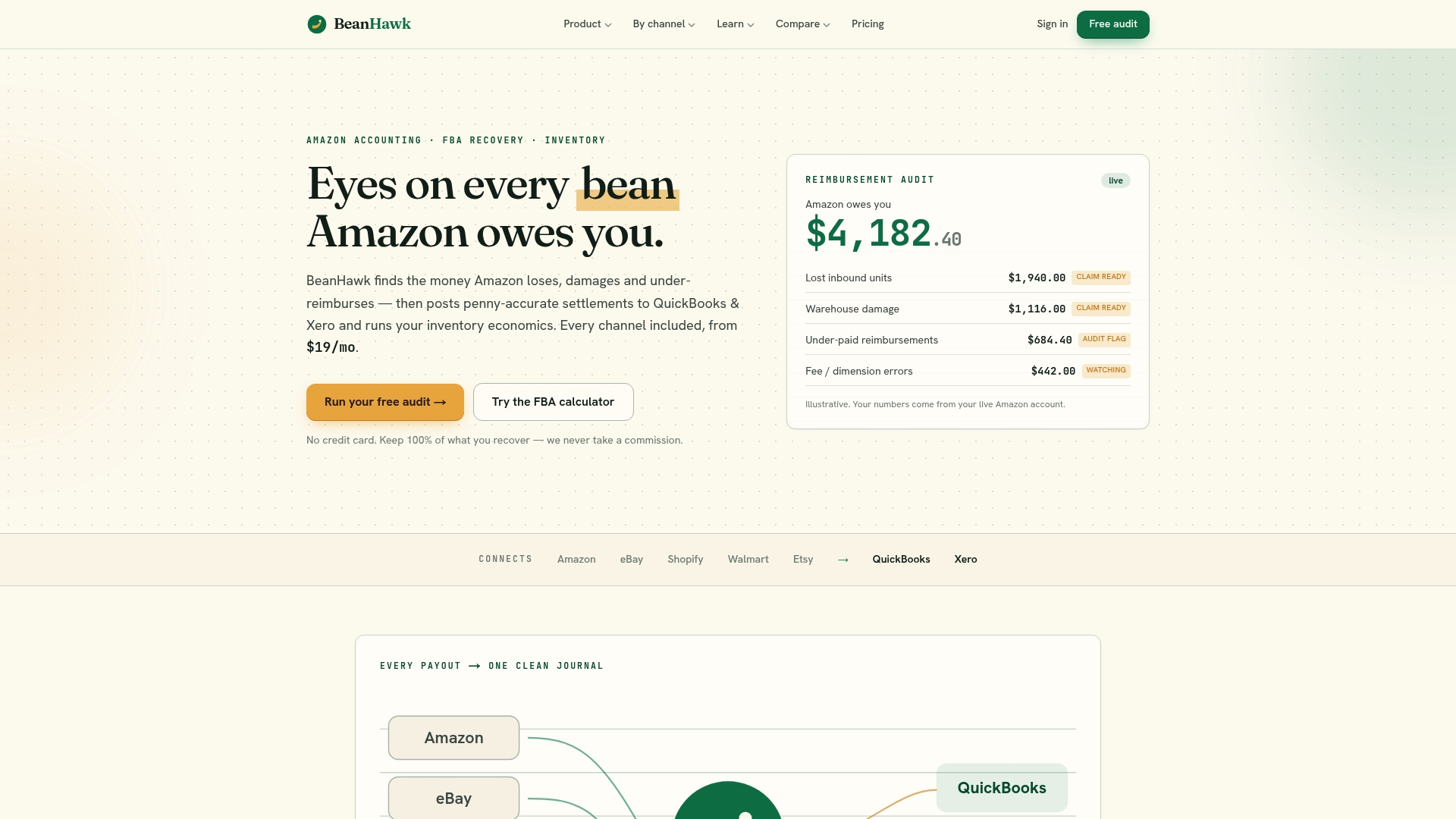
There’s no commission eating into what gets recovered, either. BeanHawk runs on a subscription tied to your order volume, so a big recovery month doesn’t cost you proportionally more than a slow one. If you’re not sure what you’re currently missing, start with the free limited audit to see what’s recoverable before committing to anything. Sellers who want the fuller picture on how reimbursements work can also check the reimbursement glossary for a plain-language rundown of claim types and eligibility windows.
Sources
- Best Amazon FBA Reimbursement Services 2026: Commission Rates Compared | AMZBase
- Getida Review 2026: Features, Pricing & Alternatives
- FBA reimbursement sourcing-cost policy guide
- Amazon FBA Reimbursement Rules 2026: What Changed and How to Claim
FAQ
Is Getida worth it for a small Amazon seller?
Getida makes sense if you value hands-off, fully managed recovery and don’t mind paying roughly 25% commission for account management and claim transparency. Sellers with low claim volume often find the commission harder to justify relative to a self-service tool or automated alternative.
What’s the best Amazon FBA reimbursement service?
There isn’t one universal answer since it depends on whether you need commission-based hands-off recovery (Getida), a lower-cost legacy option (Refunds Manager), or recovery paired with accounting reconciliation (BeanHawk). Sellers prioritizing clean books alongside recovery tend to get more net value from an accounting-integrated approach.
Is FBA still profitable in 2026?
FBA remains profitable for most sellers, though Amazon’s sourcing-cost valuation change has reduced typical reimbursement payouts in some categories, making accurate cost tracking more important to overall margin than before.
Can I do FBA and FBM at the same time?
Yes, Amazon allows sellers to run Fulfilled by Amazon and Fulfilled by Merchant simultaneously on the same account, and many sellers use both to manage inventory risk and shipping costs across different SKUs.
Do reimbursement services work for multi-channel sellers, not just Amazon?
Commission-based services like Getida and Refunds Manager focus specifically on Amazon FBA claims. An approach like BeanHawk’s, built around centralized monitoring and accounting reconciliation, extends more naturally to sellers managing inventory and settlements across multiple sales channels.