
Stop Silent SKU Losses for Sellers: Reconcile Amazon Ledger to COGS and Automate

Use SKU or FNSKU as your accounting unit, and treat the Inventory Ledger Report as the authoritative source for FBA reconciliation. Pull that report at a regular cadence, cross-check it against Statement View for cash and fees, and archive both before Amazon’s retention window closes. Everything else in your books should trace back to those two anchors.
TL;DR:
- Regularly cross-check the Inventory Ledger Report with Statement View to ensure accurate FBA inventory reconciliation before Amazon’s 18-month data retention expires.
- Use consistent, concise SKU naming conventions that include channel prefixes and avoid reusing SKUs for different products to simplify tracking and reduce mismatches.
- Pull specific reports for different questions: inventory levels from the ledger, cash flow from Settlement View, and fees from fee and storage reports to avoid confusion.
- Investigate and resolve SKU discrepancies immediately by pulling ledger events and transaction IDs for clear evidence before escalating to Seller Support.
- Automating SKU monitoring and reconciliation with tools like BeanHawk helps detect errors early, especially for large SKU catalogs that outperform manual processes.
Table of Contents
- SKU vs FNSKU: what each identifier means and how to use them
- Which Seller Central reports to pull and what each one is for
- A step-by-step process for reconciling SKUs
- Troubleshooting the usual causes of SKU discrepancies
- How SKU accuracy shapes COGS and tax reporting
- How automated monitoring cuts reconciliation work down
- Why routine SKU checks matter more than sellers assume
- Evaluating BeanHawk for automated SKU accounting and recovery
- Where to verify these reports and rules yourself
- Sources
- FAQ
SKU vs FNSKU: what each identifier means and how to use them
A SKU is the identifier you create for your own inventory: a short code that ties a product to your internal records and to the listing you manage in Seller Central. An FNSKU is Amazon’s version, generated once you enroll an item in Fulfillment by Amazon, and it is what scanners and warehouse staff actually read when your inventory moves through a fulfillment center. Your SKU maps to that FNSKU, and the pairing is what lets Amazon’s systems and your books talk about the same unit without confusion.
Merchant SKUs are required in every inventory file you upload, must be unique to your account, and are the field Amazon uses to associate stock with a specific product detail page, according to Amazon’s seller guidance on inventory files. Once a SKU exists for one product, you cannot reuse it for a different one: uploading new inventory under an existing SKU simply replaces the data tied to that code. A related forum thread confirms the same rule in practice and adds a hard limit: SKUs can run up to 40 characters, which is plenty of room for a structured naming convention but easy to overrun if you’re not deliberate about it.
A few habits prevent most of the mismatches sellers run into later:
- Keep SKUs short, readable, and built from a consistent pattern, such as category, variant, and size, rather than random strings.
- Add a channel prefix when you sell the same product across marketplaces, so a SKU never has to mean two different things.
- Never retire and reissue a SKU for a new product, even months later; create a new one instead.
- Document your naming convention somewhere your bookkeeper can see it, not just in your head.
Get this right at setup and the rest of your reconciliation work gets considerably easier, because every report downstream inherits whatever structure you built into the SKU itself.
Which Seller Central reports to pull and what each one is for
Amazon does not give you one report that does everything, and trying to force one to serve every purpose is where most reconciliation headaches start. Each report uses different logic and different timing, and matching the right report to the right question is half the job.
The Inventory Ledger Report is Amazon’s own recommended tool for reconciling FBA inventory. It shows starting and ending balances, receipts, customer orders, returns, and adjustments at the FNSKU level, and it supports daily, weekly, or monthly aggregation depending on how granular you need to get, according to Amazon’s Inventory Ledger help page. If you only pull one report for reconciliation, this is the one.
Detailed transaction data in the Inventory Ledger is retained for only 18 months. After that window, granular movement history disappears even though your aggregate inventory levels remain visible, so waiting until tax season to pull a year-old ledger can leave you without the detail you need.
Beyond the ledger, a few other reports each answer a narrower question:
- Settlement or Statement View covers a 14-day payment cycle and breaks out deposits, referral fees, FBA fees, storage fees, and refunds, which makes it the right source for cash and fee reconciliation rather than unit counts.
- All Orders and Business Reports show sales and units by order date, which is useful for sales trend analysis but not a substitute for the ledger, since order date and settlement timing rarely line up.
- Fee Preview and Transaction View give per-order and per-SKU fee estimates you can use to allocate costs accurately before they hit a settlement.
- Storage Fee reports break down monthly and long-term storage charges by SKU, which you need for full landed-cost accuracy.
A common source of confusion is trying to reconcile Business Reports against Settlement Reports directly. One seller forum thread on report mismatches makes the underlying issue explicit: Business Reports use order date while Settlement and Payments reports use ship date, so the same timeframe will produce different numbers in each. That is not a bug in either report, it is two tools built for two different jobs. For a fuller rundown of which report to reach for and when, our overview of the reports every Amazon seller should pull walks through each one in more depth.
A step-by-step process for reconciling SKUs
Reconciliation gets manageable once you treat it as a fixed sequence rather than a scramble every time the numbers look off. Here is the order that works for most sellers doing this monthly or quarterly.
- Export your source documents first. Pull the Inventory Ledger Report by FNSKU, the Settlement CSVs for the period, the All Orders report, inbound shipment receipts, and your purchase order or landed-cost records.
- Roll forward quantities at the SKU level. Take the opening balance from the ledger, add receipts from inbound shipments, subtract units sold and returned, add or subtract Amazon adjustments, and the result should match the ledger’s ending balance for that SKU.
- Investigate any variance immediately, rather than carrying it forward. A quantity gap that shows up this month is far easier to trace than one buried under three more months of activity.
- Map landed costs to each SKU. Allocate freight, duties, and prep costs from your PO records across the units received, so your cost per unit reflects what it actually took to get that inventory sellable.
- Reconcile fees and settlements against orders. Match referral fees, FBA fees, storage charges, and refunds from Settlement View against the corresponding units in your ledger, and factor in advertising spend, to arrive at true profitability per SKU rather than just revenue.
- Flag unresolved discrepancies for escalation. If a variance survives the checks above, gather the specific ledger events and transaction IDs tied to it before contacting Seller Support.
- Open a case with evidence attached, not just a description of the problem. A precise packet, including SKU, date window, and transaction IDs, moves faster through Amazon’s support queue than a general complaint.
Pro Tip: Run the quantity roll-forward and the fee reconciliation separately. Mixing unit counts with dollar amounts in the same check makes it harder to tell whether a discrepancy is a counting problem or a pricing problem.
Our step-by-step inventory reconciliation process walks through a worked example of this same sequence if you want a template to adapt, and our guide to FBA inventory reconciliation covers the mechanics of the roll-forward formula in more detail.
Troubleshooting the usual causes of SKU discrepancies
Most reconciliation problems trace back to a small set of repeat offenders, and knowing them in advance saves hours of guessing.
Timing differences are the most common source of confusion. An order placed on the last day of a month might not ship, and therefore might not settle, until the following month, which means your order-date sales figures and your settlement-based cash figures will rarely tie out for the same calendar window. Accounting guidance on inventory reconciliation notes that discrepancies often trace back to timing differences, unrecorded receipts, or data-entry errors, not necessarily lost inventory.
Beyond timing, a few other patterns show up repeatedly:
- Inbound receiving errors where a shipment arrives short, damaged, or mislabeled, which shows up in the ledger as a receipt that does not match your PO quantity.
- Wrong or mismatched FNSKUs, often from a labeling error at receiving, which can cause a unit to appear under the wrong SKU entirely.
- Stranded inventory, where units are physically in a fulfillment center but not listed as sellable, which will not show up in your sales reports even though it is sitting on Amazon’s shelves.
- Returns and refunds, which often post to a later settlement period than the original sale, creating a gap if you’re comparing single periods in isolation.
Pro Tip: When a SKU won’t reconcile, isolate it first. Pull just that SKU’s ledger events for the date window in question before you try to compare it against anything else.
The triage sequence that tends to work fastest: isolate the SKU, define the exact date range, pull every ledger event in that window, collect the associated transaction IDs, and only then escalate. One forum thread on unresolved inventory-to-payments mismatches describes this same order of operations, noting that a clear packet of ledger events and transaction IDs materially improves how quickly Seller Support resolves a case. Mislabeled units at receiving are common enough that it’s worth double-checking barcode quality before you assume a case is Amazon’s fault. Guidance on FBA labeling and barcode standards is a useful reference if you suspect a scanning issue caused the mismatch in the first place. For locating specific missing units, our guide to finding missing FBA inventory covers the evidence Amazon typically asks for.
How SKU accuracy shapes COGS and tax reporting
Clean SKU-level records are not just an operations convenience, they are what your tax return rests on. Businesses required to account for inventory generally must use the accrual method and properly identify cost of goods sold, and the IRS guidance in Publication 538 allows methods like Specific Identification or FIFO to match costs to the inventory items they belong to. Which method you use determines how a cost swing in one shipment flows through to your reported profit, and that decision only works cleanly if your SKU-level cost data is accurate to begin with.
Specific Identification tracks the actual cost of each unit, which is practical when you carry low volume or high-value items with distinct landed costs. FIFO assumes the oldest inventory sells first, which is the more common choice for sellers running higher SKU counts where tracking each unit individually isn’t realistic. Either way, the input is the same: a landed cost per SKU that includes the product cost plus freight, duties, and any prep or labeling fees.

A few habits reduce audit risk and save time later:
Snapshot your Inventory Ledger annually, ideally tied to your fiscal year end, rather than relying on Amazon to hold onto the detail indefinitely. Keep your landed-cost documentation, invoices, freight bills, and prep receipts, organized by SKU rather than by shipment, so you can answer a valuation question for any single item without digging through unrelated paperwork. And export your detailed transaction data before it ages past Amazon’s 18-month retention window, since that is the same limit that applies to the Inventory Ledger’s granular history.
How automated monitoring cuts reconciliation work down
Manual reconciliation catches problems after they’ve already cost you money. Continuous monitoring of inbound shipments and FBA ledger events, by contrast, is built to flag an under-reimbursement or a missing unit close to when it actually happens, rather than three months later when the transaction detail may already be aging out of Amazon’s retention window.
Continuous monitoring against inbound shipments and ledger events can flag reimbursement gaps at the SKU level as they occur rather than in a periodic sweep. When a discrepancy is confirmed, settlements may post automatically to accounting software, removing a common source of manual error: journal entries that misclassify an inventory offset or double-count a fee from manual entry errors.
For sellers running enough SKUs that manual reconciliation has become a full workday every month, this kind of automated posting keeps the books current without adding headcount. It does not replace the reconciliation logic covered above, it applies that same logic continuously instead of in batches.
Why routine SKU checks matter more than sellers assume
Small SKU errors rarely stay small. A mislabeled unit at receiving, a SKU reused too early, a settlement that never quite matched the ledger: each one seems trivial on its own, but they compound quietly across a catalog with hundreds of SKUs until a seller finds themselves unable to explain a meaningful chunk of their reported inventory value. The sellers who avoid this treat reconciliation as a routine, not a fire drill.
A workable cadence: review the Inventory Ledger weekly for anything that looks off, reconcile fully against settlements monthly, and archive a full export annually before Amazon’s retention window closes. None of this requires sophisticated tooling, just consistency. The businesses that skip it almost always end up doing the same work later, under worse conditions, with less data available to fix it.
, Tim
Evaluating BeanHawk for automated SKU accounting and recovery
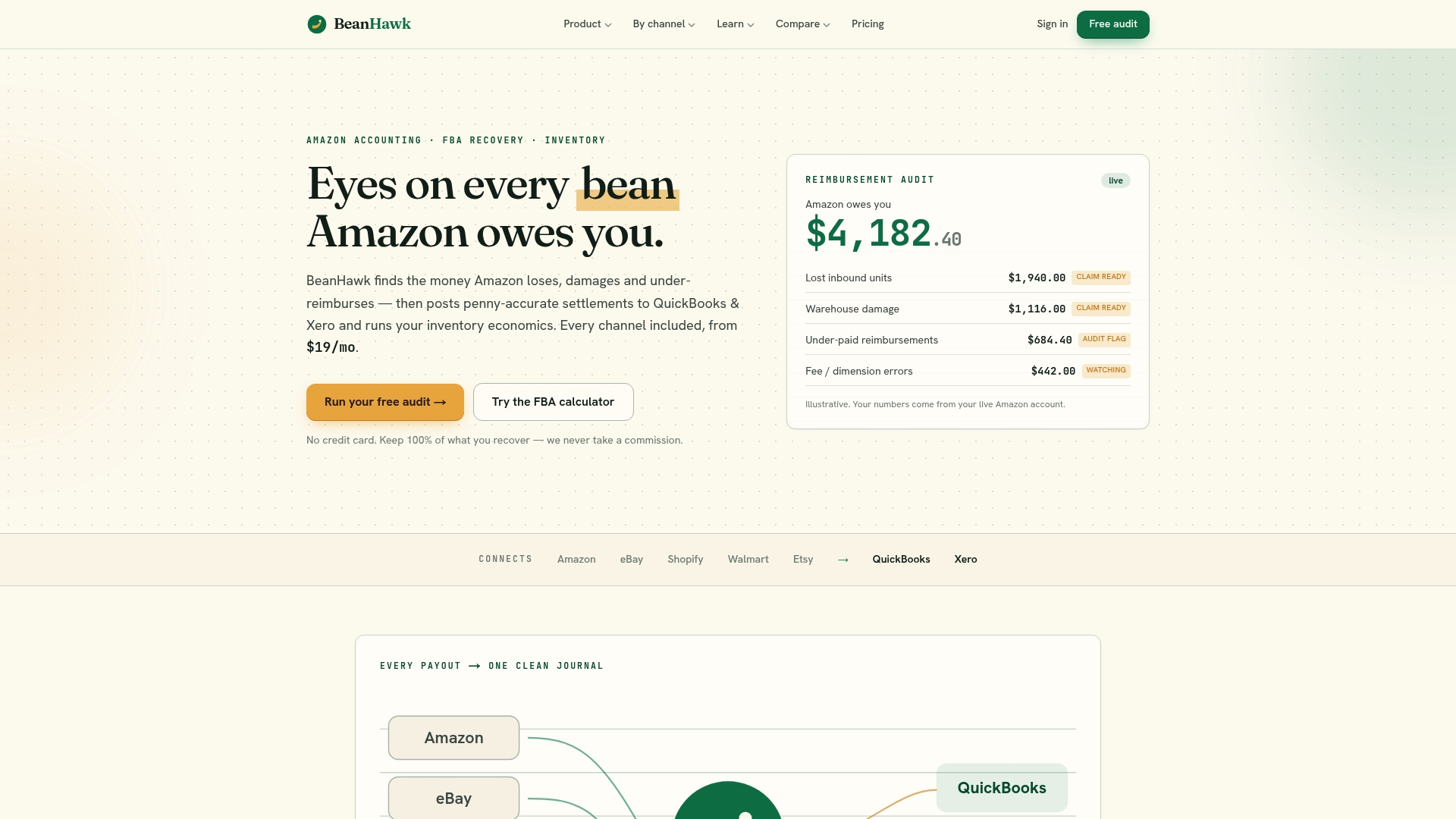
If reconciliation keeps surfacing the same unexplained adjustments month after month, or your SKU count has outgrown what a spreadsheet can track, that’s usually the point where automation pays for itself rather than adding overhead. BeanHawk monitors inbound shipments and FBA ledger events continuously, flags under-reimbursed or lost inventory at the SKU level, and posts settlements automatically to QuickBooks and Xero so your books reflect Amazon’s numbers without manual journal entries.
A few signs it’s worth a closer look:
- You’ve noticed recurring inventory adjustments you can’t fully explain from the ledger alone.
- Your SKU count has grown past what manual monthly reconciliation can realistically cover.
- You have a backlog of unresolved cases with Seller Support and no clear evidence trail to escalate them.
BeanHawk charges flat subscription pricing based on order volume, starting with a Free plan and scaling through Starter, Growth, and Scale tiers, and never takes a commission on funds it recovers. If you want to see what it would find in your own account first, the free FBA reimbursement audit is the place to start. If you’re mapping settlements into your books manually right now, our guide to reconciling Amazon in QuickBooks Online is worth reading before you decide whether to automate that step.
Where to verify these reports and rules yourself
These are the primary sources behind the reconciliation steps above, useful if you want to pull the reports yourself or check a rule before you rely on it.
- Amazon’s Inventory Ledger Report help page, the official reconciliation source for FBA.
- Amazon’s guidance on SKUs in inventory files.
- IRS Publication 538 on accounting methods and inventory.
- AccountingTools on inventory reconciliation practices.
- Amazon seller forum threads on settlement timing and escalation patterns.
Sources
- Inventory Ledger report , Amazon Seller Central help
- Amazon Seller Central: Role of SKUs in inventory files
- IRS Publication 538: Accounting Periods and Methods (inventory guidance)
- How do I reconcile inventory? , AccountingTools
FAQ
What is the SKU on Amazon?
A SKU on Amazon is a unique code you assign to a product to track it in your own inventory and connect it to a specific listing. It’s merchant-created, meaning you control the format, and Amazon requires it in every inventory file you upload.
What does SKU mean in accounting?
In accounting, a SKU is the unit you use to track cost, quantity, and revenue for a single product line, which makes SKU-level records the basis for calculating cost of goods sold. Accurate SKU-level tracking supports inventory valuation methods like Specific Identification or FIFO under IRS accounting guidance.
What is an SKU code on Amazon?
An SKU code on Amazon is the identifier you create to represent a product internally, distinct from Amazon’s own FNSKU, which is generated when that item enters FBA. The two are linked, but the SKU is yours to define, while the FNSKU is assigned automatically once you enroll the item in fulfillment.
How do I get a SKU number for Amazon?
You create your own SKU when you list a product, entering it directly in Seller Central or in the inventory file you upload. There’s no need to request one from Amazon, but once assigned to a product, that SKU cannot be reused for a different item, according to Amazon’s seller guidance.
How often should I reconcile my Amazon SKUs?
Most sellers review the Inventory Ledger Report weekly and run a full reconciliation against settlements monthly, then archive a complete export annually. This cadence catches discrepancies while the supporting ledger data is still within Amazon’s 18-month retention window.